
HACCP and disease-treatment claims answer two different questions. HACCP asks whether a food is safe to produce and eat. A disease-treatment claim, however, raises a separate question: is the product being marketed as a drug?
When a product is promoted to treat, cure, mitigate or prevent disease, that language can affect how FDA classifies it. Such statements may appear on packaging, ecommerce pages, blogs, leaflets and inserts shipped with orders. Therefore, companies should review a product’s intended use before using therapeutic language in the U.S. market. Food safety certification or import paperwork is not authorization for drug claims.
Quick answer
HACCP helps identify and control food safety hazards linked to products and processes. It does not decide whether marketing language makes a product a drug. Intended-use and claims questions need a separate regulatory review.
Who this article is for
This guide is for food safety managers, HACCP teams and companies that market any food product with wellness or therapeutic language. For the dietary supplement angle specifically, see our article on HACCP hazard analysis vs FDA dietary supplement disease claims.
Why the two reviews must stay separate
Under the Federal Food, Drug, and Cosmetic Act, the term “drug” includes articles intended for use in the diagnosis, cure, mitigation, treatment or prevention of disease (21 U.S.C. 321(g)(1)). Intended use is judged by objective intent. FDA’s regulation explains that this intent may be shown by labeling claims, advertising matter, or oral or written statements (21 CFR 201.128).
By contrast, a hazard analysis looks at biological, chemical and physical hazards. For facilities under 21 CFR Part 117, it must identify and evaluate known or reasonably foreseeable hazards for each type of food (21 CFR 117.130). Nothing in that analysis evaluates whether a marketing claim is lawful. Our HACCP hazard analysis guide explains the method in detail.
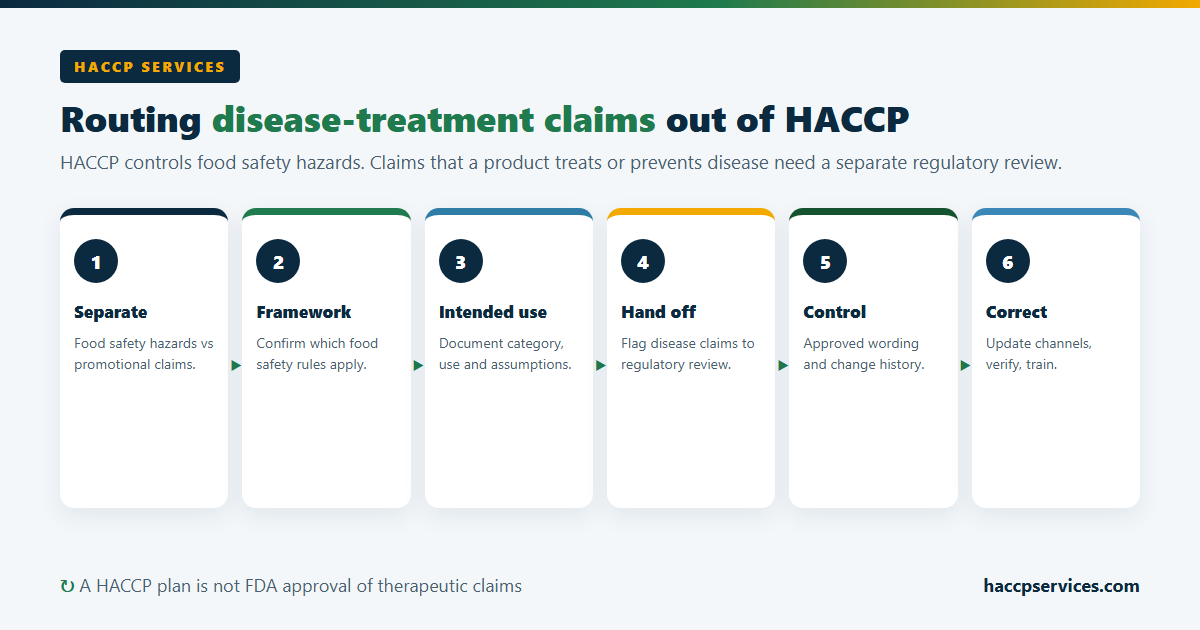
1. Separate safety hazards from promotional claims
Keep biological, chemical and physical hazard decisions distinct from claims that a product treats or prevents disease. A claim does not belong on a hazard worksheet. Likewise, a hazard control does not prove a claim.
2. Identify the applicable HACCP framework
First, determine which food safety requirement applies to the product and facility. It may be seafood HACCP (21 CFR Part 123), juice HACCP (21 CFR Part 120), a voluntary HACCP program or the Part 117 preventive controls rule. Under Part 117, a preventive controls qualified individual prepares or oversees the written food safety plan (21 CFR 117.126). See HACCP plan vs FDA food safety plan for the differences.
3. Review the intended use of the product
Next, document the product category, consumer use, preparation and safety assumptions. These facts support the HACCP plan. Then route any therapeutic claim to a separate classification review.
4. Coordinate departments without expanding HACCP scope
Create a clear handoff for when marketing proposes antiviral, anti-clotting, disease-prevention or other drug-like positioning. The HACCP team flags the wording. A regulatory reviewer then assesses it. As a result, the HACCP plan stays focused on food safety.
5. Control product information revisions
Keep HACCP documentation aligned with factual product identity and processing information. Meanwhile, claims approvals should follow their own process. Version control helps both records stay accurate; see HACCP document control.
6. Record corrective actions consistently
When promotional statements are corrected, record the affected channels, approvals, training and verification in a supporting management system. For website content, our article on dietary supplement website claims shows how this works in practice.
Product information review checklist
- Confirm the product category, intended use and responsible reviewer.
- Inventory packaging, website content, blogs, product inserts and relevant third-party listings.
- Flag disease-treatment and disease-prevention statements for regulatory assessment.
- Maintain current approved wording, reviewer decisions and change history.
- Document corrective actions and verify that affected materials were updated.
Frequently asked questions
Can a HACCP plan approve a product’s disease claims?
No. A HACCP plan is not FDA approval of therapeutic claims. It addresses food safety hazards only.
Are all dietary supplements required to have a HACCP plan?
No. Requirements depend on the product and the applicable framework. Dietary supplements have their own CGMP rule under 21 CFR Part 111. Our article on HACCP vs FDA dietary supplement claims covers that product group.
Can HACCP staff take part in claims review?
Yes. They can confirm product facts and technical consistency. However, regulatory classification should be assessed separately.
How HACCP Services can help
HACCP Services, a service of Consultare Inc. Group, supports hazard analysis and HACCP plan review where applicable, product and process documentation, cross-functional issue escalation and corrective action workflows, subject to the engagement scope.
- HACCP document control and version management
- Corrective action management
- Food safety change management
- HACCP regulatory compliance audits
Need help with your product information review?
Discuss your products, documentation and current review process with our team. You can book a free consultation or contact our team.
Start building your compliance system
If you prefer to organize and manage your compliance activities yourself, you can also create a free SystemsBuilder account. Then begin building a structured system for your compliance documentation and processes. Software does not replace product-specific regulatory assessment.
Technical sources: 21 U.S.C. 321(g)(1), 21 CFR 201.128, 21 CFR 117.130, 21 CFR 117.126 and 21 CFR Part 111. This article is educational; HACCP Services is not affiliated with FDA, and specific requirements depend on your products, processes and applicable regulations.