
Dietary supplement claims and HACCP hazard analysis answer two different compliance questions. A HACCP plan looks at food safety hazards in a process. In contrast, FDA review of a website or label statement looks at what the product is intended to do and how it is classified.
So is a HACCP plan enough to approve dietary supplement claims? No. Whether a website statement suggests that a product treats, cures, mitigates or prevents disease is a separate issue. It requires a review of the wording and the way the product is presented.
Why dietary supplement claims are not a HACCP issue
HACCP plans focus on biological, chemical and physical hazards in food production. FDA review of statements that suggest a product treats or prevents disease, however, concerns the product’s intended use and regulatory classification.
As a result, a company may need separate teams and separate controls for these questions. Treating a website claim as a HACCP critical control point would confuse two different compliance functions. In short, hazard analysis considers food safety risk, while claims review considers the representations made to consumers.
1. Identify the actual FDA concern
When FDA raises website statements that suggest products are intended to treat or mitigate disease, the concern is the claim and the product’s intended use. It is not a finding that a HACCP plan failed.
Under 21 CFR 101.93, structure/function statements for dietary supplements carry notification and disclaimer requirements. In addition, 101.93(g) describes when a statement is treated as a disease claim. Health claims follow their own rules under 21 CFR 101.14.
2. Maintain a product- and process-specific hazard analysis
Where a HACCP system is used, assess the actual biological, chemical and physical hazards in the relevant manufacturing process. A sound HACCP hazard analysis stays focused on the process. Do not treat marketing claims as a process CCP.
Also keep the legal framework clear. Dietary supplement manufacturing is governed by the CGMP rule in 21 CFR Part 111, and no universal HACCP-plan requirement applies to all dietary supplements. Our article on HACCP and dietary supplements explains where HACCP-style hazard analysis fits.
3. Create a separate claims-review workflow
Use a regulatory or marketing approval process for website statements, testimonials, ingredient benefits and disease-related language. This workflow should have its own reviewers, approval records and version history.
For example, controlled document versions make it easier to show which wording was approved, by whom and when.
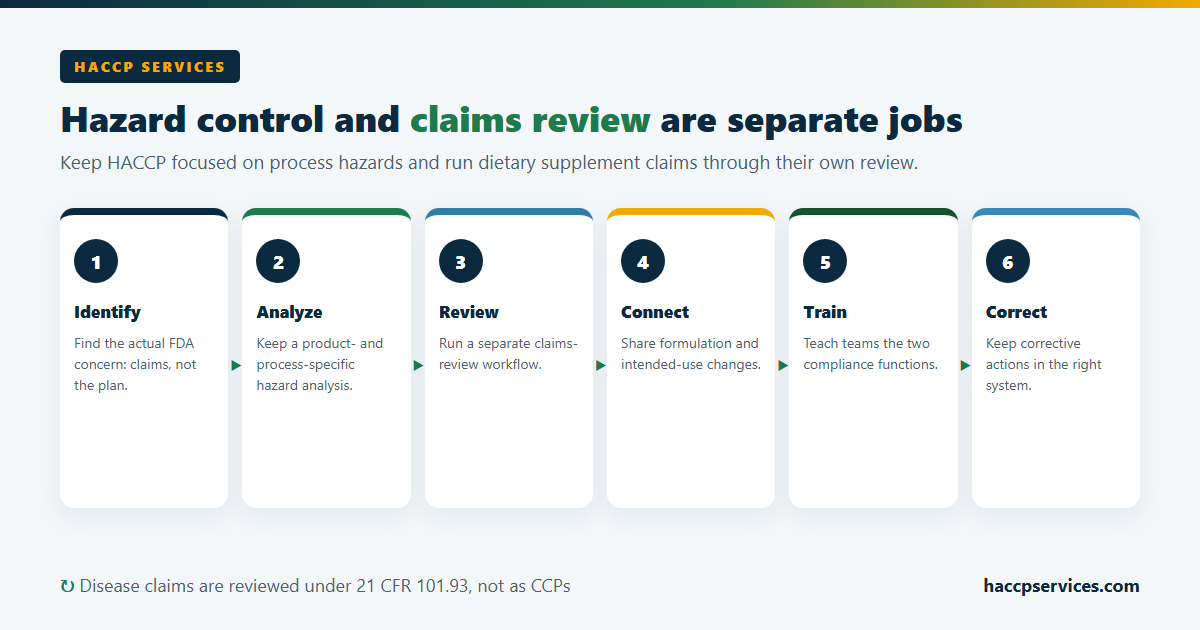
4. Connect product development and marketing
Communicate when ingredients, formulations, labels or intended uses change. That way, technical and regulatory reviewers can reassess the materials before they are published.
Quality and operations teams should share these changes with regulatory and marketing reviewers. Meanwhile, each group keeps its own decisions and records.
5. Train teams to recognize different compliance functions
Help operations teams distinguish food safety validation and monitoring from regulatory classification and promotional claims assessment. Consequently, staff will know which questions belong to the HACCP team and which belong to claims reviewers.
6. Keep corrective actions in the right system
Use HACCP corrective actions for process deviations. On the other hand, use a documented regulatory-content process for website or promotional claims issues. Mixing the two makes both sets of records harder to defend.
Frequently asked questions
Can a HACCP plan establish that dietary supplement marketing claims are lawful?
No. A HACCP plan addresses process hazards. It does not authorize disease claims in marketing or replace an applicable product-claims review.
Is every dietary supplement required to have a HACCP plan?
No. No universal HACCP-plan requirement applies to all dietary supplements. Instead, the applicable product and facility framework, including 21 CFR Part 111, should be assessed.
How should the two responsibilities work together?
Quality and operations should share product changes with regulatory and marketing reviewers, while keeping separate decisions and records.
Dietary supplement claims checklist
- Are actual product and process hazards documented where HACCP is applied?
- Is there an independent claims review and approval workflow for labels, websites and testimonials?
- Are formulation and intended-use changes shared between quality, regulatory and marketing teams?
- Are marketing corrections kept separate from HACCP process deviations?
- Do teams understand the difference between hazard control and claims assessment?
How HACCP Services can help
HACCP Services, a service of Consultare Inc. Group, can support hazard analysis, HACCP plan development and review where applicable, prerequisite programs, document control and the interface with regulatory-content review. A product-specific applicability assessment comes first.
- HACCP plan development
- Prerequisite program (PRP) gap assessment
- HACCP document control
- HACCP corrective action management
Need help managing your HACCP responsibilities?
For a focused discussion of your documentation, review processes and improvement priorities, you can book a free consultation with HACCP Services or contact our team. We can help identify an appropriately scoped next step based on your products and operations.
Start building your compliance system
If you prefer to organize and manage your compliance activities yourself, you can also create a free SystemsBuilder account. Then begin building a structured system for your compliance documentation and processes.
Technical sources: 21 CFR 101.93, FDA Structure/Function Claims and 21 CFR Part 111. This article is educational; specific requirements depend on your products, processes and applicable regulations.