
Your flow diagram and hazard analysis only protect product when both match what employees actually do on the floor. A clean flowchart can hide steps that people perform every day. If the hazard analysis relies on an outdated process map, important controls may be overlooked.
For suppliers preparing to sell to Walmart, this gap matters most after change. New equipment, a second shift or a new rework route can quietly move the process away from the approved map. Walmart supplier requirements can differ by product, facility and commercial relationship. Therefore, confirm them directly with the relevant Walmart contact before treating any practice in this guide as a mandatory Walmart rule.
Quick answer
Verify the flow diagram on site, on every relevant shift and product format. Then reassess hazards at each new or changed step. Finally, confirm that critical limits, monitoring, corrective actions and verification records still follow the current process sequence. Keep dated evidence of each walkthrough and review.
Who this article is for
This guide is for HACCP coordinators, PCQIs, plant managers and quality teams who maintain flow diagrams and hazard analyses for retail customers. It focuses on keeping both documents aligned after changes. For the first on-site check of a new diagram, see our article on process flow diagram verification before hazard analysis.
1. Capture the actual end-to-end process
Map receiving, storage, preparation, processing, rework, packaging, holding and distribution steps as they apply. Also include outsourced activities and alternate flows. For example, a product diverted to rework or a temporary storage area can change hazard exposure. Codex General Principles of Food Hygiene (CXC 1-1969) treat the flow diagram as a basis for the hazard analysis, so every gap carries forward.
2. Verify the diagram at the facility
Walk the production line with knowledgeable personnel. Compare the diagram against actual equipment, people and product movement. In addition, consider different shifts, product formats, maintenance modes and nonroutine operations. A diagram that is correct on day shift may be wrong at night or during changeovers.
3. Reassess hazards at every relevant step
Evaluate biological, chemical and physical hazards at each step, and identify controls suited to the product and operation. A missing process step can leave an entire hazard pathway out of the plan. For FDA-registered facilities under Part 117, the written hazard analysis must consider factors such as manufacturing procedures, equipment design, storage and distribution under 21 CFR 117.130. Our HACCP hazard analysis guide explains the method.
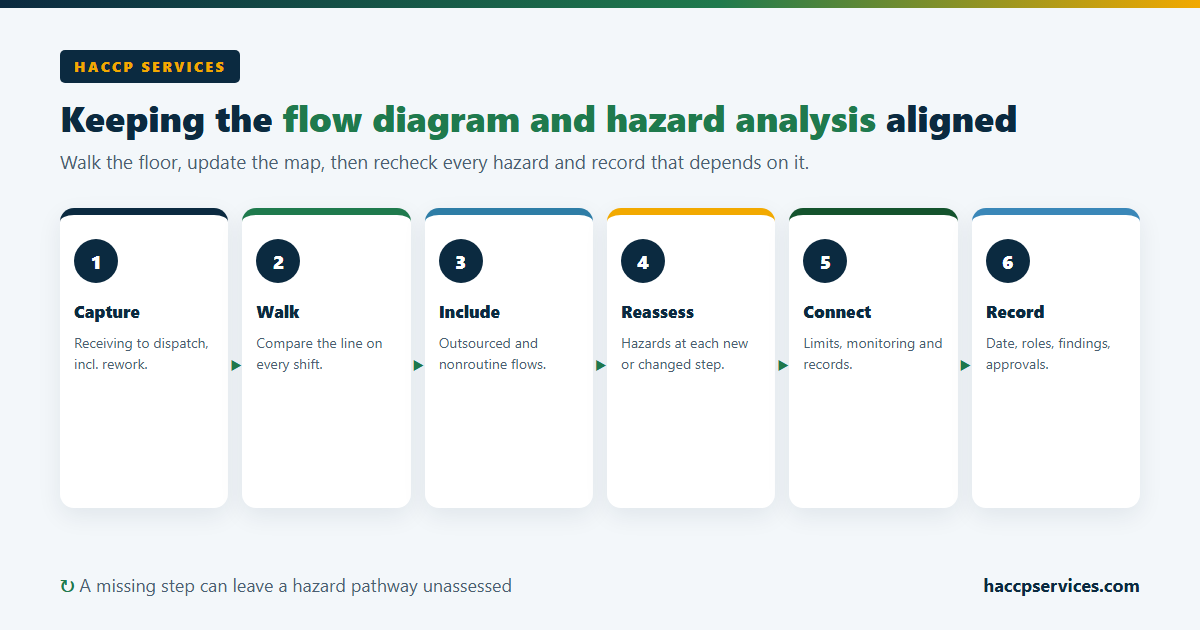
4. Connect controls to records
Confirm that operating limits, monitoring, corrective actions and verification evidence match the current process sequence. If a step moves or splits, the related forms and frequencies may need to change too. Meanwhile, keep version control and a documented technical review after each change. Under 21 CFR 117.170, a significant change that creates a reasonable potential for a new hazard, or a significant increase in a known one, triggers reanalysis of the food safety plan. Meat and poultry establishments have parallel reassessment duties under 9 CFR 417.4.
5. Retain evidence of process verification
Record the walkthrough date, participating roles, observations, approved changes and any further actions. As a result, you can show when the diagram was last confirmed and by whom. Customer and certification expectations should be checked separately from applicable law. For a wider view of plan readiness, see HACCP plans for Walmart food suppliers.
Frequently asked questions
How often should a flow diagram be verified on site?
Verify it when the plan is developed and whenever the process changes. Many teams also include it in periodic plan reviews and reassessments.
What changes should trigger a hazard analysis review?
New equipment, layout changes, new products or formats, rework routes, outsourced steps and new suppliers are common triggers. Any change that could introduce a new hazard deserves review.
Does an accurate flow diagram guarantee acceptance as a Walmart supplier?
No. Accurate documents support readiness. However, supplier approval rests with Walmart and its own requirements.
Supplier readiness checklist
- Capture the actual end-to-end process, including rework and outsourced steps.
- Verify the diagram at the facility across shifts and product formats.
- Reassess hazards at every new or changed step.
- Connect limits, monitoring and records to the current sequence.
- Retain dated evidence of each process verification.
- Verify the applicable Walmart supplier program and all relevant product and facility requirements.
- Assign owners for documentation, follow-up actions and periodic review.
How HACCP Services can help
HACCP Services, a service of Consultare Inc. Group, supports process walkthroughs, flow-diagram updates, hazard-analysis gap reviews and document-control improvements, subject to the engagement scope.
- Facility and process flow optimization
- New product and process change impact assessment
- HACCP plan reassessment
- HACCP document control and version management
Does your HACCP flow diagram match what really happens on the floor?
Review missing steps and the related hazard-control records with our team. You can book a free consultation or contact our team.
Start building your compliance system
If you prefer to organize and manage your compliance activities yourself, you can also create a free SystemsBuilder account. Then begin building a structured system for your compliance documentation and processes.
Technical sources: Codex Alimentarius (General Principles of Food Hygiene, CXC 1-1969), FDA FSMA Final Rule for Preventive Controls for Human Food, 21 CFR 117.130, 21 CFR 117.170, 9 CFR 417.4 and Walmart supplier requirements. This article is independent educational content, not legal advice. HACCP Services is not affiliated with or endorsed by Walmart Inc. or FDA. Walmart-specific supplier requirements must be confirmed directly with Walmart. Regulatory applicability depends on the product, facility, activity and current law.