
Walmart supplier HACCP verification is about showing that your safety and quality controls work in practice, and that current records support them. For manufacturers and importers considering a Walmart supply relationship, a validated plan is only the start. Ongoing verification evidence is what demonstrates control day after day.
Walmart first-party suppliers and third-party Marketplace sellers use different qualification pathways. Applicable requirements depend on the product, facility, commercial relationship and current law. Therefore, check Walmart’s current supplier policies before treating any recommended practice in this guide as a mandatory Walmart rule.
Quick answer
Validation establishes evidence that a control measure can achieve its intended outcome. Verification evaluates whether the plan and controls are being carried out as designed. For suppliers, the practical task is to keep both evidence sets current and organized: monitoring and deviation records, calibration results, reassessments after change and training records.
Who this article is for
This guide is for food manufacturers, importers, HACCP and PCQI teams and quality leaders who keep verification evidence for retail customers.
1. Separate validation from routine verification
Keep the validation file apart from day-to-day verification records. Document the scientific or technical rationale behind critical limits and other control parameters. Then revisit that rationale when processes change. For FDA-regulated facilities under Part 117, validation and verification are set out in 21 CFR 117.160 and 21 CFR 117.165. Our article on HACCP validation versus verification for food plants explains the definitions in more depth.
2. Review critical control monitoring records
Define who performs monitoring, what is measured, how often checks occur and how results are recorded. Next, verify that deviations trigger timely product evaluation and corrective action. The records should identify the affected lots. See HACCP monitoring procedures for how monitoring is designed.
3. Calibrate and challenge monitoring equipment
Set a schedule for checking thermometers, metal detectors, scales and other critical measuring equipment. Base the frequency on each instrument’s food safety significance. In addition, retain calibration and challenge-test results. When equipment fails, assess any product that may have been affected.
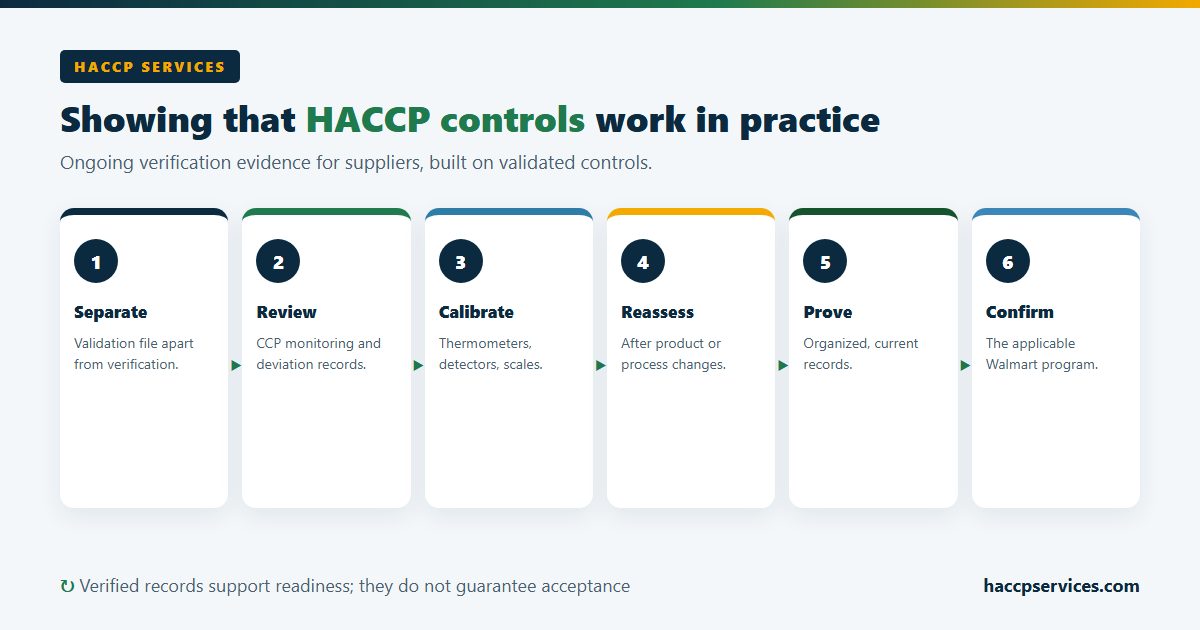
4. Reassess the plan after relevant changes
Review hazard analyses when formulations, packaging, production equipment, suppliers, intended use or regulatory obligations change. For facilities covered by FDA preventive controls requirements, consider the additional provisions of the food safety plan. In other words, do not treat traditional HACCP as a complete substitute for Part 117. Our HACCP plan vs FDA food safety plan guide covers that boundary.
5. Demonstrate effectiveness through records
Keep process flow verification, monitoring, deviation records, verification reviews, validation support and training evidence in an organized format. Use internal audit findings and complaint trends to refine controls. Meanwhile, check any distinct Walmart certification or supplier requirement separately. For record handling, see HACCP monitoring records and verification review. To see why these records do not show FDA registration status, read HACCP records and FDA registration.
Frequently asked questions
Is verification the same as validation?
No. Validation shows that a control can work. Verification shows that the plan and controls are being carried out as designed.
Do strong verification records guarantee acceptance as a Walmart supplier?
No. Organized, current records support readiness. However, supplier approval rests with Walmart and its own requirements.
Do first-party suppliers and Marketplace sellers follow the same pathway?
No. They use different qualification pathways. Confirm the requirements for your pathway directly with Walmart.
Supplier readiness checklist
- Separate validation from routine verification.
- Review critical control monitoring records.
- Calibrate and challenge monitoring equipment.
- Reassess the plan after relevant changes.
- Demonstrate effectiveness through records.
- Verify the applicable Walmart supplier program and all relevant product and facility requirements.
- Assign owners for documentation, follow-up actions and periodic review.
How HACCP Services can help
HACCP Services, a service of Consultare Inc. Group, supports food businesses through compliance gap assessments, program development, documentation control, audit preparation and corrective action coordination, subject to the engagement scope.
- HACCP plan validation and scientific justification
- Calibration and measurement control
- HACCP plan reassessment
- Third-party audit preparation
Are your HACCP controls verified and defensible?
Review validation evidence, monitoring methods and deviation handling with our team. You can book a free consultation or contact our team.
Start building your compliance system
If you prefer to organize and manage your compliance activities yourself, you can also create a free SystemsBuilder account. Then begin building a structured system for your compliance documentation and processes.
Technical sources: Codex Alimentarius (General Principles of Food Hygiene, CXC 1-1969), FDA FSMA Final Rule for Preventive Controls for Human Food, 21 CFR 117.160, 21 CFR 117.165 and Walmart supplier requirements. This article is independent educational content, not legal advice. HACCP Services is not affiliated with or endorsed by Walmart Inc. or FDA. Walmart-specific supplier requirements must be confirmed directly with Walmart. Regulatory applicability depends on the product, facility, activity and current law.