
Validation versus verification for food plants comes down to two different questions. Validation asks whether a control measure can control the hazard. Verification asks whether the system is working as planned, day after day. Mixing them up leaves gaps that reviewers notice quickly.
Food manufacturers that want to supply large retailers such as Costco need reliable, documented controls and the ability to explain them. This guide sets out practical steps for keeping validation and verification evidence separate. Regulatory duties depend on the product, facility and transaction. Retailer-specific supplier conditions should be confirmed directly with the buyer.
Quick answer
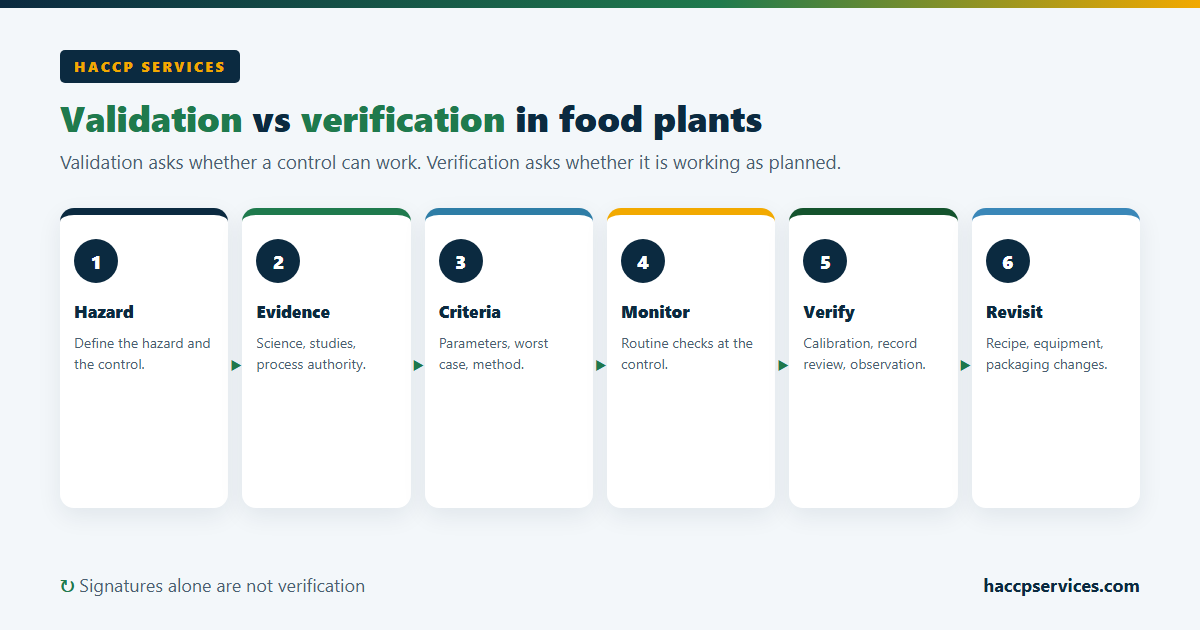
Validation gathers scientific and technical evidence that a control, properly carried out, will control the identified hazard. Verification checks that the control is actually being carried out and is effective, through calibration, record review, observation and testing. Monitoring is the routine check at the control point. All three are related, but they are not interchangeable.
Who this article is for
This guide is for plant managers, HACCP and PCQI teams and quality leaders preparing evidence for regulators, auditors or retail customers.
1. Know the difference
Each U.S. framework uses the terms in its own way, so check the rule that applies to your product:
- 21 CFR Part 117: validation of preventive controls is in 117.160, while verification of implementation and effectiveness is in 117.165.
- Juice HACCP (Part 120): 120.11 covers both verification and validation of the HACCP plan.
- Seafood HACCP (Part 123): 123.8 covers verification, including reassessment of the plan.
- USDA FSIS (9 CFR 417.4): establishments validate the plan’s adequacy and verify that it is being implemented.
For how the Part 117 food safety plan relates to a traditional HACCP plan, see our guide to the HACCP plan vs FDA food safety plan.
2. Build an evidence case for each control
Validation support may include scientific literature, process-authority recommendations, challenge studies, equipment specifications, thermal calculations or facility-specific testing. Suitability depends on the hazard, product, process and applicable regulation. Notably, Part 117 does not require validation of sanitation controls, allergen controls, the recall plan or the supply-chain program (21 CFR 117.160(c)).
3. Set measurable criteria
Describe the process parameters, equipment range, worst-case operating conditions, measurement method and acceptable outcome. A critical limit copied from another plant, without support for your food and equipment, can leave a major evidence gap. See HACCP critical limits for how limits are set.
4. Verify execution at the plant
Review monitoring records, instrument calibration, deviation investigations, periodic direct observation and product disposition decisions. Investigate missing records and repeated exceptions. Merely collecting signatures is not verification. Our article on HACCP monitoring records and verification review covers the record side in detail.
5. Revisit validation when the process changes
Changes to recipe, packaging, throughput, equipment, product size or target organism may affect the original validation case. Therefore, assess the impact before relying on the previous study. Part 117 calls for validation whenever a change could affect whether a control measure will work (117.160(b)(1)(ii)). Retail customer review does not replace a hazard analysis or regulatory requirements.
Frequently asked questions
Is verification the same as monitoring?
No. Monitoring is the routine observation or measurement at the control point. Verification confirms that monitoring and the rest of the system are working, for example by reviewing records and calibrating instruments.
Does a retailer audit validate my process?
No. A customer audit can review your evidence, but it does not replace the scientific support for your controls or your regulatory obligations.
Does good HACCP evidence guarantee Costco acceptance?
No. Strong validation and verification records support readiness. However, supplier approval and purchasing decisions rest with the buyer and its own requirements.
Supplier readiness checklist
- Confirm applicable regulations, certification scope and buyer-specific requirements in writing.
- Identify the accountable process owner and current approved procedures.
- Keep the validation file separate from routine verification records.
- Collect recent objective records tied to the correct facility, product and lots.
- Resolve exceptions with documented corrective actions and effectiveness checks.
- Test record retrieval and make the review package available to authorized reviewers.
To start a conversation with Costco about supplying products, use the official Costco Vendor Inquiries page and confirm category-specific expectations with the relevant contact. For broader preparation, see our overview of HACCP requirements for food manufacturers preparing to sell at Costco.
How HACCP Services can help
HACCP Services, a service of Consultare Inc. Group, supports food safety program development, validation planning, verification procedures, supplier documentation, regulatory readiness and quality system improvement, subject to the engagement scope.
- HACCP plan validation and scientific justification
- HACCP verification and validation requirements
- Calibration and measurement control
- HACCP plan reassessment
Need help separating validation from verification?
Share your product category, manufacturing location, current program and expected distribution timeline so the discussion can focus on the most important gaps. You can book a free consultation or contact our team.
Start building your compliance system
If you prefer to organize and manage your compliance activities yourself, you can also create a free SystemsBuilder account. Then begin building a structured system for your compliance documentation and processes.
Technical sources: FDA HACCP Principles & Application Guidelines, FDA FSMA Final Rule for Preventive Controls for Human Food, 21 CFR 117.160, 21 CFR 117.165, 21 CFR 120.11, 21 CFR 123.8 and 9 CFR 417.4. This article is educational information, not legal advice or a statement of Costco supplier approval policy. HACCP Services is independent of and not affiliated with or endorsed by Costco Wholesale, FDA or USDA. Requirements may change; confirm current rules and written buyer terms before relying on this guide.