
HACCP requirements for food manufacturers depend on the product and the process, not on the retailer you want to supply. Before approaching a large buyer such as Costco, a manufacturer needs to know which hazards can occur and how each one is controlled. It also needs to know which federal rule applies to each product.
HACCP is a systematic approach to hazard analysis and control. However, there is no single federal HACCP regulation covering every food sold at Costco. As a result, the first step is to identify the correct FDA or USDA framework. Only then should you choose a plan format or make claims about regulatory compliance.
Quick answer
Map each product to its framework first. Covered juice and seafood processors follow FDA HACCP rules (21 CFR Parts 120 and 123). Meat and poultry establishments follow USDA FSIS HACCP rules (9 CFR Part 417). Most other FDA-registered food facilities fall under 21 CFR Part 117 preventive controls. A HACCP plan supports supplier readiness, but it does not guarantee Costco approval.
Who this article is for
This guide is for food manufacturers, co-packers, quality managers and HACCP coordinators preparing for major retail distribution.
1. Identify the applicable food safety regulation
FDA Juice HACCP under 21 CFR Part 120 applies to covered juice processing. Seafood HACCP under 21 CFR Part 123 applies to covered fish and fishery products. Meanwhile, meat and poultry establishments are subject to USDA FSIS requirements, including the HACCP rules in 9 CFR Part 417.
Other FDA-regulated human food facilities may be subject to hazard analysis and risk-based preventive controls under 21 CFR Part 117. Exemptions and modified requirements can apply. These frameworks are not interchangeable, so determine the pathway for each activity before you develop or revise a plan. Our comparison of a HACCP plan vs FDA food safety plan explains the difference.
2. Build a process-specific hazard analysis
Document the actual process flow from receiving through storage, preparation, processing, packaging and distribution. Then confirm the flow diagram against on-site operations. Next, assess biological, chemical, physical and allergen hazards as applicable. Our HACCP hazard analysis guide explains the method.
Evaluate the hazards introduced or reasonably likely to occur at each step. A supplier Certificate of Analysis may support an ingredient assessment. However, it does not address hazards introduced by your own handling, processing, holding or packaging.
3. Evaluate juice pathogen reduction requirements
For juice operations covered by Part 120, 21 CFR 120.24 requires control measures that consistently achieve at least a 5-log reduction in the pertinent microorganism. The reduction must hold for at least the shelf life of the product under normal and moderate abuse storage conditions. The rule exempts certain processors, such as those subject to Part 113 or Part 114, and some single-step thermal processes.
The regulation also addresses where the treatment and final packaging must take place. Therefore, assess any claimed exemption against the actual product, process and conditions. Do not apply the 5-log statement to every juice product without checking. For more detail, read our article on juice HACCP 5-log reduction and glass bottling hazards.
4. Establish monitoring, deviation and corrective action procedures
For each required control, define the measurable parameters, monitoring frequency and responsible person. Also define the deviation response, affected-product assessment, disposition, verification and record retention. These details must reflect your hazard analysis and the applicable regulation. See HACCP monitoring procedures and HACCP corrective actions.
Depending on the operation, relevant issues may include sanitation, temperature management and allergen changeovers. Glass and foreign-material controls, equipment condition and prevention of contamination after treatment may also matter.
5. Treat HACCP as supplier readiness, not a purchasing guarantee
A well-developed and implemented food safety system supports operational discipline. It also helps you demonstrate control of identified hazards. Still, retailer-specific audits, certifications and documentation requests must be confirmed directly with the buyer, for example through Costco’s Vendor Inquiries page.
Do not claim that a HACCP plan alone guarantees Costco approval. Likewise, a HACCP plan does not replace other applicable regulatory obligations. If you are weighing a certificate, read is HACCP certification required to become a Costco food supplier.
Frequently asked questions
Is there one federal HACCP rule for all foods sold at Costco?
No. Juice, seafood, and meat and poultry have their own HACCP rules, while most other FDA-regulated facilities fall under Part 117 preventive controls.
Does a supplier Certificate of Analysis cover my hazards?
Only partly. It can support an ingredient assessment, but it does not cover hazards introduced by your own processing, holding or packaging.
Does every juice product need a 5-log reduction?
Covered juice processors generally do, but 21 CFR 120.24 contains exemptions. Check them against your actual product and process.
Supplier readiness checklist
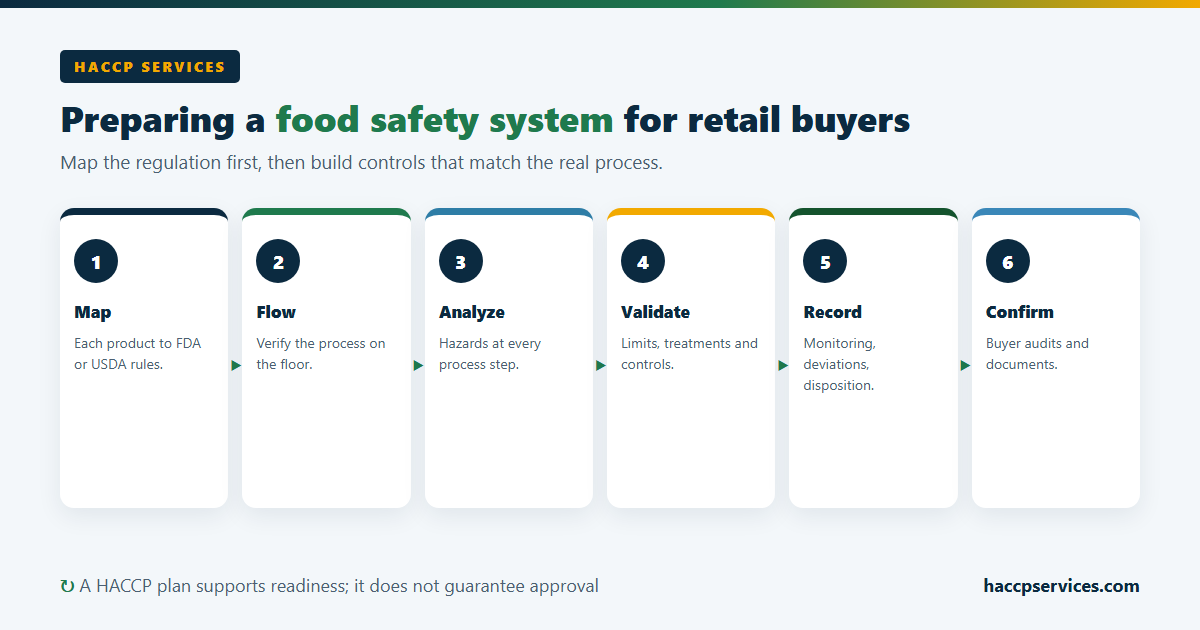
- Map each product and activity to the applicable FDA or USDA framework.
- Confirm the actual process flow and hazard analysis.
- Validate applicable critical limits, treatments or preventive controls.
- Establish monitoring, deviation, product disposition and verification records.
- Confirm retailer-specific audit and documentation requests with the buyer.
How HACCP Services can help
HACCP Services, a service of Consultare Inc. Group, supports HACCP gap assessments, hazard analysis, plan development, training coordination, validation planning, monitoring procedures and corrective action systems, subject to the engagement scope. The final plan must be specific to your product, process, facility and regulatory framework.
- HACCP plan development
- HACCP plan validation and scientific justification
- Juice HACCP plans (21 CFR 120)
- Corrective action management
Need a HACCP plan developed or reviewed?
Discuss your products, processing steps, facility operations and applicable regulations with our team. You can book a free consultation or contact our team.
Start building your compliance system
If you prefer to organize and manage your compliance activities yourself, you can also create a free SystemsBuilder account. Then begin building a structured system for your compliance documentation and processes.
Technical sources: 21 CFR 120.24 (Juice process controls), FDA Juice HACCP Hazards and Controls Guidance, FDA Juice HACCP and FSMA Guidance and FDA Preventive Controls for Human Food. This article is educational; HACCP Services is not affiliated with or endorsed by Costco Wholesale or FDA. Costco-specific supplier requirements must be confirmed directly with the relevant Costco contact, and regulatory applicability depends on your products, processes and facility.