
Dietary supplement website claims need their own controls, separate from HACCP. A company may have robust hazard analysis, monitoring and food safety procedures. Yet it can still face FDA concern over how it markets a dietary supplement online.
For regulatory clarity, do not confuse technical food safety controls with the intended-use standards that apply to promotional website content. This article shows how to run both sets of controls side by side.
Who this article is for
This guide is for food and dietary supplement manufacturers, importers, quality managers, regulatory affairs teams and the people who own marketing content.
Quick answer
HACCP identifies and manages food safety hazards in products and processes. It does not approve disease-prevention or treatment claims on dietary supplement websites. Those promotional statements need a separate regulatory review.
What FDA looks for in dietary supplement website claims
Supplement labeling may describe how a nutrient or dietary ingredient affects the structure or function of the body, subject to the conditions in 21 CFR 101.93. However, those statements must not be disease claims under 101.93(g). That paragraph looks at context, not just single words. For example, a product name, a cited publication, or pictures and symbols can imply that a product treats or prevents disease.
If the labeling of a product marketed as a dietary supplement bears a disease claim, the product will be subject to regulation as a drug, unless the claim is an authorized health claim for which the product qualifies. That is why website copy deserves a structured review.
1. Identify the applicable hazard-control framework
Determine whether a HACCP plan is required by a specific rule or used voluntarily. Dietary supplement manufacturing primarily follows the CGMP rule in 21 CFR Part 111. Our article on HACCP and dietary supplement product classification covers this in more depth.
2. Define hazards in the actual manufacturing process
Evaluate biological, chemical and physical hazards using product- and process-specific evidence. Do not rely on marketing language. A focused HACCP hazard analysis keeps this work grounded in the process.
3. Maintain controls for ingredients and production
Address process, sanitation, allergen and other hazards as appropriate to the product and operation. For practical examples, see our article on dietary supplement hygiene and contamination control.
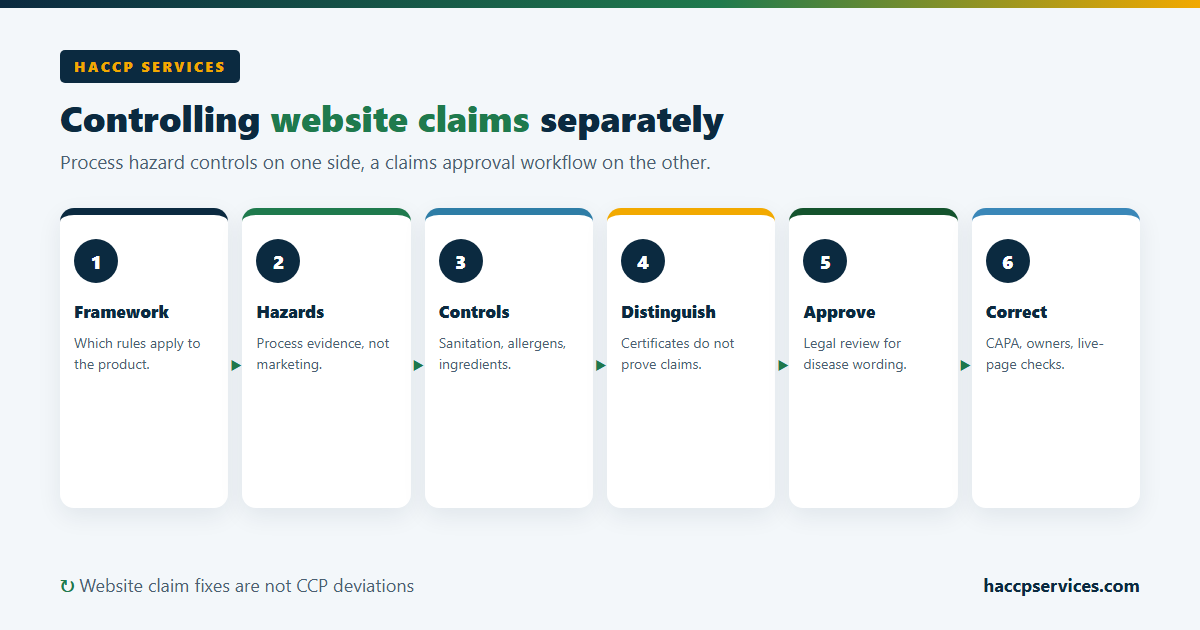
4. Distinguish a safety control from a marketing claim
Manufacturing assurance, certificates and hazard analysis show that a product is made safely. They cannot substantiate statements that a supplement treats disease. Therefore, never cite a HACCP plan or a certificate as support for a therapeutic claim on a website.
5. Keep marketing approval in a separate workflow
Require a legal or regulatory review whenever content names a disease or a therapeutic outcome. Give this workflow its own reviewers, approval records and version history. As a result, everyone can see which wording was approved, by whom and when.
6. Link corrective actions across departments
A website review may reveal problematic claims. In that case, manage the marketing correction with documented owners and verification. However, do not label it a HACCP critical control point failure. Use HACCP corrective actions for process deviations, and your CAPA or document control process for content fixes.
Frequently asked questions
Does an approved HACCP plan authorize supplement treatment claims?
No. HACCP is a food safety methodology, not a drug marketing authorization.
Is every dietary supplement required to have a HACCP plan?
No. Applicability depends on the product, the activities and the governing regulations.
Can marketing corrections be recorded in quality systems?
Yes. A company can use its CAPA or document control process to manage and verify corrections to website claims.
Dietary supplement website claims checklist
- Confirm product classification and the applicable FDA regulatory pathway.
- Maintain an approved inventory of products, labels, website content and connected social channels.
- Name the staff responsible for reviewing and approving new or revised claims.
- Document review decisions, version history and evidence supporting product information.
- Evaluate disease-related wording separately from product safety, certification and supplier assurance.
- Verify corrections on live pages and linked channels, and review recurrence through management oversight.
How HACCP Services can help
HACCP Services, a service of Consultare Inc. Group, supports HACCP applicability and gap assessments, hazard analysis and process-control review, documentation improvement and cross-functional corrective action support. Services are scoped to the specific product, applicable requirements and agreed engagement.
- HACCP regulatory compliance audits
- HACCP plan development
- HACCP document control
- Corrective action management
Need help managing your HACCP responsibilities?
Discuss your products, current documentation and compliance questions with our team. You can book a free consultation or contact our team.
Start building your compliance system
If you prefer to organize and manage your compliance activities yourself, you can also create a free SystemsBuilder account. Then begin building a structured system for your compliance documentation and processes.
Technical sources: 21 CFR 101.93, 21 CFR Part 111 and FDA Structure/Function Claims. This article is educational; HACCP Services is not affiliated with FDA, and specific requirements depend on your products, processes and applicable regulations.