
Dietary supplement hygiene problems usually start where people, tools and open product meet. Gaps in personnel hygiene, facility condition, manufacturing records, specifications or complaint review undermine confidence in the whole quality program.
A HACCP-style hazard analysis can help you organize these contamination risks. However, the U.S. rule for dietary supplement manufacturing is CGMP under 21 CFR Part 111, and a HACCP plan does not replace those duties. Part 111 sets its own requirements for personnel (Subpart B), physical plant (Subpart C) and equipment (Subpart D).
Who this article is for
This guide is written for dietary supplement manufacturers, food safety professionals, plant supervisors and HACCP practitioners.
1. Map product exposure points
Review weighing, blending, transfer, encapsulating or filling, packaging and storage. At each step, note where product touches staff, tools and environmental surfaces. Our HACCP hazard analysis guide shows how to document it.
2. Assess personnel contamination routes
Evaluate hand hygiene, uncovered arms or clothing near exposed material, illness reporting, jewelry rules and access to handwashing stations. Then observe whether practice matches the procedure.
3. Review equipment and facility conditions
Inspect blenders, transfer scoops, hoppers, structural surfaces and ceilings, and look for unsuitable temporary covers or storage materials. For cleaning between products, see our article on supplement equipment cleaning.
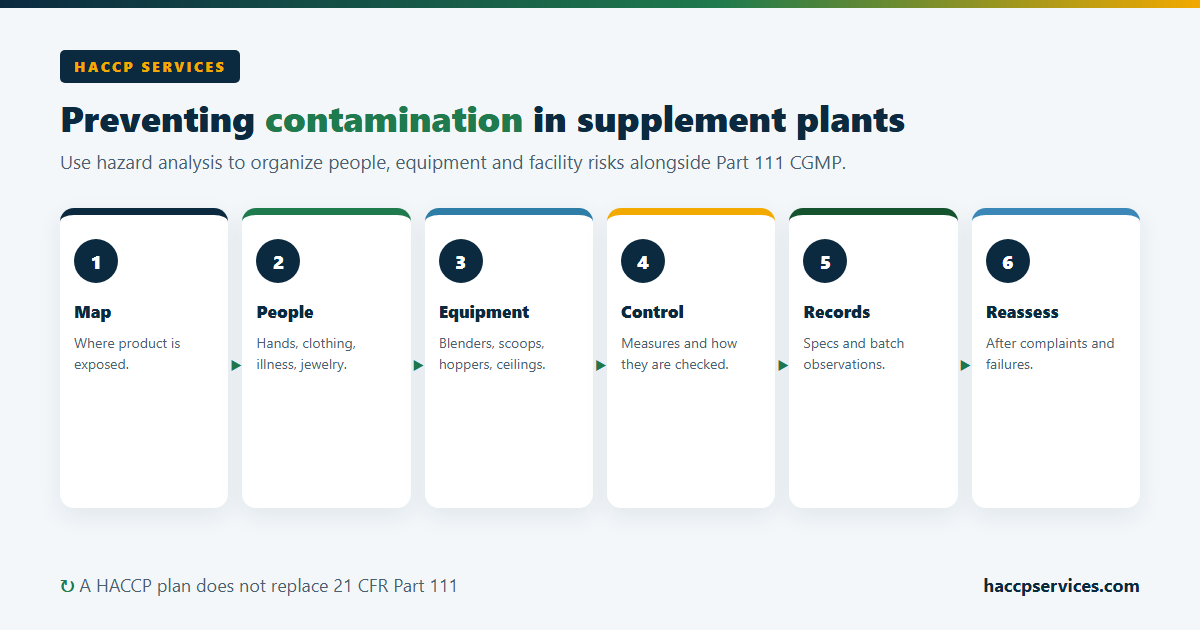
4. Define control and verification measures
For each significant hazard, document the prevention measure and how you check that it works. Most sanitation and hygiene practices are prerequisite programs, not critical control points, so do not label every one a CCP. See HACCP verification and validation.
5. Connect specifications and batch records
Specify the attributes that matter for product quality and traceability, and record actual process observations and deviations in the batch record. Our guide to dietary supplement manufacturing specifications covers Part 111 specification rules.
6. Reassess after complaints and failures
Investigate contamination concerns, assess affected materials, correct root causes and decide whether added controls are needed. In addition, trend complaints so repeat issues reach management review.
Frequently asked questions
Does a HACCP plan replace dietary supplement CGMP?
No. Where Part 111 applies, its requirements must be met regardless of any HACCP plan.
Is every sanitation practice a critical control point?
No. Most hygiene and sanitation measures are prerequisite programs verified through checks and records.
What evidence shows hygiene controls work?
Completed cleaning logs, verification records, observation results, investigations of missed tasks and corrective action follow-up.
Dietary supplement hygiene checklist
- Confirm the regulatory and program scope for each product and facility.
- Assign owners and current approvals for written procedures.
- Verify hygienic practices, equipment condition and cleaning by observation.
- Link specifications and manufacturing records to traceable batches.
- Document complaints, deviations, product impact and corrective actions.
- Review recurring findings and confirm improvements remain effective.
How HACCP Services can help
HACCP Services, a service of Consultare Inc. Group, supports hazard analysis, sanitation programs, hygienic zoning reviews and corrective action procedures for supplement manufacturers, subject to the engagement scope and applicable requirements.
- Sanitation program development
- Cross-contamination and hygienic zoning assessment
- Prerequisite program gap assessment
- Deviation investigation and root cause analysis
Need help managing your HACCP responsibilities?
Discuss your products, facilities, controls and documentation with our team. You can book a free consultation or contact our team.
Start building your compliance system
If you prefer to organize and manage your compliance activities yourself, you can also create a free SystemsBuilder account. Then begin building a structured system for your compliance documentation and processes.
Technical sources: 21 CFR Part 111 (Dietary Supplement CGMP) and FDA Hazard Analysis Critical Control Point (HACCP). This article is educational; HACCP Services is not affiliated with FDA, and specific requirements depend on your products, processes and applicable regulations.