
Supplement equipment cleaning on shared lines needs a disciplined look at how ingredients move through the operation. A process-based hazard analysis can identify material carryover, allergen cross-contact and contamination risks. Then it can assign suitable preventive practices and verification.
However, HACCP terminology should not be confused with FDA dietary supplement CGMP obligations. Equipment and utensils in supplement manufacturing are covered by 21 CFR Part 111, Subpart D (111.25 to 111.35). HACCP principles can help structure the analysis, but the required program depends on the actual products and their regulatory classification.
Who this article is for
This guide is written for HACCP coordinators, sanitation supervisors, operations managers and supplement manufacturers who run shared equipment or frequent changeovers.
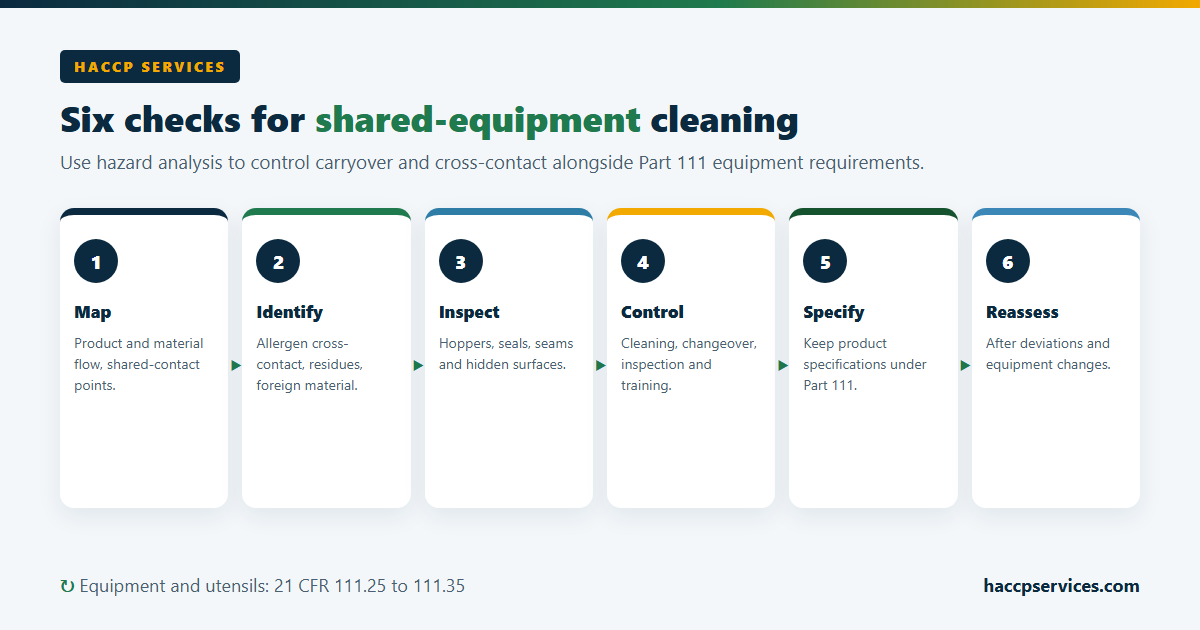
1. Map product and material flow
First, document receiving, staging, blending, transfer, filling, cleaning and storage. Include every shared-contact point where one product or ingredient could carry over into the next.
2. Identify relevant carryover hazards
Next, assess allergen cross-contact, residues, foreign material and other contamination risks based on your ingredients and facility operations. A structured HACCP hazard analysis keeps this review consistent across lines and products.
3. Review equipment cleanability for supplement equipment cleaning
Inspect hoppers, seals, seams and inaccessible surfaces that may retain material after cleaning. Part 111 requires equipment and utensils to be of appropriate design and construction and to be maintained, cleaned and sanitized (21 CFR 111.27). In practice, hard-to-clean design is often where residue hides.
4. Define cleaning and changeover controls
Establish procedures, inspections, training and verification in proportion to the risk and the process. Written procedures for equipment cleaning are part of Part 111 Subpart D (111.25), and related records are covered in 111.35.
For allergen-containing products, an allergen management program and a pre-operational inspection program help confirm that changeovers worked before the next run starts.
5. Separate hazard controls from product specifications
Ensure finished-product identity, purity, strength and composition documentation is addressed under the applicable CGMP requirements (21 CFR 111.70), as well as under any relevant hazard-control plan. In other words, a clean line supports product quality, but it does not replace specifications.
6. Reassess after deviations and equipment changes
Investigate failures, document product impact, implement corrections and verify that redesigned or revised controls work. Likewise, review the analysis whenever equipment, layout or product mix changes.
Frequently asked questions
Does a HACCP plan replace dietary supplement CGMP requirements?
No. HACCP principles can support risk assessment, but they do not replace applicable 21 CFR Part 111 obligations. For more context, see HACCP and dietary supplements.
Is every sanitation measure a CCP?
No. Classification depends on the hazard analysis and the applicable regulatory or certification framework. Many cleaning controls are prerequisite or operational controls rather than CCPs.
What should happen if residue is found after cleaning?
Assess the affected equipment and product, correct the condition and investigate its cause. Then document effective follow-up.
Supplement equipment cleaning checklist
- Have you identified which FDA regulations and certification requirements apply to the actual product and activities?
- Are cleanability, shared-equipment risks, cleaning SOPs and evidence of implementation reviewed?
- Are finished-product specifications, approved formulas, labels and production records consistent?
- Are deviations, root cause, corrective action, verification evidence and ownership documented?
- Is the analysis reassessed after equipment, layout or product changes?
How HACCP Services can help
HACCP Services, a service of Consultare Inc. Group, can support HACCP-related hazard analysis, process-flow review, shared-equipment sanitation assessment, preventive-program design, records and corrective action. Engagement scope is tailored to the specific product, facility and applicable requirements.
- HACCP sanitation program development
- Allergen management program
- Cross-contamination and hygienic zoning assessment
- HACCP deviation investigation
Need help managing your HACCP responsibilities?
Discuss your products, equipment, facility operations, specifications, manufacturing records and improvement priorities with our team. You can book a free consultation with HACCP Services or contact our team.
Start building your compliance system
If you prefer to organize and manage your compliance activities yourself, you can also create a free SystemsBuilder account. Then begin building a structured system for your compliance documentation and processes.
Technical sources: 21 CFR Part 111, Subpart D (Equipment and Utensils) and 21 CFR 111.70 (Specifications). This article is educational; specific requirements depend on your products, processes and applicable regulations.