
HACCP process deviations need a documented product evaluation and an appropriate corrective action. Consistent quality control also depends on clear product specifications, monitored operating conditions, accurate manufacturing records and authorized decisions when a process departs from approved requirements.
HACCP teams should identify hazards and choose controls that fit the actual product and regulatory framework. However, not every operational parameter is a critical control point (CCP).
Who this article is for
This guide is written for food and dietary supplement manufacturers, importers, quality teams and regulatory compliance personnel, where applicable.
1. Identify the correct food safety framework
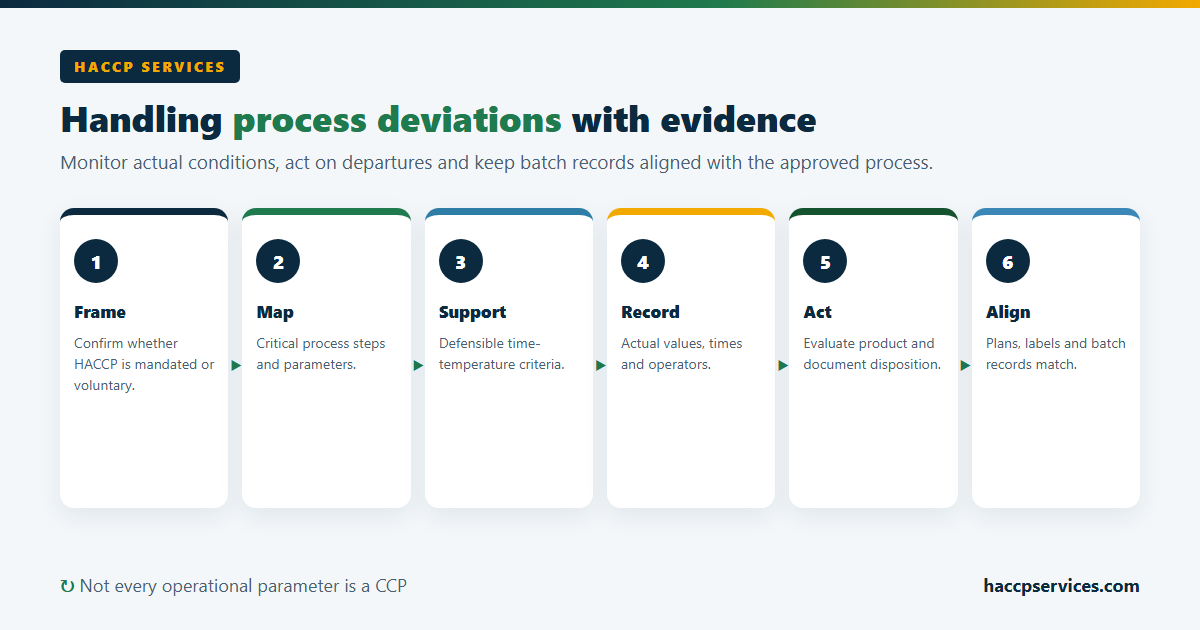
First, confirm whether HACCP is mandated, voluntary or part of a certification system for the product. Dietary supplement manufacturing obligations under 21 CFR Part 111 are not automatically HACCP requirements. For example, Part 111 sets its own rules for specifications (111.70), quality control (Subpart F, 111.103 to 111.140) and batch production records (111.255 to 111.260).
2. Map critical process steps
Next, describe receiving, treatment, blending, encapsulating or packing where applicable, holding and release. Then identify which process parameters materially affect product safety.
3. Establish defensible process criteria
Support relevant time-temperature or other controls with suitable scientific information, equipment capability and product-specific evidence. Where a parameter is a CCP, its HACCP critical limits need a documented scientific basis.
4. Record actual operating conditions
Document measured values, elapsed times when relevant, operator identifiers and references to monitoring or calibration results. Do not rely on expected settings. Sound HACCP monitoring procedures and a reliable calibration program make these records trustworthy.
5. Act when HACCP process deviations occur
When a monitored value departs from an established limit, identify the affected product and investigate the departure. Then document any hold, rework, rejection or other authorized disposition, and assess whether reassessment is needed. The HACCP corrective actions principle explains what a complete response includes.
6. Keep process plans and batch records aligned
Ensure that written instructions, in-process checks, labels, traceability, review and verification records refer to the same approved process. Otherwise, a batch record may show compliance with an outdated version of the plan.
Frequently asked questions
Is every processing temperature a HACCP critical limit?
No. Whether a limit is associated with a critical control point depends on the hazard analysis and the chosen control strategy.
What documentation supports a deviation decision?
Actual monitoring results, affected lot identification, evaluation rationale, authorized disposition and corrective action records.
Does HACCP replace dietary supplement CGMP?
No. Businesses must separately assess any applicable 21 CFR Part 111 obligations.
HACCP process deviations checklist
- Have you confirmed which legal and certification requirements apply to the product and site?
- Are owners assigned for specifications, instructions, monitoring and quality decisions?
- Are actual processing results and deviations linked to the affected product lots?
- Are product disposition, corrective actions and effectiveness checks documented?
- Are records current and retrievable, and are controls reassessed when activities change?
How HACCP Services can help
HACCP Services, a service of Consultare Inc. Group, can support HACCP hazard analysis, monitoring design, process control reviews, deviation handling and program verification, subject to the engagement scope and applicable regulatory requirements.
- CCP monitoring system design
- HACCP deviation investigation
- Product hold and disposition program
- HACCP recordkeeping system
Need help managing your HACCP responsibilities?
Discuss your product, manufacturing or import activities, existing records and priority compliance questions with our team. You can book a free consultation with HACCP Services or contact our team.
Start building your compliance system
If you prefer to organize and manage your compliance activities yourself, you can also create a free SystemsBuilder account. Then begin building a structured system for your compliance documentation and processes.
Technical sources: FDA Hazard Analysis Critical Control Point (HACCP), 21 CFR Part 111, Subpart F (Quality Control) and 21 CFR Part 111, Subpart I (Batch Production Record). This article is educational; specific requirements depend on your products, processes and applicable regulations.