
Supplement testimonials can create regulatory risk that no HACCP control will catch. HACCP evaluates food safety hazards and the measures that control them. It does not decide whether advertising, customer testimonials or online disease claims show that a product is intended for use as a drug.
A business may have strong controls for ingredient safety, processing, storage and distribution. Even so, it can still face separate regulatory issues because of its promotional statements. For that reason, review any reference to treating infections, disease symptoms or chronic conditions independently of your HACCP documents.
Who this article is for
This guide is for food safety professionals, product developers and businesses that combine HACCP-based practices with dietary supplement marketing.
Quick answer
HACCP and claims review are two separate assessments. HACCP looks at hazards in ingredients and processes. Testimonials and other marketing statements need their own review under the appropriate regulatory framework.
Why supplement testimonials matter to FDA
FDA looks at the “intended use” of a product. Under 21 CFR 201.128, intended use refers to the objective intent of the persons responsible for the labeling. That intent can be shown by labeling claims, advertising matter, or oral or written statements by those persons or their representatives.
So when a company uses customer testimonials to promote sales, those testimonials become part of its promotional material. In turn, 21 CFR 101.93(g) explains when a statement about a supplement is a disease claim. It covers explicit and implied claims, including effects on the signs or symptoms of a disease. For a broader comparison, see our article on HACCP vs FDA dietary supplement claims.
1. Define the scope of the hazard analysis
Document the food safety hazards relevant to ingredients, processing, packing and distribution. Also confirm whether HACCP is mandatory under a product-specific rule or used voluntarily. A sound HACCP hazard analysis stays focused on those process hazards.
2. Keep intended-use classification separate
Evaluate product claims and consumer-facing context through a regulatory review process. Do not record them as a HACCP critical control point. A CCP controls a food safety hazard; a testimonial is a marketing statement.
3. Identify every channel that may create concern
Next, list every place where claims can appear. Include label wording, product pages, educational blogs, social posts and the customer testimonials the company uses to promote sales. A testimonial reposted on a product page deserves the same review as the company’s own wording.
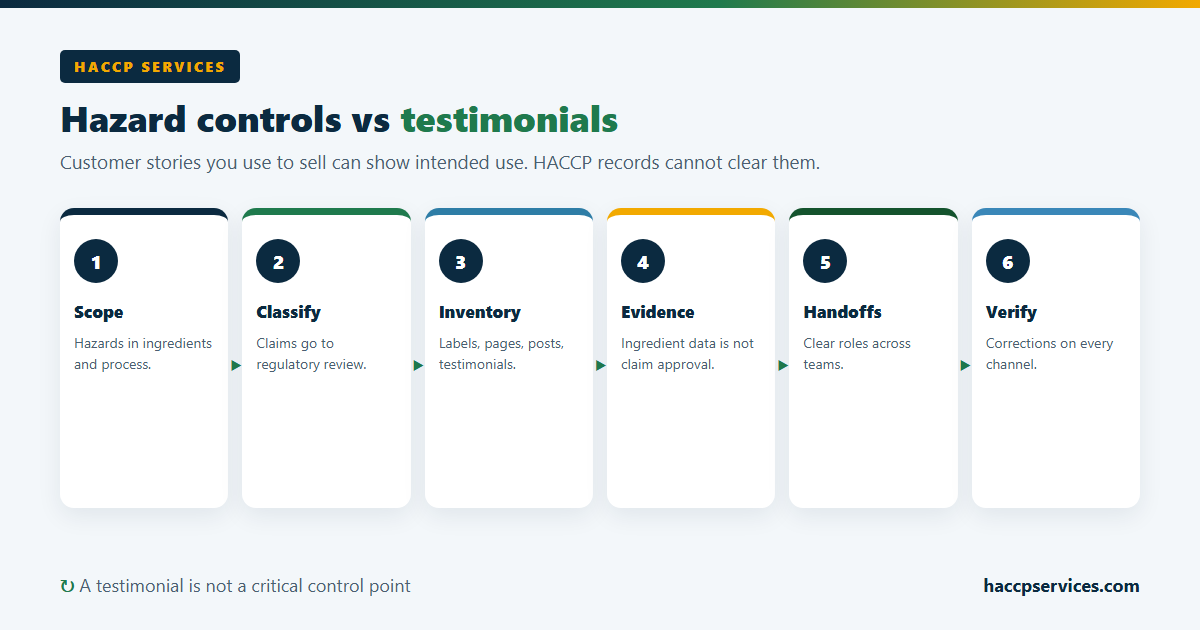
4. Confirm the limits of ingredient evidence
An ingredient study, an established food safety control or a supplier certificate does not automatically authorize treatment or prevention claims for a finished product. Likewise, a glowing customer story does not substantiate a claim. Keep safety evidence and claims evidence clearly apart.
5. Connect teams without mixing requirements
Coordinate food safety, product development, marketing and regulatory functions through clear handoffs and approval rules. Each team keeps its own decisions and records. Meanwhile, product changes are shared so that reviewers can reassess claims before publication.
6. Document corrections and verification
When claim language changes, keep the approved version on file. Then confirm that every controlled marketing channel has been updated, including archived testimonials. Controlled document versions make this easier to prove.
Frequently asked questions
Does HACCP certification permit disease-treatment claims?
No. HACCP does not grant marketing authorization for disease claims.
Is a marketing claim a HACCP critical control point?
No. HACCP controls food safety hazards, while marketing claims need a separate regulatory evaluation.
Do customer testimonials matter to FDA?
Yes. Testimonials that a company uses to promote its products can help establish intended use.
Supplement testimonials checklist
- Confirm which regulatory requirements apply to the product and operation.
- Inventory websites, labels, advertisements, social posts and testimonials used in promotion.
- Assign accountable reviewers, document decisions and control approved versions.
- Verify corrective actions across all affected channels and keep completion evidence.
How HACCP Services can help
HACCP Services, a service of Consultare Inc. Group, can assist with HACCP scope and hazard analysis, process control review, recordkeeping procedures and coordination between food safety and product-information governance. Deliverables depend on the agreed service scope.
- HACCP plan development
- HACCP regulatory compliance audits
- HACCP document control
- Corrective action management
Need help with your HACCP responsibilities?
Discuss your products, operations and documentation priorities with our team. You can book a free consultation or contact our team.
Start building your compliance system
If you prefer to organize and manage your compliance activities yourself, you can also create a free SystemsBuilder account. Then begin building a structured system for your compliance documentation and processes.
Technical sources: 21 CFR 201.128, 21 CFR 101.93 and FDA Structure/Function Claims. This article is educational; HACCP Services is not affiliated with FDA, and specific requirements depend on your products, processes and applicable regulations.