
Produce water contamination often starts in ordinary places: irrigation lines, recirculated wash water and harvest bins that carry soil and plant debris back to the field. A HACCP-style hazard analysis helps you trace those routes and decide which controls matter most.
Field observations involving recirculated water, vegetative debris in bins and incomplete risk-assessment decisions show why written controls must work in routine operations. This article gives general risk-management guidance. It is not commentary about any named farm.
Quick answer
A produce hazard analysis can identify contamination pathways involving irrigation, harvest bins and postharvest water. HACCP-style assessment is a useful risk-management tool. However, it is not the FDA Produce Safety Rule, and it does not create a universal HACCP-plan requirement for farms. Covered farms must meet the specific standards in 21 CFR Part 112.
Who this article is for
This guide is written for produce food safety coordinators, packinghouses, processors, HACCP teams and farm operations managers.
1. Map the produce handling process
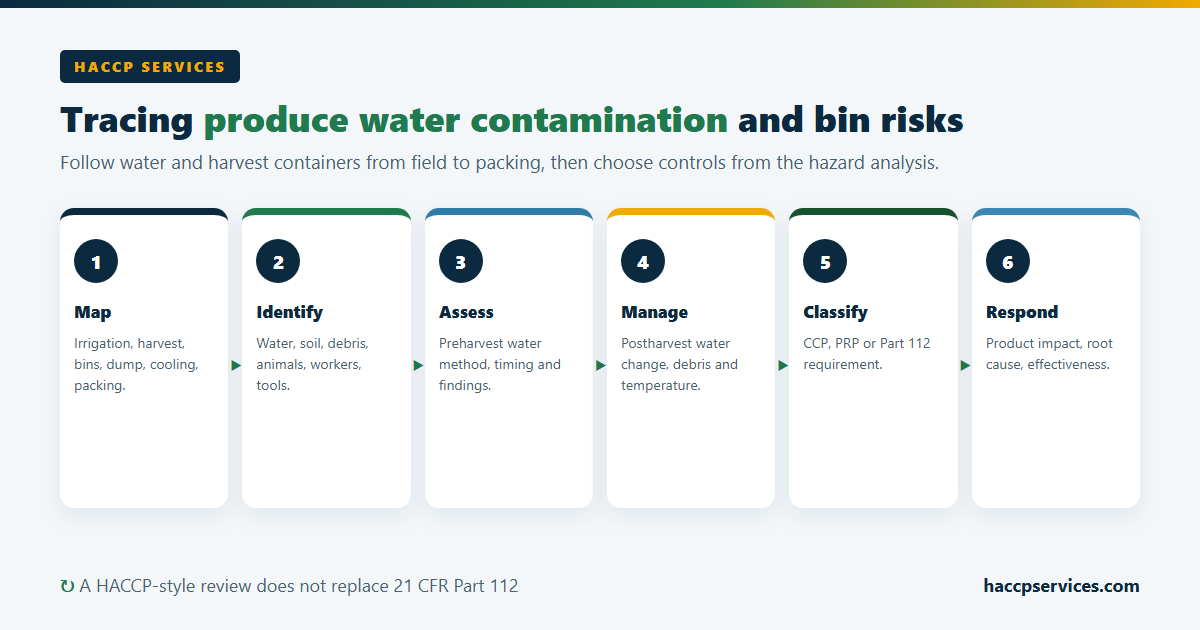
Document irrigation, harvest, bin transport, dumping, postharvest water contact, cooling and packing. Then walk the flow to confirm it matches what crews actually do. Mark every point where water, soil or bins touch the crop. Our guide to process flow diagram verification explains how to check the map on site.
2. Identify biological and physical contamination pathways
Evaluate how contaminated water, soil, debris, animals, equipment and workers could introduce hazards into covered produce. Harvest bins deserve special attention. They move between field, transport and packing, so they can carry soil and plant material from one area to the next. Part 112 also requires food contact surfaces of equipment and tools to be inspected, maintained and cleaned, and sanitized when necessary and appropriate (21 CFR 112.123(d)). The HACCP hazard analysis principle shows how to rank each pathway.
3. Assess preharvest agricultural water exposure
Review the irrigation method, direct contact with the crop, timing before harvest, environmental conditions and assessment findings. For covered produce other than sprouts, 21 CFR 112.43 requires a written agricultural water assessment, prepared at least once annually, for water applied by a direct application method, unless an exemption applies. The assessment considers the water system, application practices, crop characteristics and environmental conditions.
4. Control postharvest water and recirculation
Evaluate water condition, contamination routes, monitoring, cleaning and action thresholds for your actual process. Under 21 CFR 112.44, water that directly contacts covered produce during or after harvest must have no detectable generic E. coli in 100 mL. In addition, untreated surface water must not be used for these purposes. The same section requires water change schedules for recirculated or reused water and visual monitoring for buildup of soil and plant debris.
5. Select control measures based on the hazard analysis
Use scientifically supported measures, and define who monitors them and how they are verified. Do not automatically label water or bin controls as CCPs. Many are better managed as prerequisite or sanitation programs, or as specific Part 112 requirements. See HACCP critical control points for the decision logic.
6. Respond to deviations with evidence
When a control fails, assess the impact on affected produce first. Next, correct the immediate problem and investigate the root cause. Finally, verify that the corrective action worked, and reassess the hazard analysis after repeat incidents. Our HACCP corrective actions page outlines the steps.
Frequently asked questions
Are all produce farms required to have a HACCP plan?
No. Legal requirements depend on the products and activities. For covered farms, 21 CFR Part 112 sets produce-specific obligations, including agricultural water standards.
Is visible debris the same as proven pathogen contamination?
No. Debris can signal a hygiene risk, but it does not prove that pathogens are present. It still calls for investigation and cleaning.
Must every water-control step be a CCP?
No. Control classification depends on the hazard analysis and the applicable regulatory or management-system framework.
Produce water and harvest bin checklist
- Map direct water and bin-to-produce contact points.
- Document the hazard rationale and why each control was selected.
- Assign practical monitoring responsibilities and record them.
- Set water change schedules and debris checks for recirculated water.
- Evaluate affected produce whenever a control fails.
- Reassess the hazard analysis after repeat incidents.
How HACCP Services can help
HACCP Services, a service of Consultare Inc. Group, supports produce hazard analysis, process-flow evaluation, agricultural water control review, sanitation procedures, monitoring plans and corrective-action investigations. Service scope and recommendations are tailored to each product and operation.
- Fresh produce packing and handling HACCP plans
- Water, ice and compressed air safety programs
- Sanitation program development
- Corrective action management
Need help with your produce hazard analysis?
Discuss your operation, water sources, harvest practices and documentation with our team. You can book a free consultation or contact our team.
Start building your compliance system
If you prefer to organize and manage your compliance activities yourself, you can also create a free SystemsBuilder account. Then begin building a structured system for your compliance documentation and processes.
Technical sources: 21 CFR Part 112 (Produce Safety), including 112.43, 112.44 and 112.123, and FDA FSMA Final Rule on Produce Safety. This article is educational; HACCP Services is not affiliated with FDA, and specific requirements depend on your products, activities and applicable regulations.