
HACCP system reviews and FDA registration renewal can share one project meeting, but each obligation should be evaluated on its own. Many food manufacturers already hold a regular food safety review. Adding the 2026 renewal to that agenda is practical, because the same people often know the sites, products and records.
However, the two workstreams answer different questions. HACCP documentation focuses on hazards, controls and operational verification. FDA registration, in contrast, concerns covered establishments and the information FDA requires, including the 2026 biennial renewal. This article closes our series with a practical way to run both together without mixing them up.
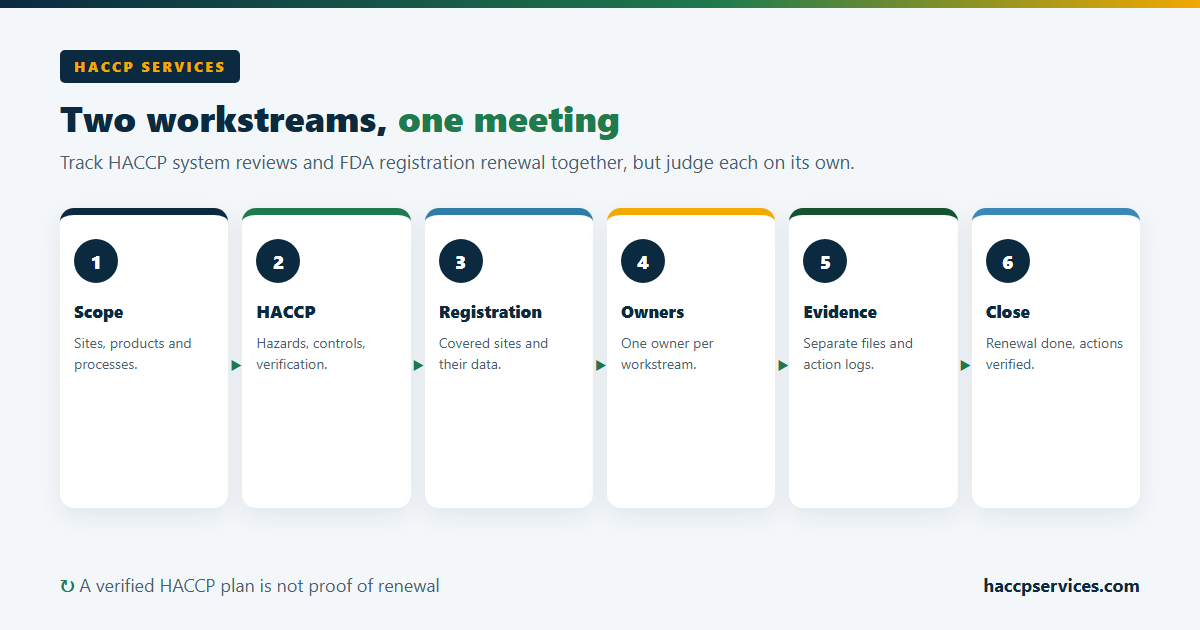
Quick answer: Track both workstreams in one meeting, but give each its own owner, evidence and action log. A completed registration is not evidence that a HACCP plan is adequate. Likewise, a verified HACCP plan is not proof of renewal. Covered facilities must renew by December 31, 2026.
Who this article is for
This guide is written for food safety managers, HACCP team leaders, regulatory contacts and site leadership who coordinate food safety reviews across one or more facilities.
1. Why one meeting works, and where it can go wrong
A combined meeting saves time. The HACCP team already reviews flow diagrams, hazard analyses and records. Those same discussions often reveal site changes, new products or new partners that matter for registration too.
The risk is false comfort. If the meeting notes say “food safety system reviewed”, people may assume renewal is done. Conversely, a renewal confirmation may make people think the HACCP plan is current. Clear separation in the agenda prevents both mistakes. Our article on FDA facility registration versus HACCP responsibilities explains this boundary in more depth.
2. Workstream one: the HACCP system review
The HACCP review checks whether hazards are still identified and controlled. Typical agenda items include:
- Flow diagrams verified against current operations.
- Hazard analysis updated for new products, ingredients or equipment.
- Critical control points, critical limits and monitoring still suitable.
- Corrective actions and deviations reviewed for trends.
- Verification activities, such as record review and calibration, completed.
For facilities covered by 21 CFR Part 117, the food safety plan must be prepared, or its preparation overseen, by a preventive controls qualified individual under 21 CFR 117.126. Our guide to the HACCP plan vs FDA food safety plan explains how these documents relate.
3. Workstream two: FDA registration readiness
The registration workstream checks administrative status, not hazard control. Typical items include:
- Which establishments must register, based on their activities and any exemptions.
- Whether required registration information is still accurate.
- Whether the DUNS number matches each facility address.
- Whether the 2026 renewal was submitted and confirmed for each covered facility.
Under section 415 of the Federal Food, Drug, and Cosmetic Act (21 U.S.C. 350d) and 21 CFR 1.230, covered facilities must renew between October 1 and December 31 of each even-numbered year. An earlier update does not replace the renewal. FDA currently recognizes the DUNS number as an acceptable Unique Facility Identifier and does not charge a renewal fee.
4. Assign owners for both workstreams
Give each workstream a named owner. In many companies, the HACCP team leader owns the technical review. Meanwhile, a regulatory contact owns registration and renewal. Both report into the same meeting, but each signs off only their own area.
Also name a backup for each owner. Renewal windows are short, so a single absence should not stall the work.
5. Keep distinct evidence and action logs
Use two evidence files. The HACCP file holds hazard analyses, monitoring records, corrective actions and verification results. The regulatory file holds applicability conclusions, registration records and renewal confirmations.
Similarly, keep two action logs, or one log with a clear workstream column. Each action needs an owner, a due date and evidence of closure. Good HACCP document control makes this easy to maintain.
6. Close both workstreams before December 31, 2026
Before the year ends, confirm that each covered facility has completed its 2026 renewal. In parallel, confirm that open HACCP actions are closed or tracked with realistic dates. The two closures are separate decisions, so record them separately.
Afterwards, schedule the next review. A HACCP management review cycle can carry the registration check forward to the next renewal period.
A sample meeting agenda
- Changes since the last meeting: sites, products, processes and partners.
- HACCP workstream: hazard analysis updates, deviations, verification results.
- Registration workstream: applicability, information accuracy, renewal status.
- Open actions for each workstream, with owners and due dates.
- Decisions and sign-offs, recorded separately for each workstream.
Common mistakes
- Recording one combined sign-off for both workstreams.
- Treating a completed renewal as evidence that the HACCP plan is adequate.
- Treating a verified HACCP plan as proof of renewal.
- Leaving renewal to the last days of December.
- Storing renewal confirmations inside HACCP monitoring files.
Frequently asked questions
Can we review HACCP and registration in the same meeting?
Yes. A shared meeting is practical, but each obligation should be assessed independently, with its own owner and evidence.
Does a completed renewal show that our HACCP plan is adequate?
No. Registration is administrative. HACCP adequacy depends on hazard analysis, controls and verification.
Does a verified HACCP plan prove we renewed?
No. Keep facility-specific renewal evidence in the regulatory file.
HACCP system reviews and renewal checklist
- Review HACCP technical records against current process needs.
- Assess FDA facility registration separately.
- Confirm the 2026 renewal where required, by December 31, 2026.
- Assign an owner and backup for each workstream.
- Retain distinct evidence and action logs.
- Record separate sign-offs for each workstream.
More in this series
- FDA Registration Renewal 2026 for HACCP-Based Food Operations
- FDA Facility Registration Versus HACCP Responsibilities in 2026
- Using a HACCP Site Inventory to Support FDA Registration Review
- FDA Registration Renewal Checks for HACCP Co-Packing Operations
- Farm and Food Manufacturing Activities in FDA Registration Review
- Reviewing FDA Registration After HACCP Product and Process Changes
How HACCP Services can help
HACCP Services, a service of Consultare Inc. Group, supports HACCP program review, hazard analysis, regulatory coordination and food safety documentation, subject to the engagement scope.
- HACCP plan reassessment
- Hazard analysis support
- HACCP management review
- HACCP regulatory compliance audits
Need help coordinating both workstreams?
Discuss your HACCP review, registration status and records with our team before the December 31, 2026 deadline. You can book a free consultation or contact our team.
Start building your compliance system
If you prefer to organize and manage your compliance activities yourself, you can also create a free SystemsBuilder account. Then begin building a structured system for your compliance documentation and processes.
Technical sources: FDA Biennial Registration Renewal User Guide, FDA reminder on biennial renewal requirements, FDA Online Registration of Food Facilities, 21 U.S.C. 350d, 21 CFR Part 1, Subpart H and 21 CFR 117.126. This article is educational and is not legal advice or an official statement of FDA policy; HACCP Services is not affiliated with FDA, and specific requirements depend on your facility, operations and applicable regulations. Verify current requirements through official FDA sources.