
A HACCP site inventory gives your team a reliable starting point for FDA registration review, because it lists where food is actually made, packed, held or sent out for processing. Most food safety systems already hold the raw material: process flow diagrams, site descriptions, supplier lists and facility lists.
However, an inventory is a working tool, not a legal answer. It helps you see each physical establishment clearly. Each site must then be assessed against the registration rules and exemptions. This article explains how to build the inventory, who should own it and what records to keep before the 2026 renewal period closes on December 31, 2026.
Quick answer: Build one inventory row per physical establishment. Record its activities, its operator and any outsourced steps. Then assess registration applicability site by site, and file renewal evidence by facility. A current HACCP plan is not evidence that the 2026 biennial renewal was completed.
Who this article is for
This guide is written for HACCP coordinators, food safety and quality managers, regulatory contacts and operations leaders who need a clear picture of their sites before renewal decisions are made.
1. Why a HACCP site inventory is useful
HACCP work already forces you to describe your operation. You map each process step, verify the flow on the floor and note where product moves between buildings. As a result, your HACCP files usually know more about your real footprint than any single spreadsheet does.
A HACCP site inventory turns that knowledge into a simple list of places. It shows which establishments handle food, what they do and who runs them. A verified process flow diagram is often the best source for this first draft.
2. Start from the documents you already have
Begin by collecting the documents that describe where food is handled. Useful sources include:
- HACCP plans and process flow diagrams for each product or process.
- Site descriptions, floor plans and facility lists.
- Co-packing, storage and distribution agreements.
- Approved supplier and service provider lists.
- Previous registration records and renewal confirmations, where available.
Next, compare these sources with each other. Gaps often appear quickly. For example, an overflow warehouse may appear in a contract but not in any HACCP plan.
3. List every physical establishment
Registration is tied to a facility, not to a brand or a product line. Under 21 CFR 1.227, a facility is any establishment, structure or structures under one ownership at one general physical location that manufactures/processes, packs or holds food. A single building may also house more than one distinct facility if they are under separate ownership.
Therefore, give each physical location its own row. Include the full address, the legal name of the operator and the person responsible for the site. Do not merge two sites just because they share a HACCP plan.
4. Distinguish production, packing, holding and outsourced activities
For each establishment, record what actually happens there. Use plain categories first:
- Production: mixing, cooking, cutting, freezing, packaging and similar steps.
- Packing: placing food into containers, including repacking.
- Warehousing: storage, including cold storage and distribution holding.
- Outsourced: steps done by a co-packer, warehouse or other third party.
Afterwards, compare these descriptions with the definitions in 21 CFR 1.227. The plain labels help people talk about the site. The regulatory definitions, in contrast, are what the applicability assessment must use.
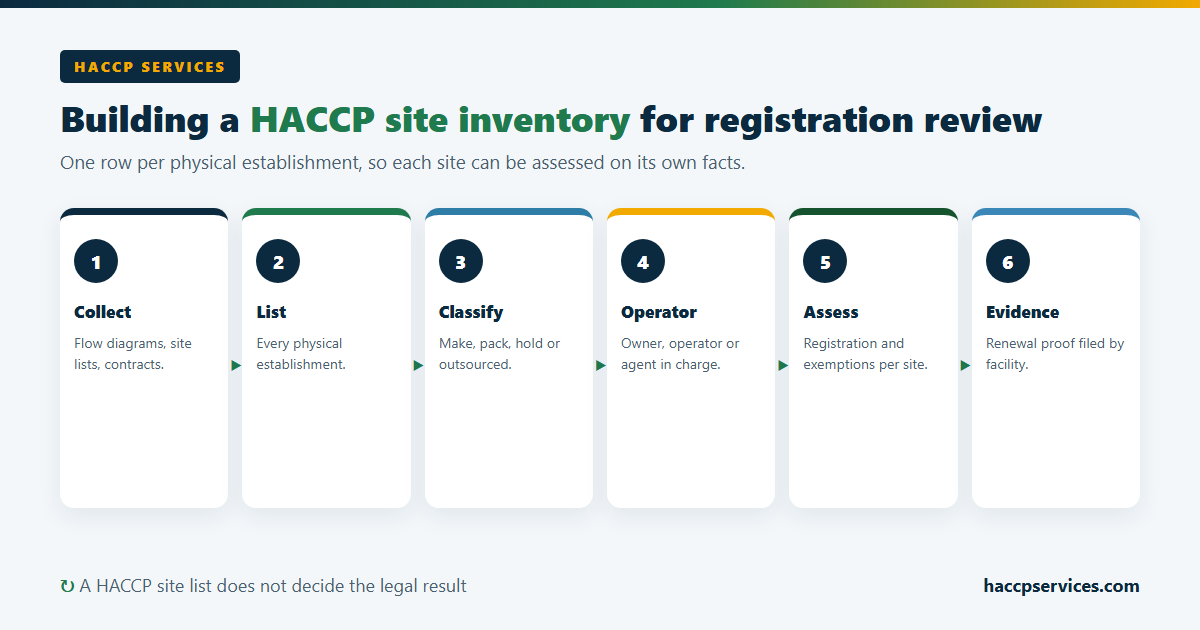
5. Identify the owner, operator or agent in charge
Under 21 CFR 1.225, the owner, operator or agent in charge of a covered facility must register it. Consequently, your inventory should name that party for every site. For outsourced sites, this is usually the co-packer or warehouse operator, not your company.
Record a contact person as well. That person will be asked for renewal confirmation later, so the contact details must stay current.
6. Assess registration applicability site by site
Once the inventory is complete, each establishment can be evaluated against the registration requirements. 21 CFR 1.226 lists facilities that do not have to register, such as farms, retail food establishments and restaurants, as defined in the rule. Applicability and exemptions require facility-specific review.
The inventory supports that review, but it cannot decide the result. A row marked “warehouse” or “farm” is a description, not a legal conclusion. When the answer is unclear, seek a qualified regulatory assessment and record the reasoning.
7. Know the 2026 renewal facts
Under section 415 of the Federal Food, Drug, and Cosmetic Act (21 U.S.C. 350d) and 21 CFR 1.230, facilities required to register must renew between October 1 and December 31 of each even-numbered year. The 2026 deadline is December 31, 2026. An earlier registration update does not replace the renewal.
FDA currently recognizes the DUNS number as an acceptable Unique Facility Identifier, and it charges no renewal fee. So, add the DUNS number to each relevant row and check that it matches the facility address. For the wider renewal picture, see our FDA registration renewal 2026 overview.
Who does what
- HACCP coordinator: drafts the inventory from flow diagrams and site descriptions.
- Operations and procurement: confirm outsourced sites and contracts.
- Regulatory contact: leads the applicability assessment and renewal tracking.
- Site managers: confirm activities, addresses and operator details.
Records to keep
- The dated inventory, with version control and an owner.
- The applicability conclusion and reasoning for each establishment.
- Facility-specific renewal confirmation, where registration applies.
- Evidence of DUNS and address checks.
Good HACCP document control keeps these records findable. Still, file them separately from monitoring and verification records.
Common mistakes
- Listing products or brands instead of physical establishments.
- Leaving out overflow storage, seasonal sites or outsourced steps.
- Treating a current HACCP plan as proof of 2026 renewal.
- Assuming one site’s registration answer applies to every site.
- Letting the inventory go stale after site or contract changes.
If you run several plants, our article on FDA registration renewal across multiple HACCP production sites explains how to collect site-level evidence.
Frequently asked questions
Can a HACCP site inventory decide whether a site must register?
No. The inventory organizes the facts. Each establishment still needs its own assessment against the registration requirements and exemptions.
Does a current HACCP plan show that a facility renewed in 2026?
No. A HACCP plan describes hazard controls. Renewal evidence is a separate, facility-specific record.
Should outsourced sites appear in our inventory?
Yes. List them so that you can request renewal confirmation from the relevant operator where registration applies.
How often should the inventory be updated?
Update it whenever sites, activities or contracts change, and review it before each renewal period.
HACCP site inventory checklist
- Map operating and outsourced food handling sites.
- Record the physical operator and actual activities for each site.
- Seek regulatory assessment of registration applicability.
- Check DUNS and address details for each relevant facility.
- Retain facility-specific renewal evidence where required.
- Review the inventory after every site or contract change.
Related reading
- FDA Registration Renewal 2026 for HACCP-Based Food Operations
- FDA Registration Renewal Across Multiple HACCP Production Sites
- Mapping Food Handling Activities to FDA Registration Requirements
- FDA Registration Renewal Considerations for Food Warehouses
How HACCP Services can help
HACCP Services, a service of Consultare Inc. Group, supports HACCP process mapping, facility scope analysis, food safety documentation and regulatory coordination, subject to the engagement scope.
- Facility and process flow review
- Multi-site HACCP standardization
- HACCP document control
- HACCP regulatory compliance audits
Need help building your site inventory?
Discuss your sites, outsourced activities and records with our team before the December 31, 2026 deadline. You can book a free consultation or contact our team.
Start building your compliance system
If you prefer to organize and manage your compliance activities yourself, you can also create a free SystemsBuilder account. Then begin building a structured system for your compliance documentation and processes.
Technical sources: FDA Biennial Registration Renewal User Guide, FDA reminder on biennial renewal requirements, FDA Online Registration of Food Facilities, 21 U.S.C. 350d and 21 CFR Part 1, Subpart H. This article is educational and is not legal advice or an official statement of FDA policy; HACCP Services is not affiliated with FDA, and specific requirements depend on your facility, operations and applicable regulations. Verify current requirements through official FDA sources.