
In HACCP co-packing operations, the brand owner’s documents and the co-packer’s FDA facility registration answer different questions. The brand owner may hold specifications, a HACCP plan and supplier approval files. The co-packer, however, operates the physical establishment where the food is processed or packed.
That difference matters during the 2026 renewal period. If the co-packing site must register, its renewal is due by December 31, 2026. This article explains how brand owners and co-packers can verify renewal at the right site, while keeping HACCP controls tied to the real process.
Quick answer: Identify the physical co-packing site. Determine whether that facility must register, and request site-specific 2026 renewal evidence where it applies. Keep HACCP technical records and regulatory records in separate files. A co-packer’s food safety certificate does not replace required FDA registration.
Who this article is for
This guide is written for brand owners, co-packers, private label teams, supplier quality managers and HACCP coordinators who share production across businesses.
1. Why brand documents are not registration evidence
A brand owner’s files describe the product and the expected controls. For example, they may include specifications, a HACCP plan or an approved supplier record. None of these shows that the co-packing facility completed its 2026 renewal.
Under 21 CFR 1.225, registration duties sit with the owner, operator or agent in charge of a covered facility. Therefore, the question is about the co-packer’s establishment, not about whose name is on the label. Our article on FDA registration responsibilities in contract food manufacturing covers this principle in more detail.
2. Identify the actual co-packing site
Start with the exact address where your product is made or packed. A co-packer may run several plants, so a company name is not enough. Ask which plant runs each product, and record it.
Also note any further sites in the chain. For instance, the co-packer may send finished goods to a separate warehouse. Each of these establishments may need its own review.
3. Determine whether that facility must register
Registration applicability depends on the activities at the site and any exemptions in 21 CFR 1.226. In most cases, the co-packer is best placed to assess its own status. Even so, the brand owner should understand the conclusion and keep a record of it.
When status is unclear, ask for the co-packer’s reasoning. If needed, seek a qualified regulatory assessment rather than assuming the answer.
4. Request current, site-specific renewal evidence
Under section 415 of the Federal Food, Drug, and Cosmetic Act (21 U.S.C. 350d) and 21 CFR 1.230, covered facilities must renew between October 1 and December 31 of each even-numbered year. The 2026 deadline is December 31, 2026. A prior registration update does not replace the renewal.
So, ask the co-packer for confirmation that the named site completed its 2026 renewal. A general letter covering “all our plants” is weaker evidence than a facility-specific confirmation. FDA charges no fee for renewal, so cost should not delay it.
5. Check that the identifying details match
FDA currently recognizes the DUNS number as an acceptable Unique Facility Identifier. FDA uses it to verify the facility address. Therefore, check that the site name, address and DUNS number in the co-packer’s evidence match your approved supplier record.
Small mismatches matter. A different address may mean your product runs at a plant you have not reviewed.
6. Keep HACCP controls tied to the real process
Registration is administrative. Hazard control, in contrast, depends on the actual product and process at the co-packing site. HACCP plans and hazard controls should continue to address that real process, including any differences from your own plants.
For example, confirm that the hazard analysis covers the co-packer’s equipment, allergen practices and packaging steps. A structured supplier HACCP evaluation helps here.
Certification is not registration
Many co-packers hold food safety certificates from third-party schemes. These can be useful evidence of a working food safety system. However, a certificate is not FDA registration, and it does not show that the 2026 renewal was completed. Keep both records, and do not let one stand in for the other.
An example workflow
- Supplier quality lists every co-packed product and its production site.
- The co-packer confirms registration applicability for each site.
- Supplier quality requests 2026 renewal confirmation for each covered site.
- The HACCP team reviews the co-packer’s hazard controls for each product.
- The regulatory contact files renewal evidence apart from HACCP records.
- Any gaps go into a tracked action log with an owner and due date.
Records to keep
- The co-packing site address, operator and contact person.
- The co-packer’s registration applicability conclusion.
- Site-specific 2026 renewal confirmation, where applicable.
- HACCP review records, kept in the technical file.
Common mistakes
- Accepting a company-wide statement instead of site-specific evidence.
- Treating a third-party certificate as proof of registration.
- Reviewing the head office address instead of the production plant.
- Mixing renewal evidence into HACCP monitoring files.
Frequently asked questions
Does the brand owner renew the co-packer’s registration?
Not automatically. Registration is tied to the facility and its owner, operator or agent in charge. In a typical co-packing arrangement, that is the co-packer.
Is a co-packer’s food safety certificate enough?
No. A certificate does not substitute for required FDA registration or show that the 2026 renewal was completed.
What evidence should we request?
Request facility-specific confirmation of the 2026 renewal for the named site, and check that its details match your supplier records.
HACCP co-packing operations checklist
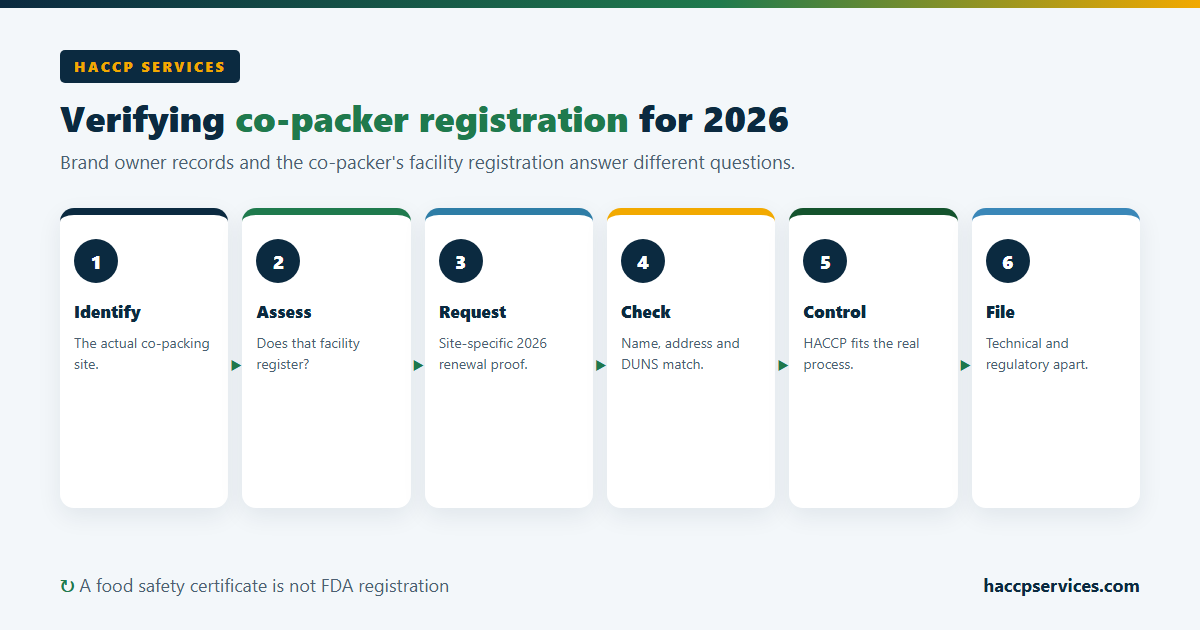
- Identify the co-packer and the actual production facility.
- Assess facility registration applicability.
- Request current, site-specific renewal evidence.
- Check name, address and DUNS details against supplier records.
- Confirm HACCP controls address the real process.
- Maintain separate HACCP technical and regulatory records.
Related reading
- FDA Registration Renewal 2026 for HACCP-Based Food Operations
- FDA Registration Responsibilities in Contract Food Manufacturing
- Separating Food Facility Roles From HACCP Process Responsibilities
- HACCP Records and FDA Registration: What They Can and Cannot Prove
How HACCP Services can help
HACCP Services, a service of Consultare Inc. Group, supports co-packer HACCP review, hazard analysis, facility document verification and regulatory compliance coordination, subject to the engagement scope.
- HACCP supplier program evaluation
- Hazard analysis support
- HACCP regulatory compliance audits
- HACCP document control
Need help verifying your co-packers?
Discuss your co-packing sites, records and HACCP reviews with our team before the December 31, 2026 deadline. You can book a free consultation or contact our team.
Start building your compliance system
If you prefer to organize and manage your compliance activities yourself, you can also create a free SystemsBuilder account. Then begin building a structured system for your compliance documentation and processes.
Technical sources: FDA Biennial Registration Renewal User Guide, FDA reminder on biennial renewal requirements, FDA Online Registration of Food Facilities, 21 U.S.C. 350d and 21 CFR Part 1, Subpart H. This article is educational and is not legal advice or an official statement of FDA policy; HACCP Services is not affiliated with FDA, and specific requirements depend on your facility, operations and applicable regulations. Verify current requirements through official FDA sources.