
Mapping food handling activities site by site gives you a clear basis for FDA registration review. Food businesses may run processing rooms, warehouses, distribution centers and shared facilities. HACCP documentation often describes these activities. However, the need for FDA registration is decided under separate legal criteria.
A facility scope map links each physical site to its manufacturing, packing or holding functions. As a result, applicability and exemptions can be reviewed without assuming that every location needs its own registration.
Quick answer: List the physical locations in your product flow, describe what each one does, refer applicability and exemption questions for regulatory review, and request facility-specific 2026 renewal evidence where required. The renewal window closes December 31, 2026.
Who this article is for
This guide is written for HACCP teams, operations managers and regulatory coordinators in multi-room, multi-building or shared-facility food businesses.
1. List the physical locations in the product flow
Start from receiving and follow product through storage, processing, packing and shipping. Note every building and address involved. Our guide to process flow diagram verification shows how to confirm the flow on the floor.
2. Describe each location’s functions
Record whether each site manufactures/processes, packs or holds food. These terms are defined in 21 CFR 1.227. For example, holding means storage of food, including activities incidental to storage. The same section defines a facility as an establishment or structures under one ownership at one general physical location.
3. Link HACCP process steps to sites
Your HACCP flow already lists steps and hazards. Next, tag each step with the site where it happens. This keeps the hazard analysis and the facility map consistent. Still, the HACCP plan describes controls; it does not decide registration.
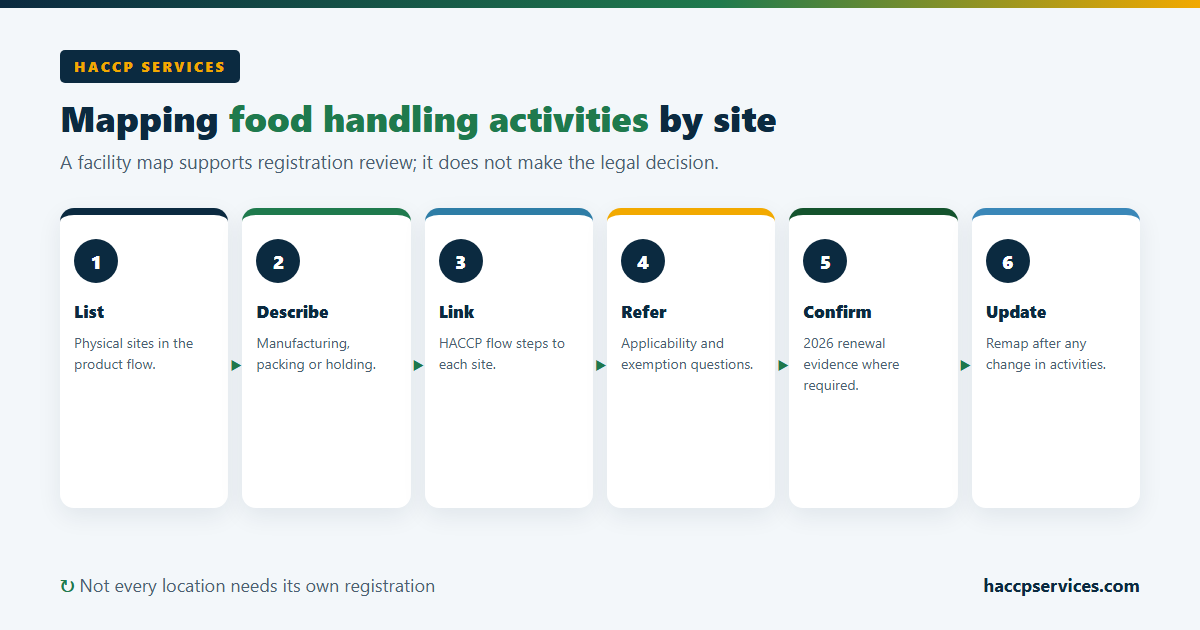
4. Refer applicability and exemption questions
21 CFR 1.225 sets out who must register, and 21 CFR 1.226 lists exemptions. Applicability and exemptions require a facility-specific assessment. Therefore, send open questions to a qualified regulatory reviewer rather than guessing from the map.
5. Understand the 2026 renewal context
Under section 415 of the Federal Food, Drug, and Cosmetic Act (21 U.S.C. 350d) and 21 CFR 1.230, facilities required to register renew from October 1 through December 31 of each even-numbered year. For 2026, the deadline is December 31. Updating a registration earlier in the year is not the same as renewing it. FDA currently recognizes DUNS as an acceptable Unique Facility Identifier, and renewal is free.
6. Request renewal evidence and keep the map current
Request facility-specific 2026 renewal evidence as appropriate. Then file it apart from HACCP records, in line with good HACCP document control. Finally, update the map whenever a site’s activities change.
Frequently asked questions
Does every location in the product flow need its own registration?
Not necessarily. Applicability and exemptions depend on each site’s activities and require a facility-specific assessment.
Does a facility map prove registration status?
No. A map supports the review. The legal determination and renewal evidence are separate.
Is an update earlier in 2026 enough?
No. An earlier update is not the biennial renewal, which runs from October 1 to December 31, 2026.
Facility scope mapping checklist
- List the physical locations involved in the product flow.
- Describe each location’s manufacturing, packing or holding functions.
- Refer applicability and exemption questions for regulatory review.
- Request facility-specific 2026 renewal evidence as appropriate.
Related reading
- FDA Registration Renewal 2026 for HACCP-Based Food Operations
- Facility Changes That May Trigger FDA Registration Review
- HACCP Records and FDA Registration: What They Can and Cannot Prove
- FDA Registration Renewal Considerations for Food Warehouses
How HACCP Services can help
HACCP Services, a service of Consultare Inc. Group, supports HACCP process mapping, hazard analysis, facility scope review and regulatory record coordination, subject to the engagement scope.
- HACCP facility and process flow optimization
- HACCP plan development
- HACCP recordkeeping system setup
- HACCP regulatory compliance audits
Need help mapping your facility scope?
Discuss your sites, activities and records with our team. You can book a free consultation or contact our team.
Start building your compliance system
If you prefer to organize and manage your compliance activities yourself, you can also create a free SystemsBuilder account. Then begin building a structured system for your compliance documentation and processes.
Technical sources: 21 U.S.C. 350d, 21 CFR Part 1, Subpart H (Registration of Food Facilities), the FDA Food Facility Registration User Guide: Biennial Registration Renewal, FDA Reminds Food Facilities of Biennial Renewal Requirements and FDA Online Registration of Food Facilities. This article is educational and is not legal advice; HACCP Services is not affiliated with FDA, and specific requirements depend on your facilities, activities and applicable regulations.