
HACCP storage controls, such as pest control, temperature control and traceability, protect food in a warehouse, but they do not decide its FDA registration status. A site can run excellent storage controls without processing any food. Its registration status, however, depends on its holding activities, ownership, location and any applicable exemptions.
This article separates the two questions for food holding operations during the 2026 biennial renewal period. It is part of our FDA registration renewal 2026 series.
Quick answer: Review your holding activities under the FDA registration rules. If registration applies, renew between October 1 and December 31, 2026. Then evaluate storage hazards and controls separately, based on the specific activity and the rules that apply to it.
Who this article is for
This guide is written for warehouse and distribution center managers, cold storage operators, HACCP coordinators, PCQIs and regulatory contacts at food holding sites.
1. Understand what “holding” means
Under 21 CFR 1.227, holding means storage of food. It also includes activities performed incidental to storage, such as fumigating food during storage. In addition, it includes activities done as a practical necessity for distribution, such as breaking down pallets. Holding does not include transforming a raw agricultural commodity into a processed food.
This matters because the activity, not the building type, drives the analysis. A “warehouse” that also relabels or repacks food may perform more than holding.
2. Assess registration applicability and exemptions
Under 21 CFR 1.225, facilities that manufacture/process, pack or hold food for U.S. consumption must register, unless an exemption in 21 CFR 1.226 applies. Exemptions include farms, retail food establishments and restaurants, among others. Registration also records activity types, including ambient, refrigerated and frozen human food warehouse/holding facility.
So, identify the physical holding location and the legal operator first. Then assess applicability for that facility. Our article on food warehouse FDA registration covers the renewal side for storage sites in more depth.
3. Evaluate storage hazards on their own merits
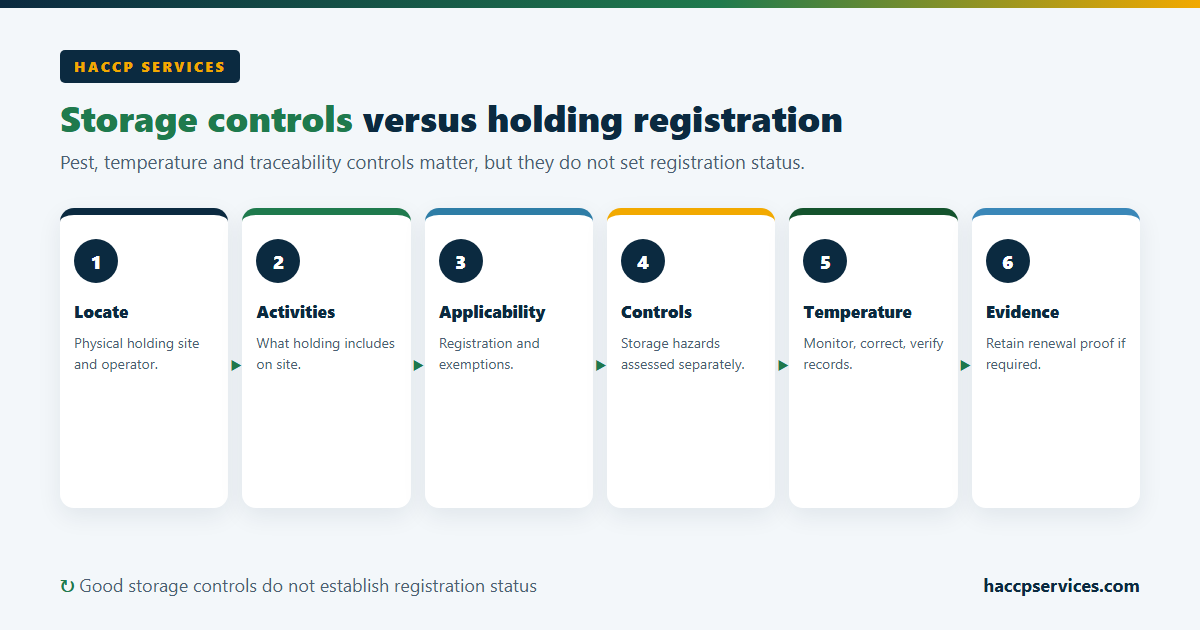
Storage hazards are real. They include temperature abuse, pest activity, damaged packaging, cross-contact and loss of traceability. However, the controls you need depend on the activity and the applicable rule, not on registration status.
For example, Part 117 gives special treatment to storage-only sites. Under 21 CFR 117.7, the hazard analysis and preventive controls requirements do not apply to a facility solely engaged in the storage of unexposed packaged food. Instead, if that food needs time/temperature control for safety, modified requirements in 21 CFR 117.206 apply.
4. Build sound temperature controls
For refrigerated packaged food that needs time/temperature control, 21 CFR 117.206 requires the facility to:
- Establish and implement adequate temperature controls.
- Monitor them often enough to show they are consistently performed.
- Take corrective action after a loss of temperature control that may affect safety. That means correcting the problem, evaluating affected food and keeping unsafe food out of commerce.
- Verify the controls, including calibration and review of monitoring and corrective action records.
These steps mirror HACCP principles. Our pages on HACCP monitoring procedures and corrective actions explain the method in more detail.
5. Keep registration evidence separate
For facilities required to register, renewal runs from October 1 to December 31 of each even-numbered year, under 21 CFR 1.230. The 2026 deadline is December 31, 2026. An earlier update does not replace renewal. FDA charges no renewal fee and currently accepts the DUNS number as the Unique Facility Identifier. File the renewal confirmation in a regulatory file, apart from temperature logs and pest control records.
Example workflow for a holding site
- The site manager lists the site address, operator and every activity performed.
- The regulatory contact assesses registration applicability and exemptions.
- The food safety lead identifies storage hazards for the food actually held.
- The team sets, monitors and verifies storage controls, such as temperature and pest control.
- The regulatory contact confirms the 2026 renewal where registration applies.
- Both sets of evidence are filed separately and reviewed on schedule.
Common mistakes to avoid
- Assuming a site needs no registration because it does not process food.
- Assuming the manufacturing plant’s HACCP plan covers an off-site warehouse.
- Overlooking incidental activities, such as relabeling, that change the analysis.
- Logging temperatures without reviewing records or acting on deviations.
Frequently asked questions
Do strong storage controls prove a warehouse is registered?
No. Storage controls address food safety hazards. Registration status depends on the facility’s activities, ownership, location and exemptions.
Does Part 117 require a full food safety plan for a storage-only site?
Not for a facility solely engaged in storing unexposed packaged food. However, 21 CFR 117.206 sets modified temperature control requirements where such food needs time/temperature control.
Does an earlier registration update count as the 2026 renewal?
No. Covered facilities must renew between October 1 and December 31, 2026.
HACCP storage controls checklist
- Identify the physical holding location and operator.
- List every holding and incidental activity performed.
- Assess registration applicability and exemptions.
- Review storage food safety controls independently.
- Monitor, correct and verify temperature controls where required.
- Retain renewal evidence if registration applies.
How HACCP Services can help
HACCP Services, a service of Consultare Inc. Group, supports HACCP and hazard review, storage operation assessment, facility mapping and regulatory document coordination, subject to the engagement scope.
- Cold storage and distribution HACCP plans
- Traceability and recall program development
- Calibration and measurement control
- HACCP regulatory compliance audits
Need help reviewing your storage operations?
Discuss food safety management, regulatory records and compliance coordination for your holding sites with our team. You can book a free consultation or contact our team.
Start building your compliance system
If you prefer to organize and manage your compliance activities yourself, you can also create a free SystemsBuilder account. Then begin building a structured system for your compliance documentation and processes.
Technical sources: FDA Food Facility Registration User Guide: Biennial Registration Renewal, FDA reminder on biennial renewal requirements, FDA Online Registration of Food Facilities, 21 U.S.C. 350d, 21 CFR Part 1, Subpart H and 21 CFR Part 117. This article is educational and is not legal advice; HACCP Services is not affiliated with FDA, and specific requirements depend on your facility, operations and applicable regulations. Verify current requirements through official FDA sources.