
Sanitary design is the physical foundation that a HACCP program stands on. When surfaces are hard to clean, water collects or people and materials cross paths, even a well-written plan becomes difficult to follow. As a result, sanitation crews re-clean the same spots, findings repeat and audit discussions get harder.
This article explains how facility and equipment design creates hazards, where those issues belong in your HACCP system and how to run a practical improvement review. It is written for HACCP teams, food processors, sanitation leads and maintenance supervisors.
Quick answer
Sanitary design means building, installing and maintaining the plant and equipment so they can be cleaned, inspected and kept in repair. It supports your prerequisite programs and feeds your hazard analysis. However, a design weakness is not automatically a critical control point (CCP). Instead, assess each issue in context, choose a proportionate fix and verify that it worked.
What good sanitary design looks like
Good design is not about buying the most expensive equipment. Rather, it is about conditions that make contamination less likely and cleaning more reliable. In practice, look for:
- Suitable surfaces. Smooth, durable materials that cleaning can reach and that staff can inspect.
- Hygienic equipment installation. Equipment set up and maintained to limit food residue, moisture build-up and hard-to-clean areas.
- Sensible layout and flow. Movement of people and materials that limits unnecessary cross-contact and cross-contamination.
- Moisture control. Drainage, condensation controls and maintenance practices that fit the product and process.
U.S. rules reflect the same ideas. For example, 21 CFR 117.20 requires a plant suitable in size, construction and design to facilitate maintenance and sanitary operations. Likewise, 21 CFR 117.40 requires equipment to be adequately cleanable and installed so it and adjacent spaces can be cleaned and maintained.
How design weaknesses create hazards
Design problems rarely cause harm directly. Instead, they make contamination more likely or controls less reliable. Typical routes include:
- Biological hazards. Residue and moisture in seams, hollow frames or dead spaces can support microbial growth that cleaning does not reach.
- Allergen cross-contact. Product can hide in areas that are hard to strip down during changeovers.
- Physical hazards. Worn parts, loose fittings and makeshift repairs can shed fragments into product.
- Chemical hazards. Poor access can lead to chemical residues or lubricant contact where product is exposed.
Where sanitary design fits in HACCP
HACCP rests on the Codex General Principles of Food Hygiene (CXC 1-1969), which place good hygiene practices underneath the HACCP plan. In the United States, mandatory HACCP applies to juice (21 CFR Part 120), seafood (Part 123) and USDA-inspected meat and poultry (9 CFR Part 417). Most other FDA-registered facilities follow 21 CFR Part 117 instead, where a written hazard analysis leads to risk-based preventive controls.
Either way, design matters. Under 21 CFR 117.130, the hazard evaluation must consider “the condition, function, and design of the facility and equipment.” So, when you walk the process for a HACCP hazard analysis, record design conditions as inputs. Most issues will then be managed through prerequisite programs such as sanitation, maintenance and zoning. Only some will need a preventive control or a CCP. Our HACCP prerequisite checklist shows how these foundations support CCPs.
A practical sanitary design improvement process
The following four-step cycle keeps the review practical and accountable.
1. Observe
Walk the process with sanitation, maintenance, operations and food safety staff. Record actual conditions, not what drawings show. Also note which products and process steps each condition affects. A verified process flow diagram makes this walk much easier.
2. Assess
Next, judge how significant each condition is. Consider product exposure, the cleaning method, product risk and evidence from monitoring and verification. For instance, a rough weld on a guard rail far from exposed product carries less risk than the same weld on a ready-to-eat slicer.
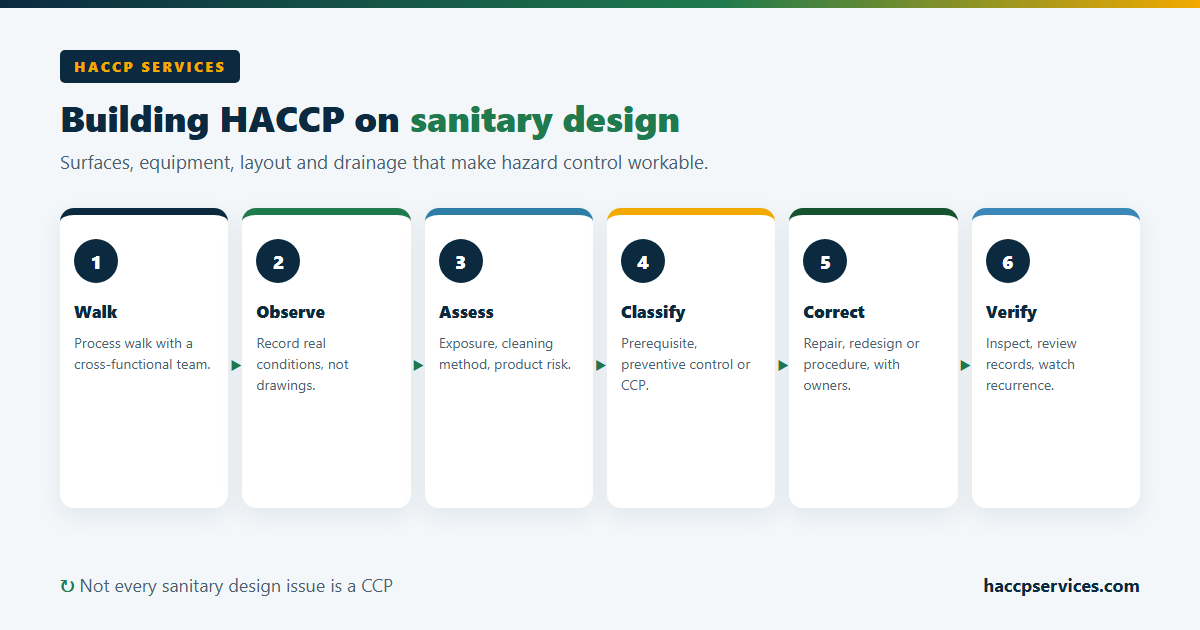
3. Correct
Then choose a fix that matches the risk. Options include repair, redesign, a procedural control or further evaluation. Assign an owner and a target date to each action.
4. Verify
Finally, confirm that the action was completed. Use inspection, records and suitable sanitation verification. After that, watch whether the condition comes back. Our article on HACCP sanitation verification covers this step in more detail.
Records to keep
- Walk-through notes with dates, locations, photos and affected products.
- Risk assessment for each finding, including the reasoning behind the classification.
- An improvement register with owners, due dates and status.
- Work orders, repair records and post-repair cleaning or inspection sign-offs.
- Verification evidence, such as inspection results and trend reviews.
Example scenario
Consider a hypothetical plant packing cooked, ready-to-eat products. During a walk-through, the team finds a hollow tubular frame under the packing table with an open end cap. Inside, there is residue and moisture. The frame sits above exposed product.
The team first records the condition and links it to the packing step. Next, they assess it as a potential harborage for environmental pathogens. Because the product receives no further lethal treatment, the finding is significant. However, the team does not call it a CCP. Instead, maintenance seals the frame and the sanitation schedule adds a focused check. Finally, the hazard analysis notes the condition and the sanitation controls that address it, and follow-up inspections confirm the fix holds.
Frequently asked questions
Is every sanitary design issue a critical control point?
No. Most design issues are managed through prerequisite programs or, under Part 117, sanitation and other preventive controls. Classify each issue based on its actual risk in your process.
Does good sanitary design replace cleaning and sanitation?
No. Good design makes cleaning more effective and easier to verify. You still need written sanitation procedures, monitoring and records.
Who should take part in a sanitary design review?
Include food safety, sanitation, maintenance and operations staff. Each group sees different conditions, and each owns part of the fix.
Sanitary design checklist
- Walk the actual process with a cross-functional team.
- Record surfaces, equipment, layout and moisture conditions as found.
- Assess each sanitary design finding against product exposure and risk.
- Decide whether it belongs to a prerequisite program, a preventive control or a CCP.
- Assign owners and dates for every corrective action.
- Verify completion and track whether conditions recur.
How HACCP Services can help
HACCP Services, a service of Consultare Inc. Group, helps HACCP teams review prerequisite programs, organize hazard analysis inputs and keep practical improvement registers, subject to the engagement scope. We advise and support implementation. Facility management approves and carries out changes, and we do not promise certification, regulatory approval or a particular audit outcome.
- Prerequisite programs (PRP) gap assessment
- Sanitation program development
- Cross-contamination and hygienic zoning assessment
- Facility and process flow optimization
Need help with sanitary design in your HACCP program?
Discuss your facility, equipment, records and risks with our team. You can book a free consultation or contact our team.
Start building your compliance system
If you prefer to organize and manage your compliance activities yourself, you can also create a free SystemsBuilder account. Then begin building a structured system for your compliance documentation and processes.
Technical sources: Codex Alimentarius General Principles of Food Hygiene (CXC 1-1969), 21 CFR 117.20 (plant and grounds), 21 CFR 117.40 (equipment and utensils) and 21 CFR 117.130 (hazard analysis). This article is educational and is not legal advice; HACCP Services is not affiliated with FDA, and specific requirements depend on your products, processes and applicable regulations.