
HACCP sanitation verification answers one question: was the equipment actually ready for safe production? A signed cleaning form may not answer it. When verification is weak, sanitation failures can turn into costly deviations or recurring audit findings.
For businesses preparing to supply Walmart, credible sanitation records support supplier confidence. However, applicable requirements depend on the product, the facility, the commercial relationship and current law. Confirm them directly with the relevant Walmart contact before treating any practice below as a mandatory Walmart rule.
Quick answer
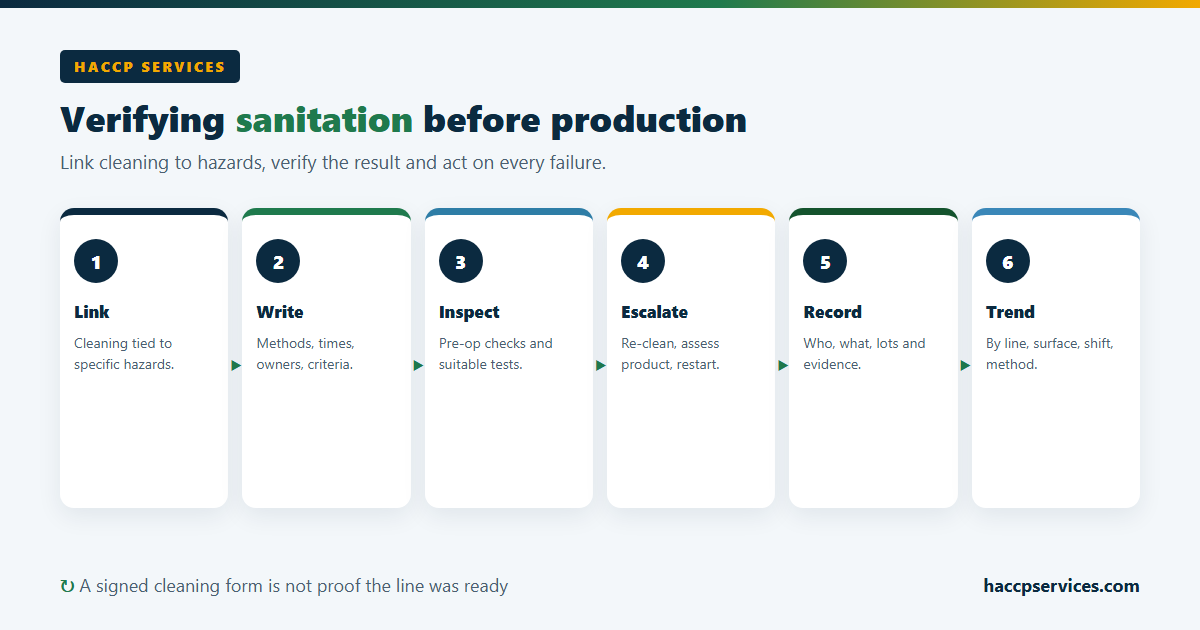
Link each cleaning task to the hazard it controls. Then write clear procedures, verify results with methods suited to the risk, and escalate every failure with a product assessment. Finally, trend repeat problems so you fix causes, not symptoms. Good sanitation evidence supports readiness, but it does not guarantee acceptance as a Walmart supplier.
Who this article is for
This guide is for sanitation managers, HACCP coordinators, quality teams and plant leaders who sign off lines before production.
1. Connect sanitation to the hazard analysis
Identify whether cleaning controls relevant biological, allergen or other hazards on specific equipment, rooms and production steps. Then document the difference between routine GMP cleaning and any sanitation preventive control your food safety plan requires. Under 21 CFR 117.135(c)(3), sanitation controls cover the cleanliness of food-contact surfaces and the prevention of allergen cross-contact and cross-contamination. For background, see HACCP and sanitation prerequisite programs.
2. Write clear sanitation procedures
Define the equipment, methods, chemical concentrations where relevant, contact times, frequencies, responsible staff and acceptance criteria. Make sure every shift can follow the procedure safely and consistently. This includes restarts after maintenance or unexpected interruptions, when steps are most often skipped.
3. Verify more than completion of a checklist
Use pre-operational inspections, record review and visual checks. Add ATP or microbiological methods when they suit the identified risk. Keep in mind that a visual pass or ATP reading does not automatically show the absence of a specific pathogen or allergen. Where Part 117 applies, 21 CFR 117.165 lists verification activities such as environmental monitoring and record review. Our guide to HACCP monitoring records and verification review explains how to review records well.
4. Escalate failures and assess product
Define what happens when a check fails: re-cleaning, investigation, disposition of potentially affected product and verification before restart. Under 21 CFR 117.150, corrective action procedures must address the problem, reduce recurrence and evaluate all affected food. See HACCP corrective actions for the principle.
5. Record what happened and what was done
Retain who observed the problem, the actions taken, the relevant lots and the evidence that the sanitation control was restored. Clear records make it easier to explain decisions during audits and customer reviews.
6. Review recurring trends
Evaluate repeated failures by line, surface, shift and procedure. Then target training, equipment or method improvements where the pattern points. Use findings to strengthen your HACCP or preventive controls documentation. Also, check applicable retailer expectations separately. For the wider picture, read our article on Walmart supplier HACCP verification.
Frequently asked questions
Is a completed cleaning checklist enough?
No. A checklist shows that a task was signed off. Verification shows that the equipment met the acceptance criteria before production.
Does an ATP pass prove there is no pathogen or allergen?
No. ATP detects organic residue in general. It does not confirm the absence of a specific pathogen or allergen.
Does strong sanitation verification guarantee acceptance as a Walmart supplier?
No. It supports readiness, but supplier approval rests with Walmart. In addition, “HACCP certification” is not a single legal certificate; it usually refers to a third-party audit.
Supplier readiness checklist
- Connect sanitation to the hazard analysis.
- Write clear sanitation procedures.
- Verify more than completion of a checklist.
- Escalate failures and assess product.
- Record what happened and what was done.
- Review recurring trends.
- Confirm the applicable Walmart supplier program and all relevant product and facility requirements.
- Assign owners for documentation, follow-up actions and periodic review.
How HACCP Services can help
HACCP Services, a service of Consultare Inc. Group, can assess sanitation procedures, identify critical verification gaps, help improve record design and support action plans for consistent implementation, subject to the engagement scope.
- HACCP sanitation program development
- Pre-operational inspection program development
- Environmental monitoring program design
- Corrective action management
Is sanitation truly verified before production starts?
Review your sanitation procedures, verification records and corrective action workflow with our team. You can book a free consultation or contact our team.
Start building your compliance system
If you prefer to organize and manage your compliance activities yourself, you can also create a free SystemsBuilder account. Then begin building a structured system for your compliance documentation and processes.
Technical sources: Codex Alimentarius (General Principles of Food Hygiene, CXC 1-1969), FDA FSMA Final Rule for Preventive Controls for Human Food, 21 CFR Part 117 and Walmart supplier requirements. This article is independent educational content, not legal advice. HACCP Services is not affiliated with or endorsed by Walmart Inc. or FDA. Walmart-specific supplier requirements must be confirmed directly with the relevant Walmart contact. Regulatory applicability depends on the product, facility, activity and current law.