
A strong CCP deviation response turns a missed critical limit into a controlled, documented product decision instead of an improvised one. A deviation can change an ordinary shift into an urgent problem. Clear roles and traceable actions help teams respond the same way every time, even under pressure.
For suppliers serving large retail customers, the stakes include product that may already be in distribution. This article looks at deviation response from that angle: holding and evaluating lots, investigating the cause and deciding when a customer must be told. Walmart supplier requirements can differ by product, facility and commercial relationship. Therefore, confirm them directly with the relevant Walmart contact before treating any practice here as a Walmart rule.
Quick answer
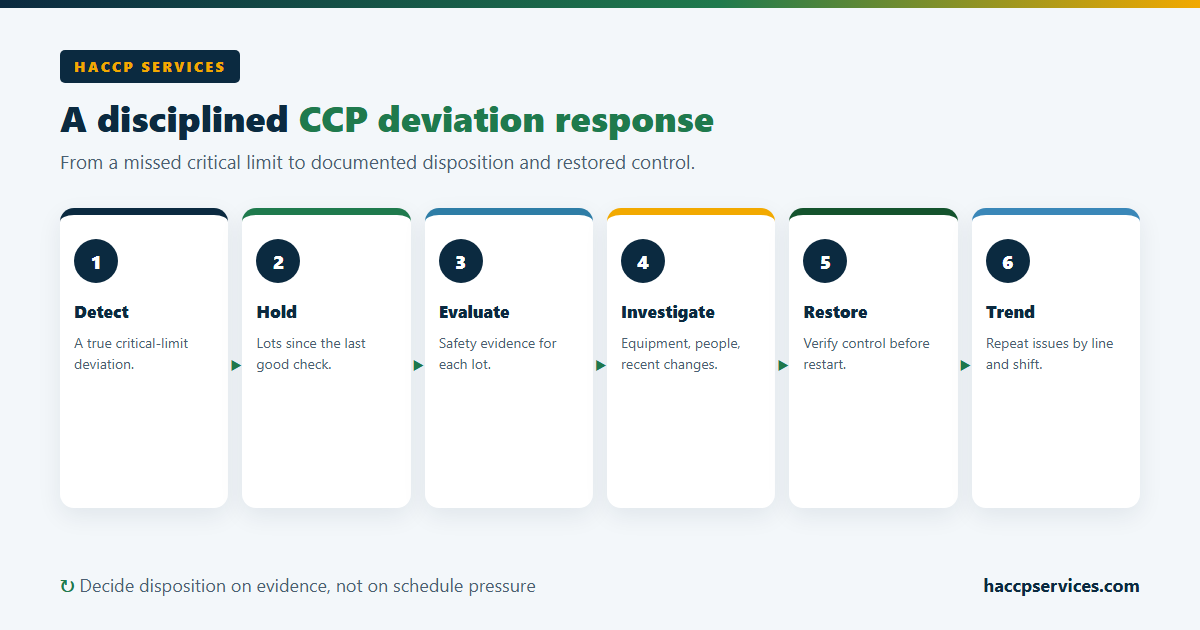
Define exactly what counts as a critical-limit deviation. Then hold every lot produced since the last satisfactory check, evaluate its safety with documented evidence and investigate the cause. Verify that control is restored before normal production resumes. Finally, decide in advance who escalates and who contacts customers when affected product may have shipped.
Who this article is for
This guide is for HACCP teams, PCQIs, production supervisors and quality managers at plants supplying retail customers. For the general method of handling deviations and disposition, see our article on HACCP deviation handling and product disposition.
1. Define deviation triggers precisely
List the monitored parameters, critical limits, responsible operators and required immediate response at each CCP. Employees must know when a result is a true critical-limit deviation rather than ordinary process variation. In addition, state who has authority to stop the line and place product on hold.
2. Control potentially affected product
Identify the time period and lots since the last satisfactory check. Next, segregate or hold that product, including any already in storage or transit under your control. Evaluate product safety and disposition using competent technical judgment and applicable regulations. For FDA-registered facilities under Part 117, corrective action procedures must ensure that all affected food is evaluated for safety and kept out of commerce when it may be adulterated, under 21 CFR 117.150. Seafood, juice and meat and poultry HACCP rules contain similar duties in 21 CFR 123.7, 21 CFR 120.10 and 9 CFR 417.3.
3. Investigate and correct the cause
Check equipment, calibration, personnel, procedures, supply conditions and recent changes. Then document the immediate correction, root cause, permanent action and responsible owner separately. This separation shows that the team fixed both the product problem and the reason it happened.
4. Decide when customers must be informed
Agree internally on escalation triggers before a deviation happens. For example, define what to do when held lots may have shipped, when a safety evaluation is inconclusive, or when a customer specification may be affected. Customer contracts and supplier programs may set their own notification terms. Therefore, keep them on file and confirm them with the relevant Walmart contact rather than relying on assumptions.
5. Verify control restoration
Review process checks, calibration, repeated monitoring and release evidence before returning to normal operations. Also keep the scientific and procedural basis for any rework or other disposition decision. Corrective action records should be reviewed as part of verification; see HACCP corrective actions for the principle.
6. Trend recurrent CCP problems
Review deviations by line, shift, product and equipment to find underlying failures. As a result, repeat issues lead to lasting fixes rather than repeated holds. Process-related deviations and batch records are covered in our article on HACCP process deviations and batch records.
Frequently asked questions
Which lots are affected by a CCP deviation?
Start with all product made since the last satisfactory monitoring result. Then widen or narrow the scope based on documented evidence.
Can product be released after a deviation?
Only after a documented safety evaluation supports it. If safety cannot be assured, keep the product out of commerce. Rework or other disposition then needs a documented technical basis.
Does a good deviation procedure guarantee acceptance as a Walmart supplier?
No. A sound procedure supports readiness. However, supplier approval rests with Walmart and its own requirements.
Supplier readiness checklist
- Define deviation triggers and hold authority at each CCP.
- Control all product since the last satisfactory check.
- Investigate and correct the cause, recorded separately.
- Set customer escalation triggers in advance.
- Verify control restoration before restart.
- Trend recurrent CCP problems.
- Verify the applicable Walmart supplier program and all relevant product and facility requirements.
- Assign owners for documentation, follow-up actions and periodic review.
How HACCP Services can help
HACCP Services, a service of Consultare Inc. Group, reviews CCP monitoring forms, deviation procedures, lot-hold records and verification of corrective actions, subject to the engagement scope.
- Deviation investigation and root cause analysis
- Product hold, release and disposition program
- Corrective action management
- CCP monitoring system design
What happens to your product when a critical limit is missed?
Discuss your monitoring and disposition records with our team. You can book a free consultation or contact our team.
Start building your compliance system
If you prefer to organize and manage your compliance activities yourself, you can also create a free SystemsBuilder account. Then begin building a structured system for your compliance documentation and processes.
Technical sources: Codex Alimentarius (General Principles of Food Hygiene, CXC 1-1969), FDA FSMA Final Rule for Preventive Controls for Human Food, 21 CFR 117.150, 21 CFR 123.7, 21 CFR 120.10, 9 CFR 417.3 and Walmart supplier requirements. This article is independent educational content, not legal advice. HACCP Services is not affiliated with or endorsed by Walmart Inc. or FDA. Walmart-specific supplier requirements must be confirmed directly with Walmart. Regulatory applicability depends on the product, facility, activity and current law.