
HACCP deviation handling starts the moment a measurement falls outside a critical limit, and it ends only when affected product has an evidence-based disposition and the cause is corrected. Reliable, documented controls matter for every food manufacturer. They matter even more when you need to explain them to a major retail customer such as Costco.
This guide outlines practical steps for handling critical limit deviations and deciding what happens to affected product. Regulatory duties depend on the product, facility and activity. Juice, seafood, and meat and poultry HACCP rules set specific corrective action requirements, while most other FDA-registered facilities follow 21 CFR Part 117. Retailer-specific supplier conditions should always be confirmed directly with the buyer.
Who this article is for
This guide is written for food manufacturers, HACCP coordinators, quality managers and production supervisors who respond to deviations, as well as suppliers preparing for retail quality reviews.
1. Recognize a deviation without delay
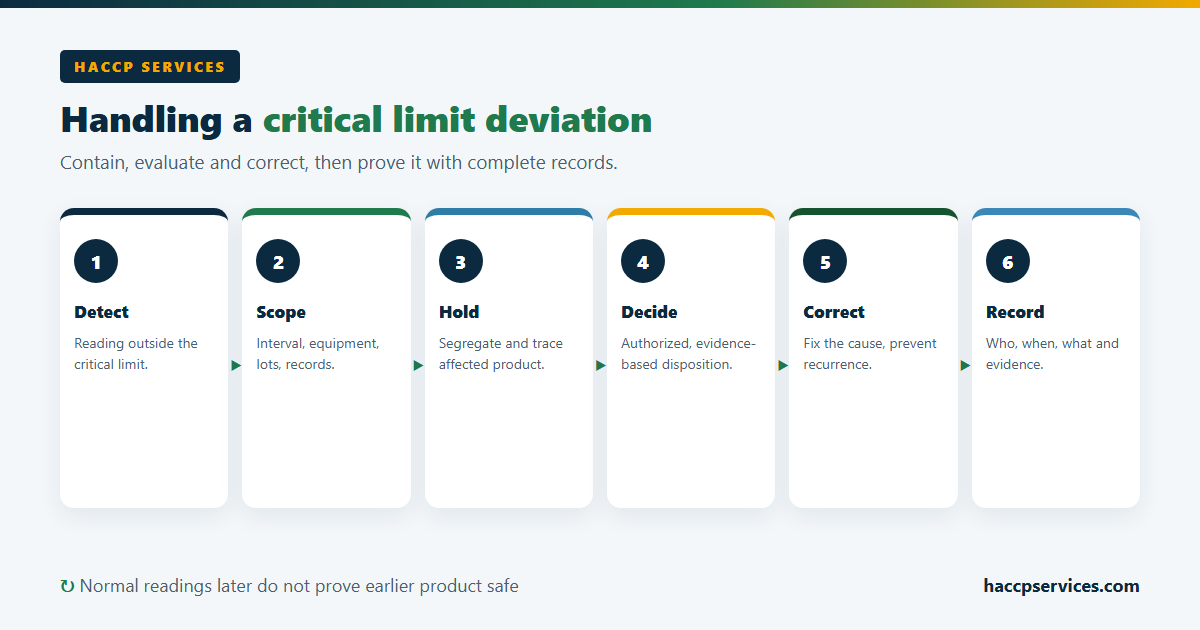
A measurement outside an established critical limit triggers the documented response. Do not limit the investigation to the sample that failed. Instead, identify the affected process interval, equipment, records and product lots.
2. Secure and evaluate affected product
Apply hold controls, traceability, authorized disposition and customer escalation as appropriate. A product cannot be assumed safe merely because later monitoring returned to normal.
The regulations are clear on this point. For example, FSIS requires that no product injurious to health or otherwise adulterated as a result of the deviation enters commerce (9 CFR 417.3). Similarly, FDA requires that all affected food is evaluated for safety and kept out of commerce when it cannot be shown to be unadulterated (21 CFR 117.150(a)(2)). See our HACCP corrective actions page.
3. Correct the process and investigate the cause
Restore control through authorized measures. Then determine whether equipment, staff training, formulation or monitoring methods contributed. A quick restart is not the same as documented corrective action closure.
Seafood and juice HACCP rules, for instance, require corrective action plans that ensure the cause of the deviation is corrected (21 CFR 123.7 and 120.10). Under 9 CFR 417.3, measures to prevent recurrence must also be established.
4. Verify corrective action records
Records should show the deviation, containment, findings, product decision, responsible person, timestamps and evidence that the process is under control. Retention and approval obligations depend on the applicable HACCP or preventive controls regulation. Under Part 117, for example, required records must generally be kept for at least 2 years (21 CFR 117.315).
For related guidance, see HACCP recordkeeping requirements and our article on HACCP process deviations and batch records.
5. Prepare for retail quality questions
For manufacturers pursuing Costco distribution, deviation trends and defensible disposition records can support customer discussions. However, buyer-specific notification conditions should come from actual contracts or approved procedures, not assumptions.
Frequently asked questions
If monitoring returns to normal, can held product be released?
Not automatically. The affected product must be evaluated, and the disposition decision must be supported by evidence and documented.
What must a HACCP corrective action achieve?
It must keep unsafe or adulterated product out of commerce and correct the cause of the deviation. Depending on the rule, it must also bring the CCP back under control and prevent recurrence.
Do good deviation records guarantee acceptance by Costco?
No. They can support supplier discussions, but Costco-specific requirements must be confirmed directly with the relevant buyer.
Supplier readiness checklist
- Confirm the applicable regulation, certification scope and buyer-specific requirements in writing.
- Identify the accountable process owner and current approved procedures.
- Collect recent objective records tied to the correct facility, product and lots.
- Resolve exceptions with documented corrective actions and effectiveness checks.
- Test record retrieval and make the review package available to authorized reviewers.
How HACCP Services can help
HACCP Services, a service of Consultare Inc. Group, supports deviation response procedures, root cause investigation, product hold and disposition programs, corrective action records and supplier documentation, subject to the engagement scope.
- Deviation investigation and root cause analysis
- Product hold, release and disposition programs
- Corrective action management
- Traceability and product recall programs
Need a HACCP deviation response and recordkeeping review?
Share your product category, manufacturing location, current program and expected distribution timeline, so the discussion can focus on the most important gaps. You can book a free consultation or contact our team.
Start building your compliance system
If you prefer to organize and manage your compliance activities yourself, you can also create a free SystemsBuilder account. Then begin building a structured system for your compliance documentation and processes.
Technical sources: FDA HACCP Principles and Application Guidelines (NACMCF), FDA FSMA Final Rule for Preventive Controls for Human Food, 21 CFR Part 117, 21 CFR Part 123 and 9 CFR Part 417. This article is educational information, not legal advice or a statement of Costco supplier approval policy. HACCP Services is independent of FDA, USDA and Costco Wholesale, and does not claim Costco affiliation, endorsement or authority to approve suppliers. Requirements may change; confirm current rules and written buyer terms before relying on this guide.