
A HACCP ingredient hazard evaluation links every material you use to its hazards, the point where each hazard is controlled and the records that prove it. A single ingredient change can alter the hazards entering a production line. Generic ingredient lists, however, rarely explain where each risk is controlled or what evidence exists.
For manufacturers supplying large retailers, ingredient evaluations are often among the first documents a customer or auditor asks to see. Walmart supplier requirements can differ by product, facility and commercial relationship. Therefore, confirm them directly with the relevant Walmart contact before treating any practice in this guide as a mandatory Walmart rule.
Quick answer
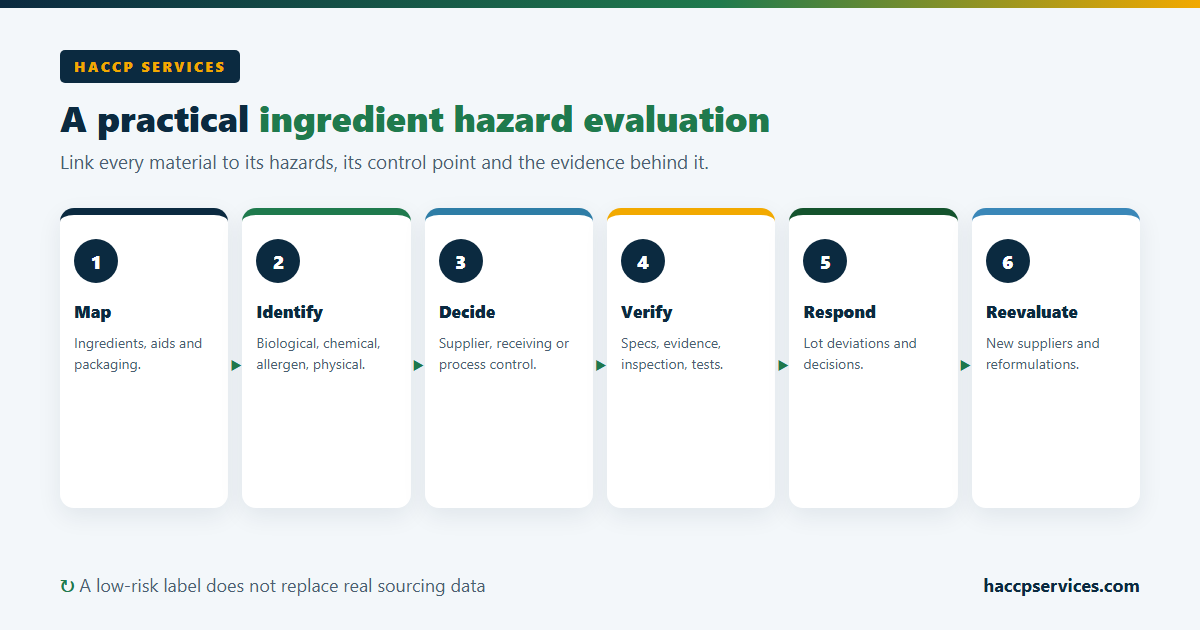
List every ingredient, additive, processing aid and relevant packaging material with its supplier. Identify known or reasonably foreseeable hazards for each. Then decide whether the supplier, receiving or a later process step controls each hazard, and document why. Verify incoming controls and reevaluate whenever suppliers, formulas or relevant information change.
Who this article is for
This guide is for food manufacturers, PCQIs, HACCP teams, purchasing staff and quality managers who maintain hazard analyses for retail customers.
1. Map ingredients to the actual product
List ingredients, additives, processing aids and relevant packaging, including supplier and source information. Consider the intended use, consumer group and process conditions for each material. For example, an ingredient added after a kill step carries different risk than one added before it.
2. Identify known or reasonably foreseeable hazards
Evaluate biological, chemical, allergen and physical hazards using product and supplier information. A general low-risk category should not replace a look at actual sourcing and product conditions. For FDA-registered facilities under Part 117, the hazard analysis must consider raw materials and other ingredients, and it covers food allergens as chemical hazards, under 21 CFR 117.130. For allergen programs, see allergen management program development.
3. Decide where controls are applied
Determine whether each hazard is managed by the supplier, at receiving or later in manufacturing. Then document the rationale. Traditional HACCP is not always the complete framework here. When a Part 117 facility relies on its supplier to control a hazard, a risk-based supply-chain program may be required under 21 CFR 117.405. Our HACCP plan vs FDA food safety plan guide explains that boundary.
4. Verify incoming controls
Use approved specifications, supplier evidence, inspections or appropriate testing based on the identified risk. In addition, keep records of lot-level deviations, affected-product decisions and corrective actions. For imported materials, our article on imported ingredient supplier controls covers supplier approval in more depth.
5. Reevaluate after changes
Review new suppliers, reformulations, incidents and relevant regulatory information for their effect on the hazard evaluation. As a result, the evaluation stays tied to the materials you actually buy. New products need the same discipline; see HACCP hazard analysis for new food products. Meanwhile, confirm any distinct Walmart supplier or certification obligations independently.
Frequently asked questions
Does every ingredient need its own hazard evaluation?
Every material should be considered. Similar materials can be grouped when sourcing, use and hazards are truly comparable, and the grouping rationale is documented.
Is a supplier certificate enough to control an ingredient hazard?
Not on its own. The evaluation should explain what the certificate covers, what is verified at receiving and what remains for your process.
Does a thorough ingredient evaluation guarantee acceptance as a Walmart supplier?
No. Thorough documentation supports readiness. However, supplier approval rests with Walmart and its own requirements.
Supplier readiness checklist
- Map ingredients, processing aids and packaging to the actual product.
- Identify known or reasonably foreseeable hazards for each material.
- Decide and document where each control is applied.
- Verify incoming controls based on risk.
- Reevaluate after supplier, formula or information changes.
- Verify the applicable Walmart supplier program and all relevant product and facility requirements.
- Assign owners for documentation, follow-up actions and periodic review.
How HACCP Services can help
HACCP Services, a service of Consultare Inc. Group, helps organize material hazard evaluations, supplier records and receiving-control documentation, subject to the engagement scope.
- HACCP supplier program evaluation
- HACCP plan development
- New product and process change impact assessment
- HACCP document control and version management
Do your ingredient hazard evaluations reflect your actual suppliers?
Identify missing hazard or supplier control evidence with our team. You can book a free consultation or contact our team.
Start building your compliance system
If you prefer to organize and manage your compliance activities yourself, you can also create a free SystemsBuilder account. Then begin building a structured system for your compliance documentation and processes.
Technical sources: Codex Alimentarius (General Principles of Food Hygiene, CXC 1-1969), FDA FSMA Final Rule for Preventive Controls for Human Food, 21 CFR 117.130, 21 CFR 117.405 and Walmart supplier requirements. This article is independent educational content, not legal advice. HACCP Services is not affiliated with or endorsed by Walmart Inc. or FDA. Walmart-specific supplier requirements must be confirmed directly with Walmart. Regulatory applicability depends on the product, facility, activity and current law.