
Drainage and moisture control is a prerequisite program that many food plants underestimate. Standing water, condensation and uncontrolled moisture can raise contamination concerns, especially where food is exposed or the process is sensitive. Moreover, these problems rarely improve through paperwork alone. The site conditions behind them need to be understood and fixed.
This article explains how moisture creates hazards, where it fits in your HACCP system and how to run a focused review. It is written for HACCP coordinators, sanitation leaders and maintenance teams.
Quick answer
Drainage and moisture control means managing where water comes from, where it goes and where it collects. In most plants, it sits within prerequisite programs such as sanitation, maintenance and environmental controls. Your hazard analysis should still consider moisture conditions, because they can affect hazards such as environmental pathogens. Review the facts, prioritize by risk, fix the cause and verify the result.
Why moisture creates food safety hazards
Water itself is not the hazard. Instead, moisture gives contamination a way to grow, spread or reach product. Common problems include:
- Standing water. Pooled water on floors or equipment can support microbial growth and spread with foot traffic and carts.
- Condensation. Drips from ceilings, ducts, pipes or cold surfaces can fall onto exposed product or food-contact surfaces.
- Splash and aerosols. High-pressure hoses and poorly placed drains can carry residue from floors and drains onto equipment.
- Wet and dry crossover. Traffic between wet and dry areas can move moisture into zones where it does not belong.
U.S. rules address these conditions directly. For example, 21 CFR 117.37(b) requires plumbing to provide adequate floor drainage where floors are subject to flooding-type cleaning or where operations discharge water onto the floor. In addition, 21 CFR 117.20(b)(4) requires construction that keeps drip or condensate from fixtures, ducts and pipes from contaminating food, food-contact surfaces or packaging.
Where drainage fits in HACCP and prerequisite programs
HACCP builds on the Codex General Principles of Food Hygiene (CXC 1-1969), which treat good hygiene practices as the base for the HACCP plan. Mandatory U.S. HACCP applies to juice (21 CFR Part 120), seafood (Part 123) and USDA-inspected meat and poultry (9 CFR Part 417). Most other FDA-registered facilities follow 21 CFR Part 117, where the hazard analysis may lead to preventive controls, including sanitation controls.
Therefore, start with your HACCP hazard analysis. Record moisture conditions as inputs, then decide how they are managed. In most cases, drainage and condensation belong in prerequisite programs. Where a ready-to-eat food is exposed after a lethal step, however, moisture can feed environmental pathogen risks that need stronger controls. Our article on Listeria and environmental contamination in RTE foods explains that link. For the broader picture, see why prerequisite programs matter for hazard control.
Key review considerations
- Identify where food, residues, moisture or allergens could accumulate.
- Check whether routine cleaning and inspection can reach drains, trenches and surrounding surfaces.
- Evaluate layout, personnel movement, utilities and maintenance interfaces.
- Review records of sanitation failures, drain repairs and recurring observations.
- Separate applicable requirements from voluntary technical guidance.
Practical steps for drainage and moisture control
First, review where moisture is generated and how drains perform. Then check whether cleaning creates aerosols or splash, and whether traffic crosses wet and dry areas. After that, assess the findings within your sanitation and environmental controls. The following four steps keep the work accountable.
1. Document
Record the observed condition, the affected process, the potential hazard and the supporting evidence. Photos and locations help later verification.
2. Prioritize
Assess severity and likelihood in the real facility context. Then assign a responsible person and an action deadline.
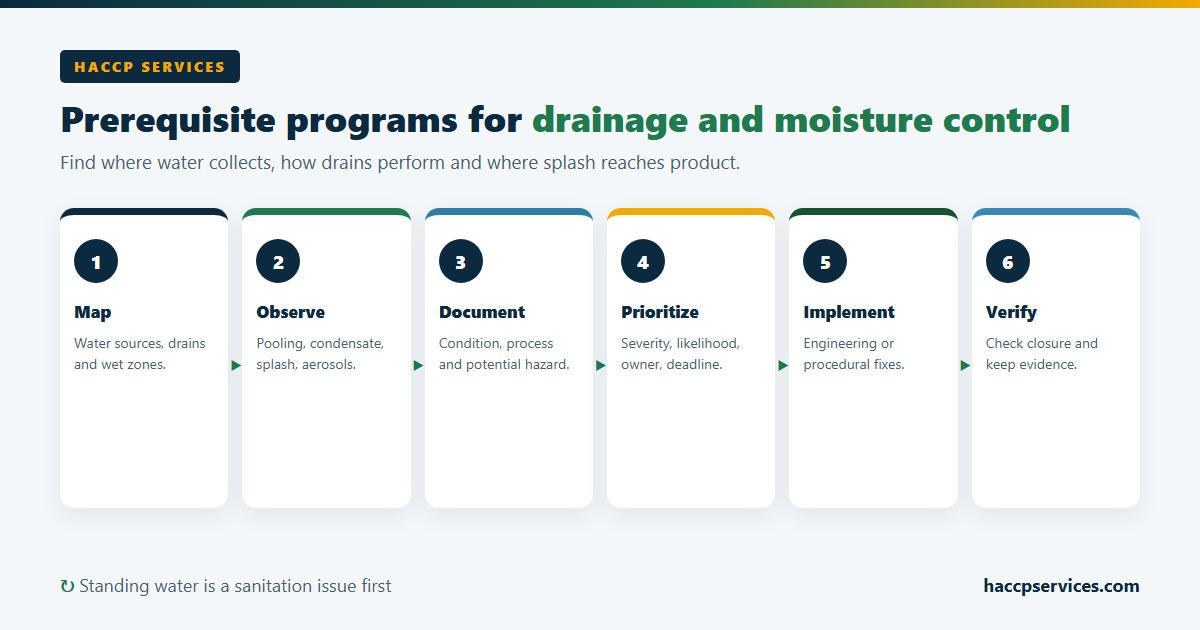
3. Implement
Approve suitable engineering or procedural changes. Get input from food safety, sanitation, operations and maintenance before work starts. For example, a fix might be regrading a floor, insulating a cold pipe or changing hose practices.
4. Verify
Check the completed action and keep objective evidence that the problem is resolved. Then watch for recurrence during routine inspections.
Records to keep
- A map of wet areas, drains and known condensation points.
- Inspection findings with dates, locations and photos.
- Risk ratings, owners and due dates in an improvement register.
- Work orders for drain, floor and insulation repairs.
- Verification results, such as follow-up inspections and environmental monitoring trends where used.
Example scenario
Consider a hypothetical plant that cooks and cools a ready-to-eat product. Each morning, the sanitation team finds water pooled near the packing line. Meanwhile, condensate forms on a chilled-water pipe above a conveyor.
The team documents both conditions and links them to the packing step. Next, they rate the condensate as the higher priority, because it sits above exposed product. Maintenance insulates the pipe and a drip shield goes up as a short-term measure. In parallel, the team reviews floor slope and hose practices to address the pooling. Finally, follow-up inspections confirm both fixes, and the hazard analysis records the conditions and the controls that manage them.
When to ask for outside support
- The same drainage or moisture condition keeps returning despite earlier corrective actions.
- An expansion, new equipment or a process change raises hygienic design questions.
- Your team needs help coordinating evidence, owners and closure before a customer or certification audit.
- Staff would benefit from training on contamination prevention and corrective action records.
Frequently asked questions
Is drainage part of the HACCP plan or a prerequisite program?
Usually, it is a prerequisite program. The hazard analysis should still consider moisture conditions, and some situations may call for a sanitation preventive control.
Can documentation alone fix a moisture problem?
No. Records show what happened, but the physical cause still needs a repair, redesign or changed practice.
Who owns drainage and moisture control?
Ownership is shared. Sanitation, maintenance, operations and food safety each control part of the problem, so assign named owners for every action.
Drainage and moisture control checklist
- Map moisture sources, drains and wet zones.
- Look for pooling, condensate, splash and aerosols during and after cleaning.
- Record each drainage and moisture control finding with evidence.
- Rate risk based on product exposure and process.
- Assign owners and deadlines for engineering or procedural fixes.
- Verify closure and monitor for recurrence.
How HACCP Services can help
HACCP Services, a service of Consultare Inc. Group, supports HACCP program reviews, prerequisite program improvement plans and corrective action records for moisture-related risks, subject to the engagement scope. Facility management approves and carries out changes, and we do not promise certification, regulatory approval or a particular audit outcome.
- Prerequisite programs (PRP) gap assessment
- Sanitation program development
- Environmental monitoring program design
- Corrective action management
Need help with drainage and moisture control?
Discuss your facility, wet areas, records and risks with our team. You can book a free consultation or contact our team.
Start building your compliance system
If you prefer to organize and manage your compliance activities yourself, you can also create a free SystemsBuilder account. Then begin building a structured system for your compliance documentation and processes.
Technical sources: Codex Alimentarius General Principles of Food Hygiene (CXC 1-1969), 21 CFR 117.20 (plant and grounds), 21 CFR 117.37 (sanitary facilities, plumbing and floor drainage) and 21 CFR 117.135 (preventive controls). This article is educational and is not legal advice; HACCP Services is not affiliated with FDA, and specific requirements depend on your products, processes and applicable regulations.