
Farm and food manufacturing activities can sit side by side in one operation, so a business label alone cannot settle FDA registration status. Food activities may include growing, harvesting, packing, processing and holding. An operation that people casually call a “farm” or a “factory” may involve several of these at once.
FDA’s registration rules use defined terms for these activities. As a result, the analysis should follow what actually happens at each site. This article explains the key definitions, a practical review workflow and the records to keep before the 2026 renewal period closes on December 31, 2026.
Quick answer: Describe the actual activities at each physical site. Compare them with the definitions in 21 CFR 1.227 and the exemptions in 21 CFR 1.226. Do not assume a farm exemption, and do not assume that HACCP documentation means a site must register. Record the conclusion, and renew covered facilities by December 31, 2026.
Who this article is for
This guide is written for growers with packing or processing operations, food manufacturers with agricultural links, HACCP coordinators and regulatory contacts who need to sort farm activities from manufacturing activities.
1. Why the business label is not enough
Business names and everyday labels describe how a company sees itself. Registration rules, however, look at activities. A grower that also cuts, cooks or blends food for sale may be doing more than farm activities. Similarly, a food plant with a HACCP plan is not automatically required to register; that depends on its activities and any exemptions.
Therefore, the review should begin with facts, not names. A verified map of each process is the most useful starting point. Our guide to mapping food handling activities to FDA registration requirements explains this first step.
2. Know the key definitions
The definitions in 21 CFR 1.227 drive the analysis. In summary:
- Farm: the rule defines a primary production farm and a secondary activities farm. A primary production farm is an operation under one management in one general physical location, devoted to growing crops, harvesting crops, raising animals or a combination. It can also pack or hold raw agricultural commodities and carry out some limited further activities described in the rule.
- Manufacturing/processing: making food from one or more ingredients, or preparing, treating, modifying or manipulating food. Examples in the rule include cooking, cutting, freezing, mixing and packaging.
- Packing: placing food into a container other than packaging it, including repacking and activities incidental to packing.
- Holding: storage of food, plus activities incidental to storage or needed for distribution.
- Mixed-type facility: an establishment that does both exempt activities and activities that require registration. A “farm mixed-type facility” is one example.
The full wording carries important limits and conditions. So, read the current text rather than relying on a summary.
3. Do not assume a farm exemption
21 CFR 1.226 lists farms among the establishments that do not have to register. However, the exemption covers operations that meet the farm definition. If a site also carries out activities outside that definition, it may be a mixed-type facility that must register.
For example, a grower that dries its own produce, or slices it for sale to others, should check those activities carefully against the definition. The answer depends on the facts and the exact rule text.
4. Describe activities site by site
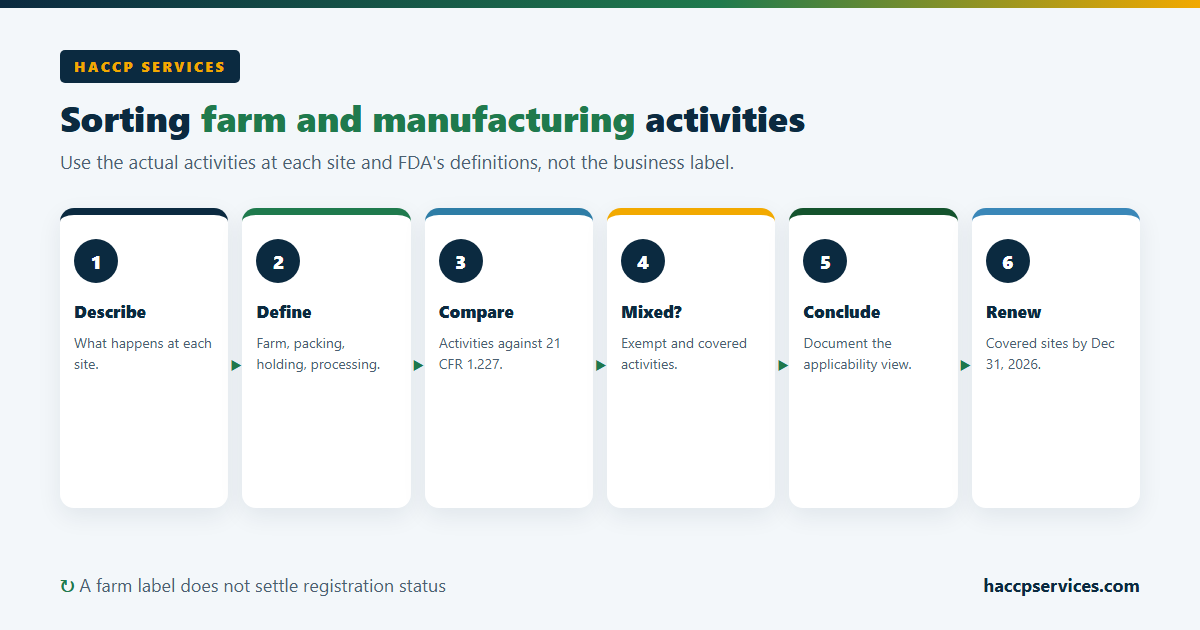
Write a short description for each physical site. Include who manages it, what crops or foods it handles and which activities happen there. Note where food goes next, and whether it is consumed on the same farm or sold on.
Next, link each activity to a defined term. Where an activity could fit more than one term, record why you chose one. This reasoning becomes part of your applicability file.
5. Review technical hazard controls separately
HACCP work answers a different question. It asks which hazards are reasonably likely and how they are controlled. A HACCP hazard analysis may be useful for a packing shed or a processing room, whatever the registration result.
So, keep the two reviews apart. A strong hazard analysis does not decide registration. Likewise, a registration conclusion does not show that hazards are controlled. For produce operations, our fresh produce HACCP plans page explains the technical side.
6. Know the 2026 renewal facts
Under section 415 of the Federal Food, Drug, and Cosmetic Act (21 U.S.C. 350d) and 21 CFR 1.230, facilities required to register must renew between October 1 and December 31 of every even-numbered year. For covered facilities, the 2026 renewal is due by December 31, 2026. An earlier update does not replace the renewal.
FDA currently recognizes the DUNS number as an acceptable Unique Facility Identifier, and renewal carries no FDA fee. For the wider renewal picture, see our FDA registration renewal 2026 overview.
Who does what
- Farm or site manager: describes the real activities at each location.
- HACCP or food safety lead: runs the technical hazard review.
- Regulatory contact or adviser: compares activities with the definitions and exemptions.
- Management: approves the documented applicability conclusion.
Common mistakes
- Assuming any agricultural business is exempt as a farm.
- Assuming any site with a HACCP plan must register.
- Overlooking activities added over time, such as slicing or blending.
- Failing to record why a conclusion was reached.
- Forgetting to revisit the conclusion after operations change.
When roles are shared across businesses, our article on separating food facility roles from HACCP process responsibilities can help.
Frequently asked questions
Is every farm exempt from FDA food facility registration?
Farms, as defined in 21 CFR 1.227, are listed in 21 CFR 1.226. However, an establishment that also carries out activities outside the farm definition may be a mixed-type facility that must register.
Does having HACCP documentation mean a site must register?
No. HACCP documentation addresses hazard control. Registration depends on the site’s activities and any applicable exemptions.
What should we keep on file?
Keep the activity description for each site, the applicability conclusion and its reasoning, and renewal evidence for covered facilities.
Farm and food manufacturing activities checklist
- Describe the actual activities at each physical site.
- Compare them with the definitions in 21 CFR 1.227.
- Assess relevant exemptions in 21 CFR 1.226, including mixed-type status.
- Review technical hazard controls separately.
- Retain a documented applicability conclusion.
- Keep renewal evidence for covered facilities.
Related reading
- FDA Registration Renewal 2026 for HACCP-Based Food Operations
- Mapping Food Handling Activities to FDA Registration Requirements
- Separating Food Facility Roles From HACCP Process Responsibilities
- FDA Registration Requirements for Food Packing and Processing Operations
How HACCP Services can help
HACCP Services, a service of Consultare Inc. Group, supports HACCP hazard analysis, facility activity mapping, food safety documentation and regulatory assessment coordination, subject to the engagement scope.
- Hazard analysis support
- Facility and process flow review
- Fresh produce HACCP plans
- HACCP document control
Need help sorting farm and manufacturing activities?
Discuss your sites, activities and records with our team before the December 31, 2026 deadline. You can book a free consultation or contact our team.
Start building your compliance system
If you prefer to organize and manage your compliance activities yourself, you can also create a free SystemsBuilder account. Then begin building a structured system for your compliance documentation and processes.
Technical sources: FDA Biennial Registration Renewal User Guide, FDA reminder on biennial renewal requirements, FDA Online Registration of Food Facilities, 21 U.S.C. 350d, 21 CFR 1.227 (definitions) and 21 CFR Part 1, Subpart H. This article is educational and is not legal advice or an official statement of FDA policy; HACCP Services is not affiliated with FDA, and specific requirements depend on your facility, operations and applicable regulations. Verify current requirements through official FDA sources.