
Thermal CCP monitoring only protects consumers when operators measure correctly and respond correctly to every deviation. When a critical temperature is missed, does your team know exactly what happens to the affected lot? A critical limit written in a HACCP plan is useful only if it drives action on the line. Manufacturers supplying large retail channels need clear records that connect the process, the lot and the disposition decision.
This guide is for manufacturers preparing for possible H-E-B supply. H-E-B maintains supplier channels and an access-controlled supplier portal for authorized business partners. However, public information does not set out one detailed food safety checklist for every supplier. Therefore, verify current requirements with the appropriate H-E-B purchasing or supplier team.
Quick answer
Establish a technical basis for each thermal limit. Then define who monitors, how often, with which instrument and at what point. Next, set conditions that trigger an automatic product hold. Finally, document affected lots, the technical review, corrective action and disposition, and trend recurring deviations. A temperature graph without a deviation decision does not show the hazard was controlled.
Is your heat step a CCP?
Traditional HACCP plans use critical limits, monitoring, corrective actions and verification at each identified critical control point. These principles come from the Codex General Principles of Food Hygiene (CXC 1-1969) and NACMCF. Whether a heat treatment is a CCP depends on the hazard analysis, the product, the process and the governing rules. Our page on HACCP critical limits explains how limits are set.
Seafood and juice have sector-specific HACCP regulations in 21 CFR Parts 123 and 120. Most other FDA-registered facilities instead follow 21 CFR Part 117. There, heat processing is a typical process control. Under 21 CFR 117.135(c)(1), process controls include the parameters and the maximum or minimum values that must be met.
What good thermal monitoring looks like
- A clear method. The record states the instrument, the measuring point and the frequency.
- Traceable readings. Each reading links to a time, a lot and the person who took it.
- Calibrated instruments. Thermometers and recorders are checked for accuracy on a set schedule.
- Timely review. Someone with authority reviews the records and signs them.
Under Part 117, 21 CFR 117.145 requires written monitoring procedures and documented monitoring. In addition, 21 CFR 117.165(a)(4)(i) requires review of monitoring and corrective action records within 7 working days, or a justified reasonable timeframe. See our HACCP monitoring procedures page for the principle.
Common gaps in deviation records
- The log shows temperatures but not the start and end of the excursion.
- Affected lots are not identified, so the scope of the hold is unclear.
- Product is released because the line restarted, not because it was evaluated.
- The same deviation recurs, but nobody trends it or finds the cause.
- The basis for the critical limit is missing or out of date.
Practical steps for thermal CCP monitoring
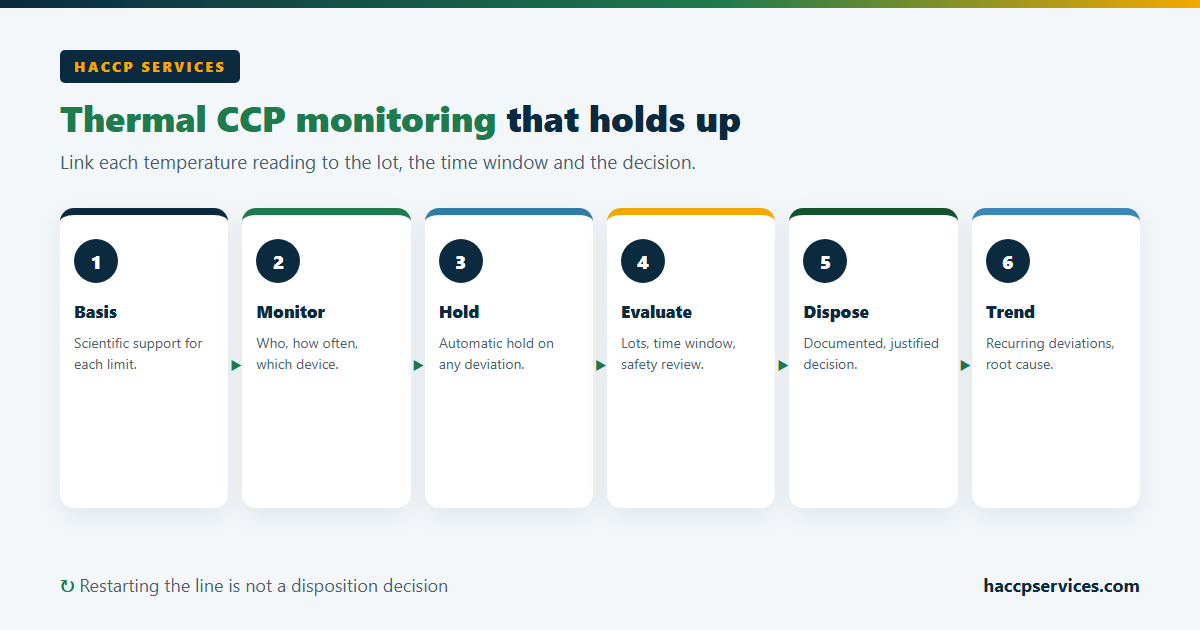
- Establish the basis. Validate, or otherwise support with technical evidence, each applicable process limit. Our article on thermal process validation covers this step.
- Define monitoring. Specify who monitors, how often, with which instrument and at what point.
- Set hold triggers. Define automatic product hold and escalation conditions for any deviation.
- Evaluate. Identify the affected time window and lots, then carry out a technical safety review.
- Decide disposition. Document the corrective action and the reasons for release, reprocessing or rejection.
- Trend. Review records and trend recurring deviations to drive preventive improvements.
Where Part 117 applies, corrective action procedures must ensure all affected food is evaluated for safety. They must also keep it out of commerce if its safety cannot be assured (21 CFR 117.150). Our post on CCP deviation response explains product disposition in more depth.
Records to keep
- The scientific or technical basis for each critical limit.
- Monitoring records with time, lot, reading, instrument and initials.
- Calibration or accuracy check records for each instrument.
- Deviation reports, including the time window and affected lots.
- Hold, evaluation and disposition decisions, with reasons.
- Record review signatures and deviation trend summaries.
Example scenario
A line making a Texas-style specialty salsa for anticipated H-E-B distribution records a short temperature excursion during a shift. The logs show temperatures. However, they do not show the affected time window, the impacted lot or the required product hold.
A robust deviation procedure should drive four actions: identify the affected product, evaluate its safety, decide disposition and verify the fix. In practice, the team would hold the lots produced during the excursion and review them technically. It would then record the decision and check whether the cause, such as a faulty probe, could recur. Our guide to HACCP deviation handling walks through similar cases.
Frequently asked questions
Can we restart the line and release product after a short excursion?
Not without evaluation. Product release must rest on an appropriate technical review of the affected lots, not on restarting the line.
Do continuous recorder charts count as monitoring records?
They can, if they are linked to lots, reviewed and signed. However, a chart alone does not record a deviation decision.
Does thermal CCP monitoring guarantee acceptance by H-E-B?
No. Good records support readiness, but supplier decisions rest with H-E-B. Confirm specific requirements with the relevant H-E-B contact.
Thermal CCP monitoring checklist
- Document the technical basis for each thermal limit.
- Define the monitor, frequency, instrument and measuring point.
- Set automatic hold and escalation triggers.
- Record the time window and affected lots for every deviation.
- Document evaluation, corrective action and disposition.
- Review records on time and trend recurring deviations.
- Confirm H-E-B-specific requirements with the relevant H-E-B contact.
How HACCP Services can help
HACCP Services, a service of Consultare Inc. Group, supports HACCP plan design, hazard analysis, CCP documentation, monitoring forms, deviation response procedures and audit-readiness reviews. Applicable Part 117 responsibilities can be evaluated alongside the HACCP approach. Deliverables are agreed with each client, and we do not promise any customer or regulatory outcome.
- CCP monitoring system design
- Product hold, release and disposition program
- Calibration and measurement control program
- Corrective action management
Would your deviation records show what happened to the lot?
Share your process flow, CCP worksheet, critical limit basis and one anonymized deviation record for a focused review. You can book a free consultation or contact our team.
Start building your compliance system
If you prefer to organize and manage your compliance activities yourself, you can also create a free SystemsBuilder account. Then begin building a structured system for your compliance documentation and processes.
Technical sources: Codex Alimentarius (General Principles of Food Hygiene, CXC 1-1969), FDA HACCP, 21 CFR 117.145 (monitoring), 21 CFR 117.150 (corrective actions), 21 CFR 117.165 (verification) and H-E-B supplier information. This article is independent educational content, not legal advice. HACCP Services is not affiliated with, sponsored by or approved by H-E-B or FDA. H-E-B-specific supplier requirements must be confirmed with the relevant H-E-B supplier or purchasing contact. Applicability depends on the product, facility and customer arrangements.