
Allergen cross-contact controls protect consumers and the supplier relationships you have worked hard to build. One undeclared allergen can undo months of supplier preparation. In packaged foods, allergen risk can come from raw material substitution, shared equipment, incomplete cleaning or packaging mix-ups. The consequences can go far beyond a complaint, to misbranding, a recall and severe consumer harm.
This article is for manufacturers preparing for possible H-E-B supply. H-E-B maintains supplier channels and an access-controlled supplier portal for authorized business partners. However, public information does not set out one detailed food safety checklist for all suppliers. Therefore, verify current requirements with the appropriate H-E-B purchasing or supplier team.
Quick answer
Map every allergen in ingredients, rework, processing aids and finished products. Next, identify shared equipment and cross-contact routes, and define controls such as scheduling, segregation and suitable cleaning. Then control labels at every change and record cleaning, deviations and training. Strong allergen controls support supplier readiness, but they do not guarantee acceptance by H-E-B.
Where allergen controls sit in the rules
For most FDA-registered facilities, 21 CFR Part 117 applies. Under 21 CFR 117.130, food allergens are chemical hazards that the hazard analysis must consider. Moreover, 21 CFR 117.135(c)(2) describes food allergen controls. They cover protection from allergen cross-contact, including during storage, handling and use, and labeling of the finished food.
In contrast, juice and seafood processors follow sector-specific HACCP rules in Parts 120 and 123. So, confirm which program governs each product before you design controls. Not every food plant falls under the same regulatory program.
What good allergen control looks like
- A current allergen map. It covers ingredients, rework, processing aids and every finished product.
- A site-specific hazard analysis. It examines shared lines, sanitation, label application and credible cross-contact routes. Our hazard analysis page explains the method.
- Defined controls. Scheduling, segregation, cleaning methods, label reconciliation and staff training are written down.
- Evidence. Records show each control happened, run by run.
Common gaps
- A new allergen is added to a shared line without reassessing the cleaning procedure.
- Rework containing an allergen is added to a product that does not declare it.
- Label versions change, but packaging-line clearance still checks the old label.
- Cleaning is done but not verified, or verification is not recorded.
- A generic template replaces a site-specific analysis of process flows and allergen exposure.
Practical steps for allergen cross-contact controls
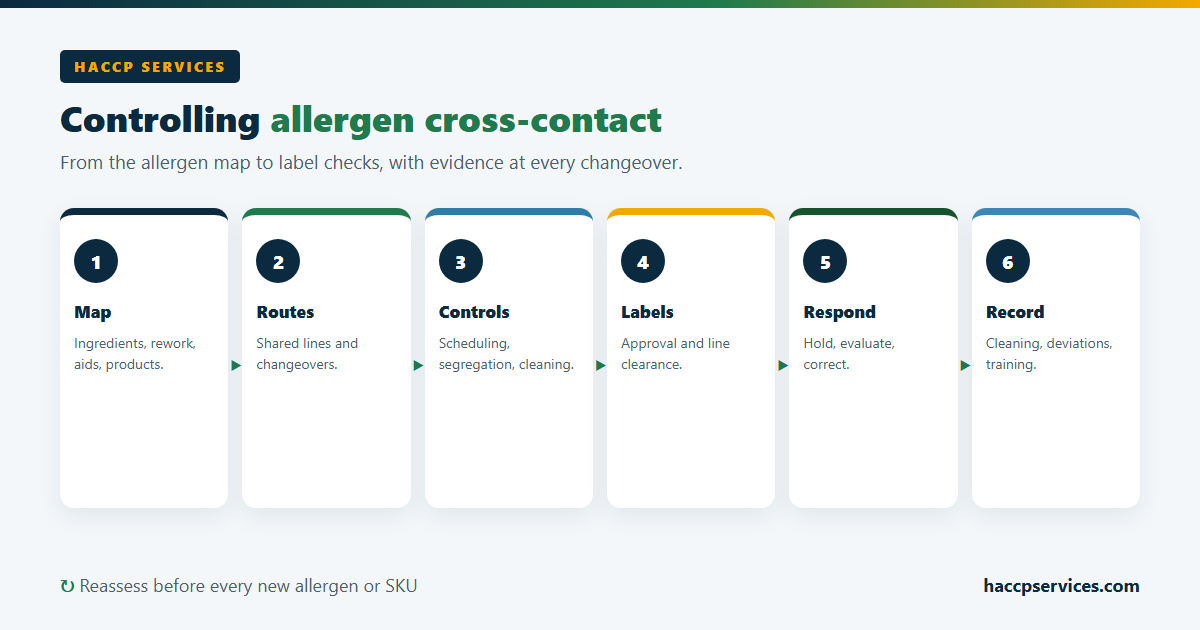
- Map allergens. List allergens in ingredients, rework, processing aids and finished products. The nine major U.S. food allergens are listed by FDA.
- Identify routes. Find shared equipment and cross-contact routes, especially during production changes.
- Define controls. Set preventive controls, monitoring and verification that fit each hazard.
- Control labels. Establish label review and packaging-line clearance procedures for every changeover.
- Respond to problems. Hold suspect product, evaluate it and correct the cause. See HACCP corrective actions for the principle.
- Record everything. Document cleaning effectiveness, deviations, corrections and staff training.
Cleaning deserves extra care. Part 117 does not require validation of food allergen controls, under 21 CFR 117.160(c). Even so, many sites choose to validate high-risk changeovers. Our article on HACCP cleaning validation explains how equipment design affects that work.
Records to keep
- The allergen matrix for ingredients, rework, processing aids and products.
- The hazard analysis section on allergens and cross-contact routes.
- Production schedules and changeover records.
- Cleaning, inspection and any verification test results.
- Label approvals, line clearance and label reconciliation records.
- Deviation, correction and training records.
Example scenario
A producer of a Texas-style specialty salsa adds a new SKU containing tree nuts on a shared line. At the same time, it plans broader H-E-B distribution. However, the existing cleaning SOP has not been assessed for the new allergen. In addition, packaging controls do not include the new label version.
The team should update the hazard analysis and operating procedures before launch. That means reassessing cleaning for tree nut residues, adding the new label to line clearance checks and training staff. It should also decide how to schedule the nut-containing product, for example at the end of a run before a full clean.
What happens when this is overlooked?
Gaps can contribute to mislabeling and food safety incidents. Where Part 117 applies, corrective action procedures must ensure affected food is evaluated. They must also keep it out of commerce if its safety cannot be assured (21 CFR 117.150). For a related view, see our post on HACCP allergen hazard controls for retail suppliers. Our guide to a HACCP plan for H-E-B suppliers covers the wider plan.
Frequently asked questions
Are allergen controls always critical control points?
No. Many sites manage allergens through preventive controls or prerequisite programs rather than CCPs. The decision should follow a documented hazard analysis.
Does a negative allergen swab prove a line is clean?
Not always. A test result is one piece of evidence. It should sit alongside visual inspection, defined cleaning methods and changeover records.
Does strong allergen control guarantee acceptance by H-E-B?
No. Sound controls and credible records support readiness, but supplier decisions rest with H-E-B. Confirm specific requirements with the relevant H-E-B contact.
Allergen cross-contact controls checklist
- Map allergens in ingredients, rework, processing aids and products.
- Identify shared equipment and cross-contact routes.
- Define controls, monitoring and verification for each hazard.
- Establish label review and line clearance procedures.
- Reassess cleaning before adding any new allergen.
- Document cleaning, deviations, corrections and training.
- Confirm H-E-B-specific requirements with the relevant H-E-B contact.
How HACCP Services can help
HACCP Services, a service of Consultare Inc. Group, can develop or review hazard analyses, HACCP plans, allergen control procedures, monitoring records and corrective action workflows. Where Part 117 applies, the food safety plan and PCQI responsibilities are evaluated separately. Deliverables are agreed with each client, and we do not promise any customer or regulatory outcome.
- Allergen management program development
- Sanitation program development
- HACCP plan development
- Corrective action management
Adding a new allergen or SKU to a shared line?
Share your allergen matrix, process flow, SKU list and line-sharing arrangements for a targeted review. You can book a free consultation or contact our team.
Start building your compliance system
If you prefer to organize and manage your compliance activities yourself, you can also create a free SystemsBuilder account. Then begin building a structured system for your compliance documentation and processes.
Technical sources: Codex Alimentarius (General Principles of Food Hygiene, CXC 1-1969), 21 CFR 117.130 (hazard analysis), 21 CFR 117.135 (preventive controls), 21 CFR 117.160 (validation), FDA Food Allergies and H-E-B supplier information. This article is independent educational content, not legal advice. HACCP Services is not affiliated with, sponsored by or approved by H-E-B or FDA. H-E-B-specific supplier requirements must be confirmed with the relevant H-E-B supplier or purchasing contact. Applicability depends on the product, facility and customer arrangements.