
HACCP rework and reprocessing decisions can save product, but they can also create hazards the original plan never covered. Production may want to reuse a held batch to reduce waste. Yet if no one can show that the rework route was evaluated for allergen, microbiological and traceability hazards, the shortcut becomes a risk.
This article explains what controlled rework looks like, the common gaps and the records to keep. It is written for food manufacturers preparing for possible H-E-B supply. Confirm any H-E-B expectations directly with the relevant H-E-B supplier or purchasing contact.
Quick answer
Treat each rework route as a process change. Before reusing product, identify the source lots and the reason for the hold, and confirm who may approve disposition. Then assess biological, chemical, physical and allergen hazards for the proposed route. Check that existing controls and critical limits still apply, and record approvals, quantities and lot genealogy. Good rework control supports supplier readiness, but it does not guarantee acceptance by H-E-B.
What the rules expect
HACCP and other applicable food safety frameworks require hazard analysis and controls suited to actual operations. Whether rework is permitted depends on the food, the process, the applicable regulation and established safety parameters. It does not depend only on the economic wish to recover product.
For most FDA-registered facilities, the Part 117 CGMPs address rework directly. Under 21 CFR 117.80:
- Rework that contains food allergens must be identified and held in a way that prevents allergen cross-contact.
- Work-in-process and rework must be handled in a way that protects against allergen cross-contact, contamination and growth of undesirable microorganisms.
- Adulterated food that can be reconditioned must be reconditioned using a proven effective method, or reexamined and found not adulterated, before it is incorporated into other food.
Juice and seafood HACCP (21 CFR Parts 120 and 123) and USDA meat and poultry HACCP (9 CFR Part 417) have their own requirements. In every case, the HACCP hazard analysis should reflect how rework is actually used.
What good rework control looks like
- A written procedure. It states which materials may be reworked, into which products and in what amounts.
- Defined authority. Only named people can approve rework and disposition decisions.
- Allergen matching. Rework goes only into products with the same allergen profile, unless a documented assessment says otherwise.
- Traceability. Lot genealogy links each rework lot to the finished lots it entered.
- Exclusions. Unsuitable materials, such as product held for a safety deviation, are clearly excluded.
Common gaps in rework programs
- Informal decisions. Rework is approved verbally on the floor, with no record.
- Allergen mismatch. Off-spec product enters a recipe with a different allergen statement.
- Lost genealogy. Nobody can show which finished lots contain the reworked material.
- Unchecked controls. The rework step changes the process, but the CCPs and critical limits are not reviewed.
- Safety deviations reworked as quality issues. Product held for a CCP deviation is blended without a safety evaluation. See our article on HACCP process deviations.
Practical steps to control rework and reprocessing
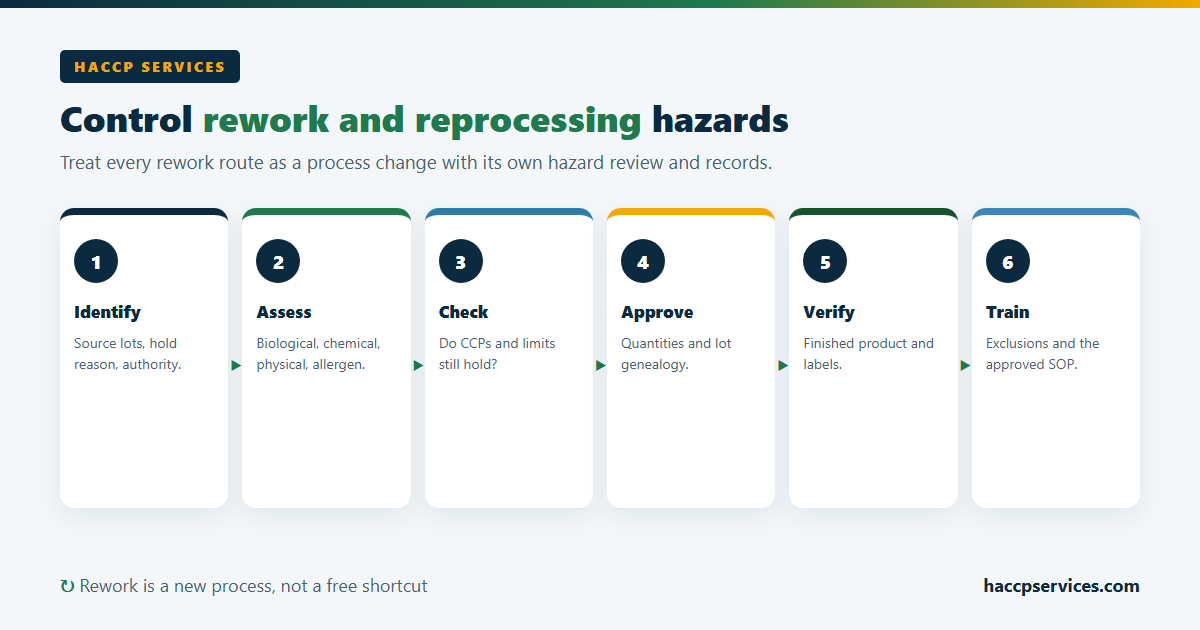
- Identify. Record the source lots, the reason for the hold and who has disposition authority before considering rework.
- Assess. Evaluate biological, chemical, physical and allergen hazards for the proposed route.
- Check. Determine whether existing controls, critical limits and monitoring remain valid for the changed process.
- Approve. Document approval, quantities and lot genealogy.
- Verify. Confirm finished product and label accuracy before release.
- Train. Exclude unsuitable materials and train staff on the approved rework procedure.
Where Part 117 applies and a preventive control fails, the corrective action steps in 21 CFR 117.150 must ensure that all affected food is evaluated for safety. They must also keep it out of commerce when its safety cannot be assured. Rework is never a way around that evaluation.
Records to keep
- The written rework procedure and its list of excluded materials.
- Hold records, the reason for each hold and the disposition decision.
- The hazard assessment for each rework route, including allergens.
- Approval records with quantities, dates and approvers.
- Lot genealogy linking rework lots to finished lots.
- Finished product verification and label checks.
- Training records for staff who handle rework.
Good genealogy also supports recall readiness. Our traceability and recall program service covers this link.
Example scenario: a bakery
A bakery plans to add off-spec baked pieces to a different product. However, the receiving recipe has a different allergen statement. In addition, the new line schedule introduces a cross-contact pathway that the plan never considered.
A controlled response starts by stopping the informal decision. The team checks whether the allergen profiles match and whether the label would still be accurate. It also reviews the line schedule for cross-contact. If the route is unsafe, the material is excluded and the decision is recorded. If the route is approved, the team documents quantities, genealogy and finished product checks. For more on allergen risks, see our article on HACCP allergen hazard controls.
Frequently asked questions
Is rework allowed under HACCP?
It can be, when the hazard analysis covers it and controls are in place. Whether it is permitted depends on the food, the process and the applicable regulation.
Can product held for a CCP deviation be reworked?
Only after a documented safety evaluation. Under Part 117, adulterated food must be reconditioned by a proven effective method, or reexamined and found not adulterated, before use in other food.
Does a rework procedure guarantee acceptance as an H-E-B supplier?
No. Sound rework controls support readiness, but supplier decisions rest with H-E-B. Also, “HACCP certification” is not a single legal certificate; it usually refers to a third-party audit.
HACCP rework and reprocessing checklist
- Identify source lots, the hold reason and disposition authority.
- Assess biological, chemical, physical and allergen hazards for each route.
- Confirm that controls, critical limits and monitoring remain valid.
- Document approval, quantities and lot genealogy.
- Verify finished product and labels before release.
- Exclude unsuitable materials and train staff on the approved procedure.
- Confirm current H-E-B supplier requirements with the relevant H-E-B contact.
How HACCP Services can help
HACCP Services, a service of Consultare Inc. Group, supports HACCP hazard reviews, rework procedures, process flow updates, traceability documentation and corrective action planning. Services are adapted to the specific product, site and customer program, subject to the engagement scope and the product’s governing regulations.
- Rework and product reprocessing control program development
- Product hold, release and disposition program development
- Corrective action management
- HACCP plan development
Is a rework shortcut creating a hazard your plan does not cover?
Share the products involved, your hazard analysis, rework SOP, allergen matrix and recent deviations. You can book a free consultation or contact our team.
Start building your compliance system
If you prefer to organize and manage your compliance activities yourself, you can also create a free SystemsBuilder account. Then begin building a structured system for your compliance documentation and processes.
Technical sources: Codex Alimentarius (General Principles of Food Hygiene, CXC 1-1969), FDA Hazard Analysis Critical Control Point (HACCP), 21 CFR 117.80 (processes and controls), 21 CFR 117.150 (corrective actions) and H-E-B supplier information. This article is independent educational content, not legal advice. HACCP Services is not affiliated with, sponsored or approved by H-E-B or FDA. H-E-B maintains an access-controlled supplier portal, and its supplier requirements must be confirmed directly with the relevant H-E-B supplier or purchasing contact. Applicability depends on the product, facility and customer arrangements.