
A HACCP plan for H-E-B suppliers is only useful when it matches what really happens on the production line. A plan that sits in a binder will not protect your next production run. Food safety risk is managed at the process, not in the formatting of a document. For a manufacturer exploring H-E-B distribution, hazard analysis must reflect receiving, processing, allergen changeovers, packaging and finished-product handling as they actually occur.
H-E-B publishes supplier information and runs an access-controlled supplier portal for authorized business partners. However, public information does not set out one detailed food safety checklist for every supplier. Therefore, confirm current food safety and commercial requirements with the relevant H-E-B supplier or purchasing contact.
Quick answer
Build the plan around your real process. Map and confirm every step, evaluate biological, chemical (including allergen) and physical hazards, and justify each control and critical control point (CCP). Then assign monitoring, deviation handling, verification and record ownership. Credible, current records help you explain your controls when a customer asks. Still, no HACCP plan or certificate guarantees acceptance as an H-E-B supplier.
Which rules apply to your plan?
HACCP is built on the Codex General Principles of Food Hygiene (CXC 1-1969) and the NACMCF principles. It uses hazard analysis, CCPs, critical limits, monitoring, corrective action, verification and records. In the U.S., however, a HACCP plan is mandatory only for certain sectors. FDA requires it for juice (21 CFR Part 120) and seafood (Part 123). USDA FSIS requires it for meat and poultry under 9 CFR Part 417.
Most other FDA-registered food facilities fall under 21 CFR Part 117 instead. There, the facility needs a written food safety plan, prepared or overseen by a preventive controls qualified individual (PCQI), under 21 CFR 117.126. The exact obligation depends on your product and operation, so decide which framework applies before you write anything. Our comparison of a HACCP plan and an FDA food safety plan explains the differences.
What a good plan looks like
- A verified process map. Every meaningful step appears, and the team has checked it on the floor.
- A reasoned hazard analysis. Each hazard has a severity and likelihood judgment, not just a name. Our hazard analysis page explains the method.
- Justified control decisions. The plan explains why a step is, or is not, a CCP.
- Clear ownership. Named roles monitor, record, review and escalate.
- Records that match the line. Logs show what really happened, shift by shift.
Common gaps between the plan and the line
Many gaps start small. For example, a flow diagram may skip a temporary holding stage. In other cases, an ingredient supplier changes and nobody revisits the hazard analysis. Typical problems include:
- Process steps added or changed since the last review.
- Allergen changeovers that are not reflected in the hazard analysis.
- Monitoring forms that do not record the time, the lot or the person.
- Corrective actions with no product disposition decision.
- Verification activities that are planned but not documented.
Ingredient risks deserve special attention. See our guide to HACCP ingredient hazard evaluation for a structured approach.
Practical steps to build a HACCP plan for H-E-B suppliers
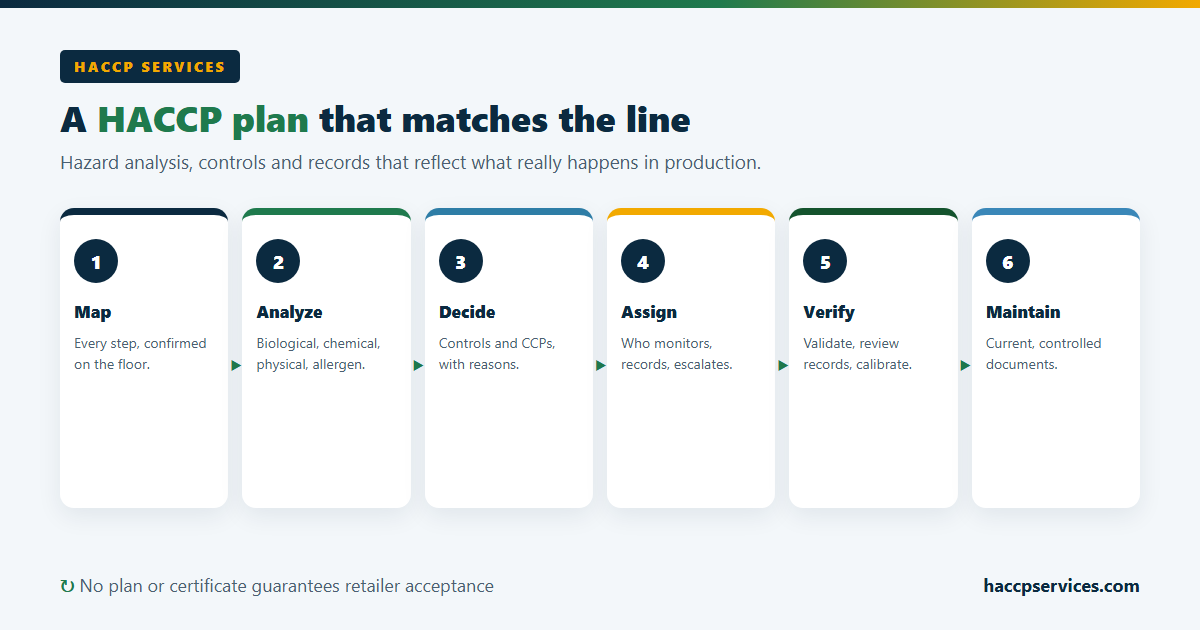
- Map the process. List each meaningful step and confirm it against actual production. Our article on verifying the flow diagram and hazard analysis shows how.
- Analyze hazards. Evaluate biological, chemical, physical and applicable allergen hazards at each step.
- Decide controls. Determine controls and any CCPs using a justified, documented method.
- Assign responsibilities. Specify who monitors each control, what is recorded and how deviations are handled.
- Verify. Validate and verify controls as required. For example, review records and calibrate instruments.
- Maintain. Keep documents controlled and current, and reassess them after any change.
Records to keep
- Product description, intended use and the verified flow diagram.
- The written hazard analysis, including the reasoning for each decision.
- The control or CCP list with critical limits or parameters.
- Monitoring records, deviation reports and corrective action records.
- Verification records, such as calibration, record reviews and validation evidence.
- Training records and the plan’s revision history.
Where Part 117 applies, 21 CFR 117.190 lists the implementation records a food safety plan requires. These include monitoring, corrective action and verification records.
Example scenario
A chilled prepared-food producer identifies a temperature-sensitive processing step. However, its recording practices are inconsistent between shifts. A HACCP-based review should establish the required control and its rationale. It should also create a monitoring record that matches daily operations, such as who reads the thermometer, when and for which lot.
For a business exploring H-E-B, the practical question is not whether a service guarantees acceptance. Instead, it is whether the company can clearly explain its records and responsibilities when asked.
What happens when this is overlooked?
If the hazard analysis misses an important step, or records do not reflect actual activity, problems follow. The facility may face repeated deviations, uncertain product disposition and gaps in verification evidence. A generic template cannot fix this, because the plan must describe your own process.
Frequently asked questions
Does H-E-B require HACCP certification?
Requirements can differ by product and supplier relationship, so confirm them with the relevant H-E-B contact. Also, “HACCP certification” is not a single legal certificate. It usually refers to a third-party audit of your HACCP system.
Do I need a HACCP plan or a food safety plan?
It depends on your product. Juice, seafood and USDA-inspected meat and poultry need HACCP plans. Most other FDA-registered facilities need a Part 117 food safety plan, which still relies on hazard analysis.
Is every hazard controlled at a CCP?
No. Many hazards are managed through prerequisite programs or other preventive controls. The choice should follow a documented hazard analysis.
HACCP plan for H-E-B suppliers checklist
- Confirm which regulatory framework applies to each product.
- Map each processing step and confirm it on the floor.
- Evaluate biological, chemical, physical and allergen hazards.
- Justify each control and CCP decision.
- Assign monitoring, deviation and verification responsibilities.
- Keep records controlled, current and consistent with the line.
- Confirm H-E-B-specific requirements with the relevant H-E-B contact.
How HACCP Services can help
HACCP Services, a service of Consultare Inc. Group, offers hazard analysis and plan development, process-flow documentation, monitoring and verification procedure support, and gap assessments. The goal is to connect written controls with your actual manufacturing process, not to sell a template. Deliverables are agreed with each client, and we do not promise any customer or regulatory outcome.
- HACCP plan development
- Facility and process flow optimization
- CCP monitoring system design
- HACCP certification and third-party audit preparation
Does your HACCP plan match your production line?
Share your product, processing steps, key hazards and existing plan, and we can discuss a scoped review. You can book a free consultation or contact our team.
Start building your compliance system
If you prefer to organize and manage your compliance activities yourself, you can also create a free SystemsBuilder account. Then begin building a structured system for your compliance documentation and processes.
Technical sources: Codex Alimentarius (General Principles of Food Hygiene, CXC 1-1969), FDA HACCP, 21 CFR 117.126 (food safety plan), 21 CFR 117.190 (records), 9 CFR Part 417 and H-E-B supplier information. This article is independent educational content, not legal advice. HACCP Services is not affiliated with, sponsored by or approved by H-E-B or FDA. H-E-B-specific supplier requirements must be confirmed with the relevant H-E-B supplier or purchasing contact. Applicability depends on the product, facility and customer arrangements.