
Prerequisite programs for H-E-B suppliers, and for any food manufacturer, are the foundation that every HACCP plan rests on. A facility can have a polished flowchart and several critical control points (CCPs). Yet if its cleaning verification, pest-control trending and supplier approval records are inconsistent, the plan has a weak base. A HACCP plan cannot make up for poor operating conditions.
This article explains what strong prerequisite programs look like, the gaps that most often appear, and how to fix them before you add more CCPs. Requirements depend on the product, the facility, the business relationship and current law. Therefore, confirm any H-E-B expectations directly with the relevant H-E-B supplier or purchasing contact.
Quick answer
Map your prerequisite programs to your products, process steps and hazards. Then make sure sanitation, pest control, personnel hygiene, water, maintenance, receiving and supplier approval each have a defined method, an owner and verification records. Fix recurring failures in these programs at the source instead of adding more HACCP monitoring points. Strong prerequisite programs support supplier readiness, but they do not guarantee acceptance by H-E-B.
Why prerequisite programs come before CCPs
HACCP systems depend on appropriate prerequisite programs, such as sanitation, personal hygiene and maintenance. The Codex General Principles of Food Hygiene (CXC 1-1969) treat these good hygiene practices as the base for the HACCP system. In other words, CCPs are meant to control specific significant hazards. They are not designed to compensate for a dirty line or an uncontrolled pest problem.
The legal framework depends on the product. FDA mandates HACCP for juice (21 CFR Part 120) and seafood (Part 123), while USDA-inspected meat and poultry plants follow 9 CFR Part 417. Most other FDA-registered food facilities fall under 21 CFR Part 117. That rule combines current good manufacturing practices (CGMPs) with hazard analysis and risk-based preventive controls. For example, 21 CFR 117.35 covers sanitary operations, including pest control. For a step-by-step review, see our HACCP prerequisite checklist before critical control points.
What good prerequisite programs look like
- Sanitation. Written cleaning methods for each area and piece of equipment, with verification and a clear escalation route when cleaning fails.
- Pest control. Exclusion measures, monitoring devices, trend reviews and documented follow-up on activity.
- Personnel hygiene. Handwashing, clothing, illness reporting and training that match the risk of each zone.
- Water, maintenance and receiving. Defined checks on water quality, equipment condition and incoming materials.
- Supplier approval. Approved supplier lists, specifications and evidence that supplier risks were evaluated.
- Allergen procedures. Storage, scheduling and changeover practices that prevent cross-contact.
Sanitary design also matters, because equipment that cannot be cleaned will defeat even a good procedure. Our article on sanitary design as a foundation for HACCP programs covers this in more detail.
Common gaps in prerequisite programs
- Cleaning without verification. Sign-off sheets exist, but no inspection or testing shows that cleaning worked.
- Pest data without trending. Service reports are filed, yet nobody reviews repeat activity in the same area.
- Supplier files that are out of date. Approvals rest on old documents or on a signed statement alone.
- No escalation route. Repeat findings are corrected again and again, but the root cause is never addressed.
- Wrong tool for the problem. More CCPs are added to cover a failing prerequisite program.
Practical steps to fix prerequisite program gaps
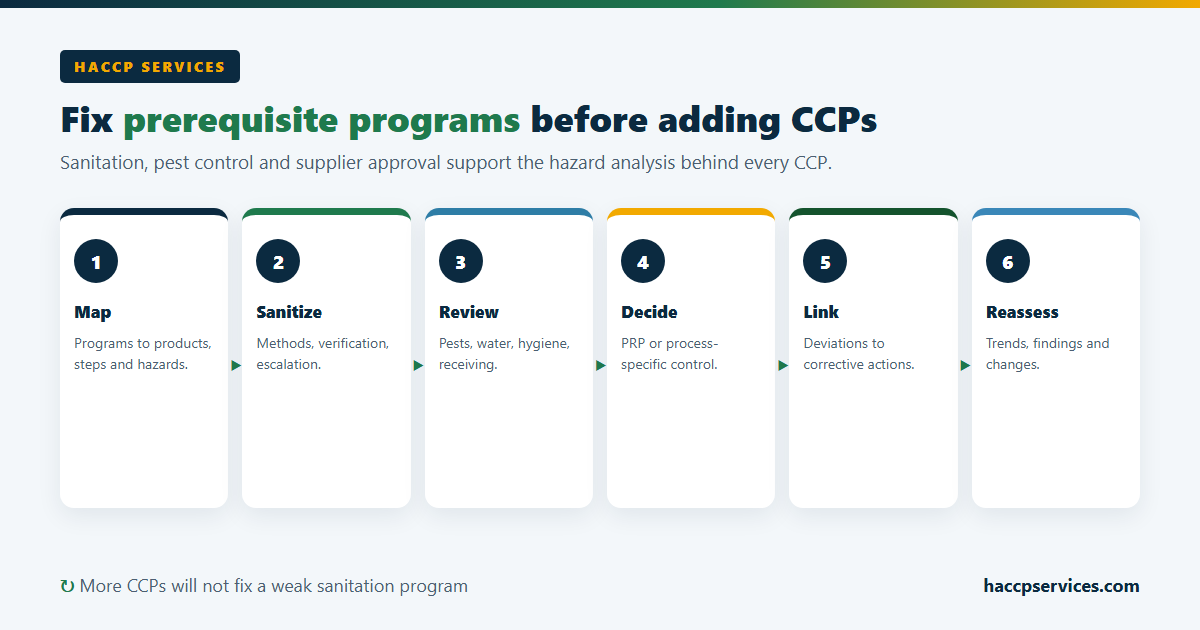
- Map. Link each prerequisite program to the products, processing steps and hazards it supports.
- Sanitize. Define cleaning methods, verification records and escalation for ineffective cleaning. Our page on HACCP sanitation verification explains how to show cleaning works.
- Review. Check pest control, water, personnel hygiene, receiving, maintenance and allergen procedures against what actually happens on the floor.
- Decide. Determine which hazards need a process-specific control rather than reliance on general prerequisites. This decision belongs in your HACCP hazard analysis.
- Link. Connect deviations and corrective actions to evidence and clear ownership.
- Reassess. Use trends, audit findings and process changes to update the programs and the HACCP plan.
Where Part 117 applies
For facilities under Part 117, some hazards that a HACCP plan would call “prerequisites” may require a sanitation preventive control. Under 21 CFR 117.135(c)(3), sanitation controls address hazards such as environmental pathogens, employee handling and food allergens. They include the cleanliness of food-contact surfaces and prevention of cross-contact and cross-contamination. Notably, sanitation controls do not need validation under 21 CFR 117.160(c). However, they still need verification, as appropriate, and records.
Records to keep
- Written sanitation procedures, cleaning records and verification results.
- Pest control service reports, device maps and trend reviews.
- Personnel hygiene and training records.
- Water, maintenance and receiving checks.
- Approved supplier list, specifications and supplier evaluation records.
- Deviation, corrective action and reassessment records with named owners.
Example scenario: a sauce manufacturer
A sauce manufacturer plans a retail launch. However, an environmental inspection finds recurring cleaning misses around packaging equipment. Instead of fixing the sanitation program, the plant keeps adding HACCP monitoring points.
A better response starts with the cleaning failure itself. The team reviews the cleaning method, the equipment design and the verification records for that area. Then it assigns an owner, sets an escalation rule for repeat misses and records the corrective actions. Finally, it reassesses the hazard analysis to confirm whether any hazard truly needs a process-specific control. If the product is intended for H-E-B consideration, this evidence should be settled before the program is described as ready.
Frequently asked questions
Can a CCP replace a weak sanitation program?
No. CCPs control specific significant hazards at defined steps. Recurring sanitation failures need to be fixed in the sanitation program itself.
Are prerequisite programs a legal requirement?
It depends on the product. For most FDA-registered facilities, Part 117 CGMPs cover many of the same areas, such as sanitary operations and pest control. Juice, seafood and USDA-inspected products have their own HACCP rules.
Do strong prerequisite programs guarantee acceptance as an H-E-B supplier?
No. Sound programs and credible records support readiness, but supplier decisions rest with H-E-B. Also, “HACCP certification” is not a single legal certificate; it usually refers to a third-party audit.
Prerequisite programs for H-E-B suppliers checklist
- Map prerequisite programs to products, process steps and hazards.
- Define sanitation methods, verification records and escalation for ineffective cleaning.
- Review pest control, water, personnel hygiene, receiving, maintenance and allergen procedures.
- Decide which hazards need process-specific controls.
- Connect deviations, corrective actions and reassessments to evidence and owners.
- Confirm current H-E-B supplier requirements with the relevant H-E-B contact.
How HACCP Services can help
HACCP Services, a service of Consultare Inc. Group, develops and reviews HACCP plans and prerequisite procedures. We also evaluate process flows and hazard analyses and support sanitation and corrective action documentation. Services are adapted to the specific product, site and customer program, subject to the engagement scope.
- Prerequisite programs (PRP) gap assessment and development
- HACCP sanitation program development
- HACCP supplier program evaluation
- HACCP plan development
Are sanitation or pest control gaps weakening your HACCP plan?
Share your HACCP plan, sanitation verification records, recent deviations and process flow diagram. You can book a free consultation or contact our team.
Start building your compliance system
If you prefer to organize and manage your compliance activities yourself, you can also create a free SystemsBuilder account. Then begin building a structured system for your compliance documentation and processes.
Technical sources: Codex Alimentarius (General Principles of Food Hygiene, CXC 1-1969), FDA HACCP Principles and Application Guidelines, 21 CFR 117.35 (sanitary operations), 21 CFR 117.135 (preventive controls), 21 CFR 117.160 (validation) and H-E-B supplier information. This article is independent educational content, not legal advice. HACCP Services is not affiliated with, sponsored or approved by H-E-B or FDA. H-E-B maintains an access-controlled supplier portal, and its supplier requirements must be confirmed directly with the relevant H-E-B supplier or purchasing contact. Applicability depends on the product, facility and customer arrangements.