
Flow verification before production expansion helps you find hidden hazards before larger volumes reach the market. Your HACCP plan may be detailed and still miss a step on the production floor. A process flow diagram is the backbone of a meaningful hazard analysis. When it omits rework, waiting time, material transfers or outsourced steps, the HACCP team may overlook hazards and misplace controls.
Expanding production for a major retail customer raises the stakes. This article is for manufacturers preparing for possible H-E-B supply. H-E-B maintains supplier channels and an access-controlled supplier portal for authorized business partners. However, public information does not set out one detailed food safety checklist for all suppliers. Therefore, verify current requirements with the appropriate H-E-B purchasing or supplier team.
Quick answer
Before you scale up, walk the full process from receiving to dispatch and compare it with the diagram. Then look for new holding stages, transfers, rework loops and outsourced steps. Next, assess whether the change introduces a new hazard or increases an existing one. Finally, re-evaluate control and CCP decisions, approve revisions, train staff and keep change-control evidence.
Why the flow diagram comes first
Codex HACCP methodology, in the General Principles of Food Hygiene (CXC 1-1969), starts with preliminary steps. The team describes the product and its intended use, constructs a flow diagram and confirms it on site. Only then does it carry out the hazard analysis. Our article on process flow diagram verification explains this sequence.
The aim is not to force every hazard into a critical control point. Instead, it is to see where hazards may arise and which controls fit. See our critical control points page for how CCPs are chosen.
What the rules say about change
Requirements vary by food category. Juice and seafood follow HACCP regulations in 21 CFR Parts 120 and 123, and USDA-inspected meat and poultry follow 9 CFR Part 417. Most other FDA-registered facilities fall under 21 CFR Part 117.
Under Part 117, 21 CFR 117.170 requires reanalysis of the food safety plan, or the relevant part, after a significant change. That applies when the change creates a reasonable potential for a new hazard or a significant increase in an existing one. In general, the reanalysis must be completed before the change takes effect. A PCQI must perform or oversee it. A move to larger batches, new equipment or a new shift pattern may well qualify.
Common hidden hazards in a flow diagram
- Temporary holding stages. Product waits between steps, which can create time-temperature abuse.
- Rework loops. Rework re-enters the process without appearing on the diagram.
- Material transfers. Pumps, bins and hoses add contact surfaces and cleaning needs.
- Outsourced steps. A co-packer or storage site handles part of the process.
- Shift differences. Night or weekend crews follow a different route.
Practical steps for flow verification before production expansion
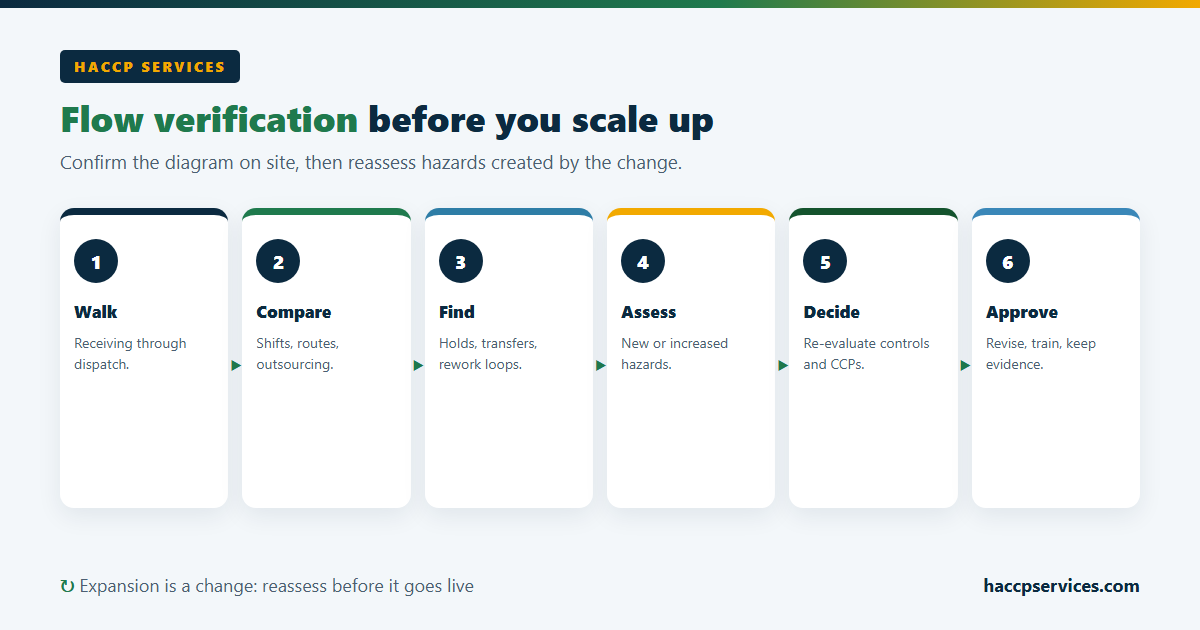
- Walk the process. Follow the product from receiving through storage, rework, processing and dispatch.
- Compare. Check the diagram against each shift, equipment route and outsourcing arrangement.
- Find changes. Note new holding stages, transfers or rework loops created by the expansion.
- Assess hazards. Identify where biological, chemical, physical and allergen hazards might be introduced or increased. Our hazard analysis page explains how.
- Decide controls. Re-evaluate CCP and other control decisions under the applicable framework.
- Approve and train. Approve revisions, train affected staff and keep change-control evidence.
Records to keep
- The current, dated flow diagram and its earlier versions.
- Walkthrough notes, with the date, the shift and who took part.
- The hazard analysis update and reasons for each decision.
- Change-control approvals for equipment, batch size or layout changes.
- Validation evidence for any new or changed control.
- Training records for staff affected by the change.
Example scenario
A manufacturer of a Texas-style specialty salsa plans greater volume for H-E-B. Its flow diagram skips a temporary holding stage between cooking and filling. Previously, the HACCP team assessed the process without examining the new time-temperature exposure created by the larger batch size.
A walkthrough would reveal the holding stage. The team would then assess whether longer holding could allow pathogen growth, and decide whether a time or temperature control is needed. It would also update the diagram, revise the plan and train the operators before the first large batch. For a related retail example, see our post on the flow diagram and hazard analysis.
What happens when this is overlooked?
An inaccurate flow diagram can create a HACCP file that looks complete but does not match actual manufacturing practice. As a result, controls may sit at the wrong steps. Our guide to a HACCP plan for H-E-B suppliers covers the wider plan.
Frequently asked questions
How often should we verify the flow diagram?
At least whenever the process changes, and as part of each periodic plan review. Many teams also walk the line during routine verification.
Does more volume always need a new hazard analysis?
Not always. However, larger batches often change holding times, cooling loads or equipment use. Assess the change and document your conclusion either way.
Will flow verification guarantee acceptance by H-E-B?
No. It supports readiness, but supplier decisions rest with H-E-B. Confirm specific requirements with the relevant H-E-B contact.
Flow verification before production expansion checklist
- Walk the full process from receiving to dispatch.
- Compare the diagram with each shift, route and outsourced step.
- Find new holding stages, transfers and rework loops.
- Assess new or increased hazards from the expansion.
- Re-evaluate CCP and other control decisions.
- Approve revisions, train staff and keep change-control records.
- Confirm H-E-B-specific requirements with the relevant H-E-B contact.
How HACCP Services can help
HACCP Services, a service of Consultare Inc. Group, supports process-flow reviews, hazard analysis, HACCP plan development or revision, verification procedures and internal audit readiness. Where Part 117 applies, this work is coordinated with PCQI responsibilities. Deliverables are agreed with each client, and we do not promise any customer or regulatory outcome.
- Facility and process flow optimization
- New product and process change impact assessment
- HACCP plan reassessment and annual review
- HACCP plan development
Planning to scale up production?
Share your current flow diagram, product description, equipment changes and latest plan review for a targeted walkthrough assessment. You can book a free consultation or contact our team.
Start building your compliance system
If you prefer to organize and manage your compliance activities yourself, you can also create a free SystemsBuilder account. Then begin building a structured system for your compliance documentation and processes.
Technical sources: Codex Alimentarius (General Principles of Food Hygiene, CXC 1-1969), FDA HACCP, 21 CFR 117.170 (reanalysis), 21 CFR Part 117 and H-E-B supplier information. This article is independent educational content, not legal advice. HACCP Services is not affiliated with, sponsored by or approved by H-E-B or FDA. H-E-B-specific supplier requirements must be confirmed with the relevant H-E-B supplier or purchasing contact. Applicability depends on the product, facility and customer arrangements.