
Thermal process validation shows, with evidence, that a heat step consistently controls the intended hazard in your product and on your equipment. A process that seems to reach the right temperature may still lack that evidence. As a result, unclear validation can lead to difficult product release and audit decisions.
For businesses preparing to supply Walmart, sound process evidence supports supplier confidence. However, applicable requirements depend on the product, the facility, the commercial relationship and current law. Confirm them directly with the relevant Walmart contact before treating any practice below as a mandatory Walmart rule.
Quick answer
Define the product and the hazard the heat step must control. Then identify the critical parameters, review the validation evidence with competent technical staff and turn validated conditions into operating limits and monitoring. Finally, reassess whenever key factors change. Good validation supports readiness, but it does not guarantee acceptance as a Walmart supplier.
Who this article is for
This guide is for food manufacturers, process engineers, HACCP teams and quality leaders responsible for cooking, pasteurizing or other heat treatments.
1. Identify the product and the required lethality objective
Describe the food, target organisms or hazards, packaging, equipment, intended storage and process conditions. Next, determine the right regulatory and scientific basis. This includes whether a recognized process authority or specialized validation is needed. For example, mandatory HACCP rules apply to meat and poultry (9 CFR Part 417), juice (21 CFR Part 120) and seafood (21 CFR Part 123). Most other FDA-registered facilities follow 21 CFR Part 117, where 21 CFR 117.135(c)(1) names heat processing as a process control. Our page on thermally processed, commercially sterile products covers one specialized category.
2. Evaluate critical process parameters
Review time, temperature, heating profile, fill weights, product viscosity, equipment capacity and other relevant factors. The parameters to validate are product-specific. Therefore, do not assume an unrelated thermal study applies to your product. Under Part 117, process controls must include the parameters and the minimum or maximum values that control the hazard. See HACCP critical limits for how limits are set.
3. Review the validation evidence
Assess the study scope, worst-case assumptions, data integrity, sensor placement, methodology and conclusions with competent technical personnel. A thermal process statement without supporting technical evidence may not be enough for the actual product and equipment. Where Part 117 applies, 21 CFR 117.160 requires validation based on scientific and technical evidence, or studies when that evidence is inadequate. Our article on validation versus verification for food plants explains the difference.
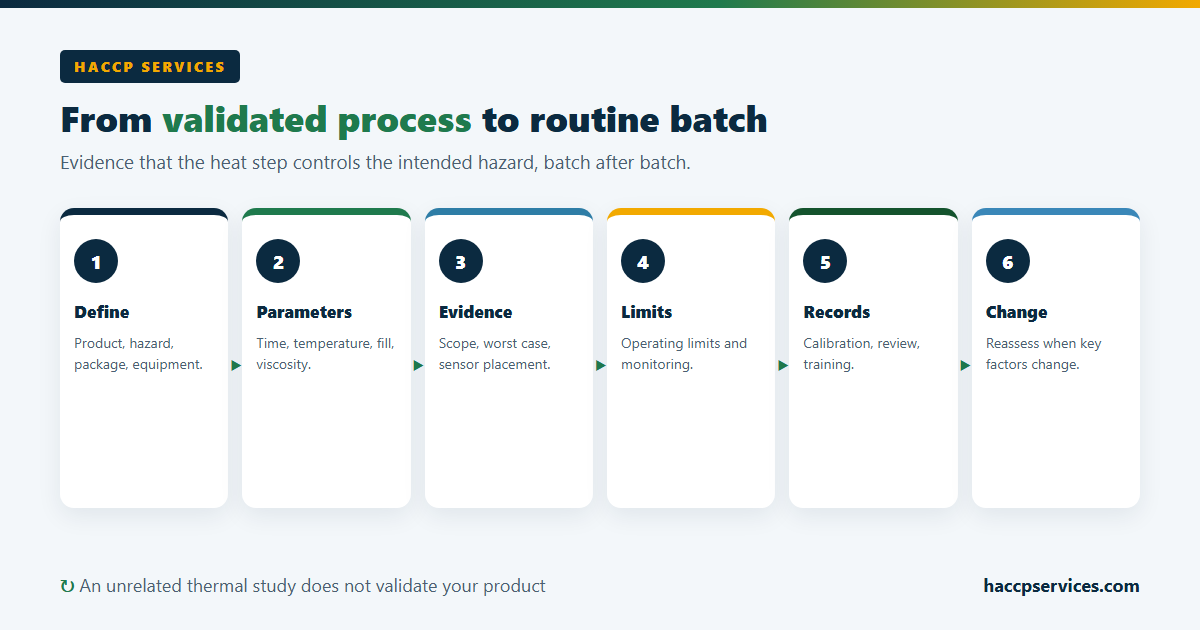
4. Connect validation with monitoring
Translate validated parameters into controlled operating limits, routine monitoring, deviation handling and product disposition. Operators should know exactly what to check, how often and what to do when a value falls outside the limit.
5. Prove routine batches match validated conditions
Use calibration, record review and operator training to show that routine batches run under the validated conditions. Calibration of process monitoring instruments is one of the verification activities listed in 21 CFR 117.165. In addition, our Walmart supplier HACCP verification article covers record review in more depth.
6. Control changes after validation
Reassess the process when formulations, package size, equipment, load configuration or other critical factors change. Part 117 also calls for validation whenever a change could affect whether a control measure works. Verify relevant Walmart certification or supplier requirements separately from product-specific regulatory obligations.
Frequently asked questions
Can we reuse a thermal study from another product?
Only if it is shown to apply. Parameters are product- and equipment-specific, so an unrelated study should not be assumed valid.
Is reaching a target temperature the same as validation?
No. Validation is the scientific and technical evidence that the process, run as designed, controls the hazard. Routine temperature checks are monitoring and verification.
Does thermal process validation guarantee acceptance as a Walmart supplier?
No. It supports readiness, but supplier approval rests with Walmart. Also, “HACCP certification” is not a single legal certificate; it usually refers to a third-party audit.
Supplier readiness checklist
- Identify the product and the required lethality objective.
- Evaluate critical process parameters.
- Review the validation evidence.
- Connect validation with monitoring.
- Prove routine batches match validated conditions.
- Control changes after validation.
- Confirm the applicable Walmart supplier program and all relevant product and facility requirements.
- Assign owners for documentation, follow-up actions and periodic review.
How HACCP Services can help
HACCP Services, a service of Consultare Inc. Group, can help organize thermal process records, identify evidence gaps, coordinate appropriate specialist review and strengthen monitoring and change-control documentation, subject to the engagement scope.
- HACCP plan validation and scientific justification
- Calibration and measurement control program
- Food safety change management
- CCP monitoring system design
Can you demonstrate that your thermal process is effective?
Discuss your product, process and existing validation evidence with our team. You can book a free consultation or contact our team.
Start building your compliance system
If you prefer to organize and manage your compliance activities yourself, you can also create a free SystemsBuilder account. Then begin building a structured system for your compliance documentation and processes.
Technical sources: Codex Alimentarius (General Principles of Food Hygiene, CXC 1-1969), FDA FSMA Final Rule for Preventive Controls for Human Food, 21 CFR Part 117 and Walmart supplier requirements. This article is independent educational content, not legal advice. HACCP Services is not affiliated with or endorsed by Walmart Inc. or FDA. Walmart-specific supplier requirements must be confirmed directly with the relevant Walmart contact. Regulatory applicability depends on the product, facility, activity and current law.