
HACCP verification audits compare the approved plan with what actually happens on the production floor, so gaps are found before they become failures. Documents can look complete while daily practices slowly drift away from the plan. Regular verification helps you spot that difference early and fix it.
For manufacturers supplying large retailers, an internal verification audit is also a practical rehearsal for customer and third-party audits. Walmart supplier requirements can differ by product, facility and commercial relationship. Therefore, confirm them directly with the relevant Walmart contact before treating any practice in this guide as a mandatory Walmart rule.
Quick answer
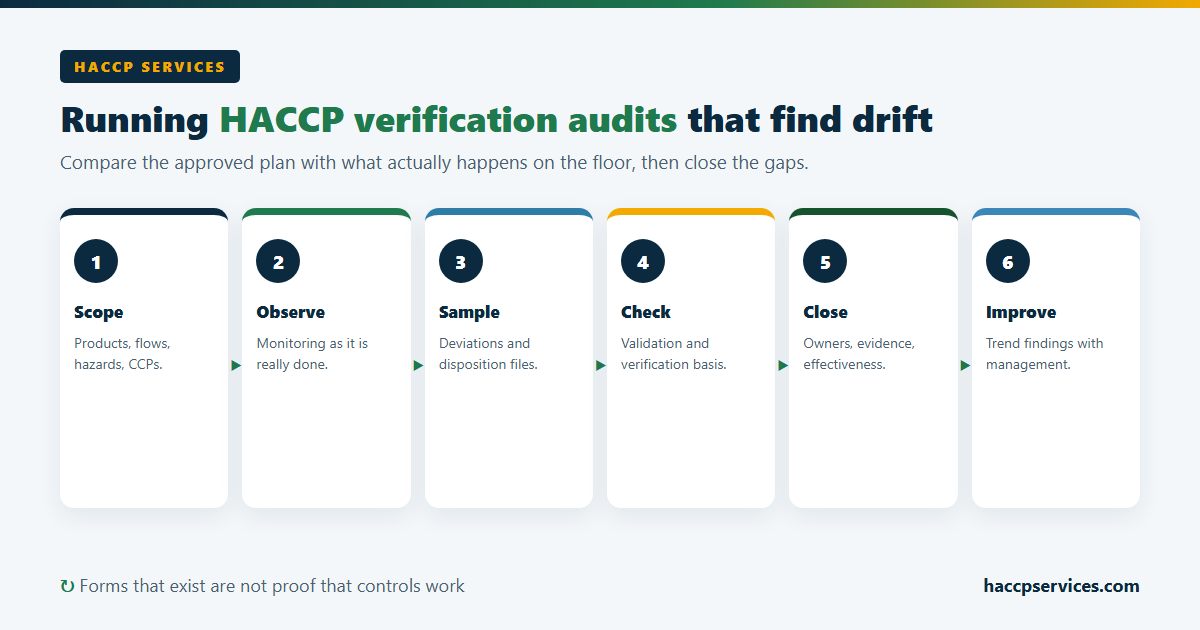
Define the audit scope, then observe monitoring as it is really done. Sample deviation and disposition files, and check that validation and verification evidence exist for each control. Finally, assign owners to every finding, confirm effectiveness and review trends with management.
Who this article is for
This guide is for HACCP coordinators, PCQIs, internal auditors and quality leaders at food manufacturing plants. For the broader evidence set retail customers expect, see our article on Walmart supplier HACCP verification.
1. Define the plan and process scope
Select the products, process flows, hazards, CCPs where applicable and related prerequisite programs for review. Then confirm that the hazard analysis still reflects actual manufacturing activities. An audit that only checks paperwork against paperwork will miss process changes.
2. Test monitoring implementation
Check whether employees use the approved limits, equipment, forms and frequencies in routine production. Observe actual operations and compare them with recorded data. In other words, confirm that the check happened as written, not just that a form exists. Our article on HACCP monitoring records and verification review covers record review in detail.
3. Review deviations and disposition
Sample out-of-limit events for immediate control, affected-product evaluation, corrective action and documented approval. Next, check whether recurring issues led to effective preventive improvement. For FDA-registered facilities under Part 117, records review must confirm that appropriate decisions were made about corrective actions, under 21 CFR 117.165.
4. Review validation and verification evidence
Confirm that relevant controls have an appropriate technical basis and that required verification activities are carried out. Validation requirements for Part 117 facilities appear in 21 CFR 117.160. Seafood and meat and poultry HACCP rules set verification duties in 21 CFR 123.8 and 9 CFR 417.4. To keep the two concepts apart, read HACCP validation versus verification for food plants.
5. Track and close audit findings
Assign an owner, a due date and evidence of implementation to each finding. Then run an effectiveness check before closing it. As a result, the same finding should not return at the next audit. Review open findings and trends with management on a set schedule. Our article on HACCP program effectiveness offers further checks. Meanwhile, check separate Walmart or certification requirements for your supplier relationship.
Frequently asked questions
How is a verification audit different from routine record review?
Routine review checks individual records soon after they are made. A verification audit looks across the system, including floor practice, trends and whether controls still fit the process.
Who should conduct HACCP verification audits?
Trained people who are reasonably independent of the area audited. A PCQI must perform or oversee certain Part 117 verification activities, such as records review.
Do clean audit results guarantee acceptance as a Walmart supplier?
No. Strong audit results support readiness. However, supplier approval rests with Walmart and its own requirements.
Supplier readiness checklist
- Define the plan and process scope for each audit.
- Test monitoring implementation on the floor.
- Review deviations and disposition decisions.
- Review validation and verification evidence.
- Track and close findings with effectiveness checks.
- Verify the applicable Walmart supplier program and all relevant product and facility requirements.
- Assign owners for documentation, follow-up actions and periodic review.
How HACCP Services can help
HACCP Services, a service of Consultare Inc. Group, conducts targeted HACCP document and process reviews, identifies gaps and helps organize follow-up evidence, subject to the engagement scope.
- HACCP regulatory compliance audits
- Third-party audit preparation
- Management review and performance evaluation
- Corrective action management
Would your HACCP program hold up to a real process verification audit?
Review your controls, audit evidence and corrective actions with our team. You can book a free consultation or contact our team.
Start building your compliance system
If you prefer to organize and manage your compliance activities yourself, you can also create a free SystemsBuilder account. Then begin building a structured system for your compliance documentation and processes.
Technical sources: Codex Alimentarius (General Principles of Food Hygiene, CXC 1-1969), FDA FSMA Final Rule for Preventive Controls for Human Food, 21 CFR 117.160, 21 CFR 117.165, 21 CFR 123.8, 9 CFR 417.4 and Walmart supplier requirements. This article is independent educational content, not legal advice. HACCP Services is not affiliated with or endorsed by Walmart Inc. or FDA. Walmart-specific supplier requirements must be confirmed directly with Walmart. Regulatory applicability depends on the product, facility, activity and current law.