
A supplier HACCP deviation does not always require an FSVP corrective action, but it always deserves a documented evaluation by the importer. A missing CCP monitoring record, a failed critical limit or a repeated verification failure can all be relevant to your FSVP. Simply filing the deviation report is not enough.
This article explains when the FSVP rule requires importer corrective action, how to evaluate a supplier deviation and what to keep on file.
Quick answer
Under 21 CFR 1.508(a), you must promptly take appropriate corrective action in two situations. The first is when you determine that a foreign supplier does not produce food under processes and procedures giving at least the same public health protection as the applicable FD&C Act requirements. The second is when the supplier produces adulterated food, or food misbranded under section 403(w) where applicable. You must document any corrective action. If you learn of the problem by other means than your verification or reevaluation, 1.508(b) also requires you to investigate whether your FSVP is adequate.
How supplier deviations reach the importer
Inside the supplier’s plant, a deviation triggers the supplier’s own HACCP corrective action. That usually means controlling affected product, fixing the cause and recording what happened. Our page on HACCP corrective actions describes this plant-level process.
The importer’s question is different. Does the deviation show that the supplier is not producing safe food, or that your verification is not giving adequate assurance? Under 1.506(e)(3), if verification results do not provide adequate assurance that hazards requiring a control are significantly minimized or prevented, you must take action under 1.508(a).
Not every deviation leads to the same response. A deviation that the supplier caught, contained and corrected may support confidence in its system. In contrast, an unexplained critical limit failure with no product disposition is a much larger concern.
What good supplier evidence looks like
- The HACCP plan scope covers the product you import.
- CCP monitoring records show the deviation and when it was found.
- The deviation report states the affected lots and product disposition.
- A root-cause analysis explains why it happened.
- Verification shows the corrective action worked.
Seek objective evidence before you accept closure. An email assurance is not the same as a hold and release record. See our article on HACCP deviation handling and product disposition for what complete disposition looks like.
Scope and exemptions
Some foods and importers follow different rules. Under 21 CFR 1.501(b), the FSVP subpart does not apply to certain juice and seafood. The exemption covers products from a supplier that must comply with, and is in compliance with, Part 120 or Part 123. Those importers follow 120.14 or 123.12. In the U.S., HACCP is mandatory for juice, seafood and USDA-inspected meat and poultry (9 CFR Part 417). Most other FDA-registered facilities follow Part 117 preventive controls, and Codex CXC 1-1969 sets international HACCP principles. Also, 1.508(c) states that the section does not limit other FDA obligations, such as those relating to recalls.
Common gaps
- Critical limit failures are left unexplained.
- Corrective actions lack product disposition evidence.
- The same deviation repeats across several periods.
- The importer has no documented evaluation of the deviation.
Practical steps
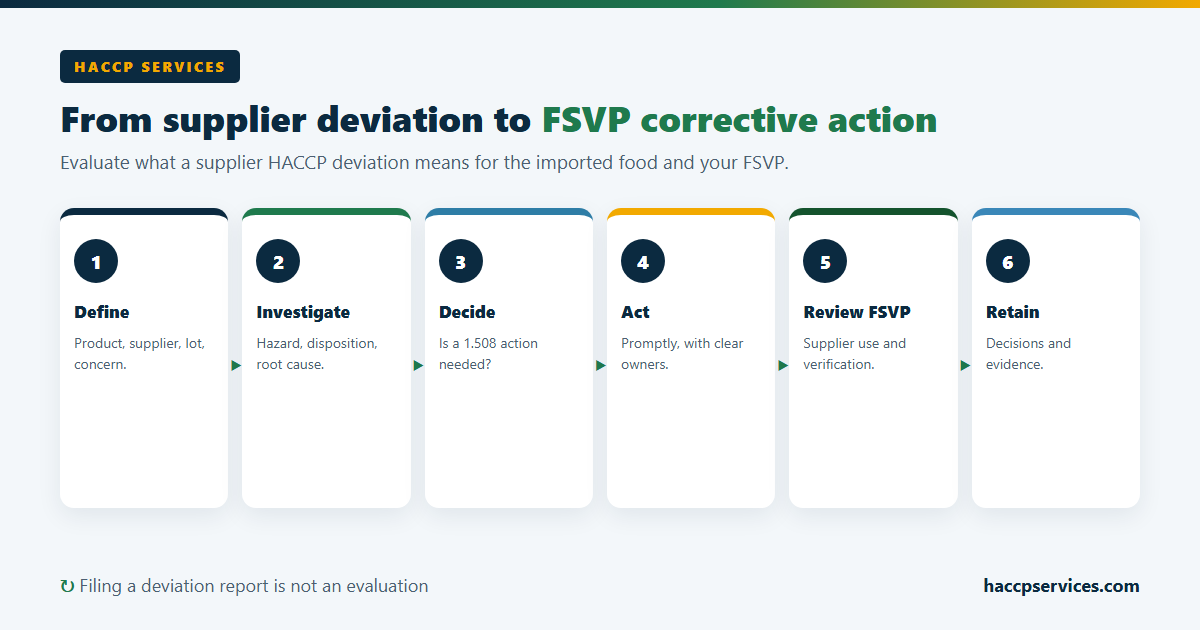
- Define. Capture the product, supplier, lot or time period, available evidence and the specific concern.
- Investigate. Obtain supplier information on the hazard, product disposition and root cause. Consider prior performance.
- Decide. Determine whether the facts meet the 1.508 threshold or reveal a significant food safety concern.
- Act. When required, promptly take appropriate corrective action and assign owners. Depending on the facts, this could include discontinuing use of the supplier until the cause is addressed.
- Review the FSVP. Decide whether supplier approval or verification activities should change. This may also be new information for a reevaluation under 1.505(c).
- Retain. Keep the investigation, decisions and supplier communications retrievable under 21 CFR 1.510.
For root-cause methods, see our service page on HACCP deviation investigation and root cause analysis.
Records to keep
- The supplier deviation report and supporting evidence.
- Your evaluation, including dates, evidence considered and who was involved.
- Any FSVP corrective action taken, as 1.508(a) requires.
- Any investigation of FSVP adequacy and resulting changes, as 1.508(b) requires.
- The status of supplier follow-up and closure evidence.
Keep binding FSVP requirements separate from optional quality tools, customer expectations and voluntary certifications. A checklist or certificate alone does not decide compliance.
Example scenario
A foreign supplier of a cooked frozen meal component reports two cooking temperature deviations in one month. The report says product was “reprocessed” but gives no lot numbers or records.
The importer’s qualified individual requests the CCP records, disposition records and root-cause analysis. The supplier shows that the affected lots were held, recooked and verified, and that a faulty probe was replaced. The importer documents its evaluation and concludes no 1.508 corrective action is needed. However, it increases the frequency of records review for the next two quarters and records that change.
Frequently asked questions
Does every supplier HACCP deviation require an FSVP corrective action?
No. The importer must evaluate it. Corrective action under 1.508 is required when the supplier is not producing food with the required level of protection, or produces adulterated or misbranded food under the cited provisions.
What could an FSVP corrective action include?
It depends on the circumstances. The rule gives one example: discontinuing use of the supplier until the cause of the problem has been adequately addressed.
Who decides on FSVP corrective action?
The importer remains responsible. FSVP activities must be performed by a qualified individual under 1.503.
FSVP corrective action checklist
- Confirm FSVP applies and check for exemptions or modified requirements.
- Match each deviation to the imported food, supplier and lot.
- Obtain disposition, root-cause and verification evidence.
- Decide whether a 1.508 FSVP corrective action is required.
- Review supplier approval and verification activities.
- Document decisions and keep records retrievable.
How HACCP Services can help
HACCP Services, a service of Consultare Inc. Group, helps importers map supplier HACCP deviations to FSVP responsibilities, review corrective action records, build issue registers and track client-approved follow-up, subject to the engagement scope. We provide independent consulting support, not FDA approval or delegated importer authority, and the need for any additional verification, recall-related activity or supplier suspension depends on the facts. For FSVP program support, see our sister site FSVP Services.
- Corrective action management
- Product hold, release and disposition
- HACCP supplier program evaluation
- HACCP recordkeeping system setup
Need help evaluating a supplier deviation?
Discuss your products, suppliers, deviation reports and upcoming decisions with our team. You can book a free consultation or contact our team.
Start building your compliance system
If you prefer to organize and manage your compliance activities yourself, you can also create a free SystemsBuilder account. Then begin building a structured system for your compliance documentation and processes.
Technical sources: 21 CFR 1.508 (corrective actions), 21 CFR 1.506 (verification), 21 CFR 1.503 (qualified individual), 21 CFR 1.510 (records) and the Codex General Principles of Food Hygiene (CXC 1-1969). This article is educational and is not legal advice; HACCP Services is not affiliated with FDA. FSVP obligations vary by food, importer, supplier and any exemptions or modified requirements, and conclusions about a specific supplier should be reached by a qualified individual.