
An FSVP qualified individual is defined by the task, not by a certificate: the person needs the education, training or experience to perform the assigned FSVP activity. HACCP and preventive controls knowledge can be very useful. However, a HACCP certificate or PCQI training does not automatically make someone the right reviewer of a foreign supplier’s evidence.
This article compares the FSVP qualified individual with the preventive controls qualified individual (PCQI) under Part 117. It also explains how to assign and document FSVP review roles.
Quick answer
Under 21 CFR 1.503(a), a qualified individual must develop your FSVP and perform each required activity. That person needs the education, training or experience, or a combination, to perform the assigned activities. The person must also be able to read and understand the language of any records reviewed. The FSVP rule does not require PCQI training, HACCP training or a dedicated FSVP certificate. Training can help show qualification, but the test is fitness for the specific task.
FSVP qualified individual versus PCQI
The two roles come from different rules and do different jobs:
- FSVP qualified individual. Defined in 21 CFR 1.500. The person may be, but does not have to be, an employee of the importer. A government employee, including a foreign government employee, may also be a qualified individual.
- PCQI. Defined in 21 CFR 117.3. A PCQI has completed training in risk-based preventive controls at least equivalent to an FDA-recognized standardized curriculum, or is qualified through job experience. Under 21 CFR 117.180, a PCQI must do or oversee tasks such as preparing a facility’s food safety plan, validation, records review and reanalysis.
In short, the PCQI role belongs to a food facility’s own food safety plan. The FSVP qualified individual role belongs to the importer’s supplier verification program. One person can hold both roles, but each must be justified on its own. Our article on the HACCP plan vs FDA food safety plan explains the facility side.
Where HACCP knowledge helps
Many foreign suppliers run HACCP-based systems. A reviewer who understands hazard analysis, CCPs, critical limits and corrective actions can read supplier records more effectively. That skill matters when you review supplier HACCP plans, monitoring logs and deviation reports. For the hazard side of sourcing, see our article on imported ingredient supplier controls.
Even so, product knowledge also counts. A reviewer experienced with dairy may need added expertise for low-moisture foods or seafood. Language counts as well, because the qualified individual must understand the records reviewed.
A separate role applies to audits. Under 1.503(b), an onsite audit under 1.506(e)(1)(i) must be done by a qualified auditor. A qualified auditor is a qualified individual with technical expertise in auditing.
Scope and exemptions
Confirm whether the standard FSVP requirements apply before assigning roles. For example, under 21 CFR 1.501(b), the FSVP subpart does not apply to certain juice and seafood. The exemption covers products from a supplier that must comply with, and is in compliance with, Part 120 or Part 123. Those importers follow 120.14 or 123.12. Other exemptions and modified requirements also exist. In the U.S., HACCP is mandatory for juice, seafood and USDA-inspected meat and poultry (9 CFR Part 417), and most FDA-registered facilities follow Part 117. Codex CXC 1-1969 sets international HACCP principles.
Common gaps
- A PCQI title is treated as automatic FSVP qualification.
- Unfamiliar imported products are reviewed without added expertise.
- Supplier HACCP findings are filed without importer evaluation.
- Nobody has checked whether the reviewer can read the records’ language.
- Records do not show who performed each FSVP activity.
Practical steps
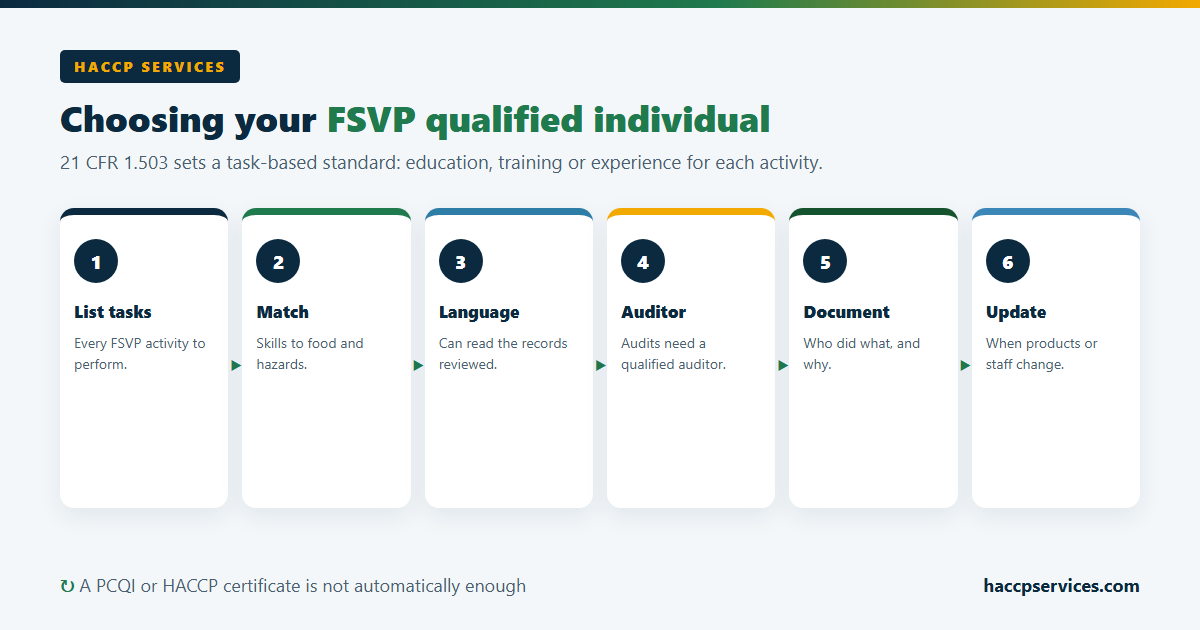
- List tasks. Identify the imported foods, suppliers and each FSVP activity, such as hazard analysis, supplier evaluation and records review.
- Match. Compare each person’s education, training and experience with the food, hazards and task.
- Check language. Confirm the reviewer can read and understand the supplier records.
- Assign auditors. Use a qualified auditor for any onsite audit used as a verification activity.
- Document. Record who performed each activity, what was considered and what remains open.
- Update. Revisit assignments when products, suppliers or staff change.
Records to keep
- Evidence of each reviewer’s relevant education, training and experience.
- Documentation that a qualified individual performed each activity, as the verification provisions in 1.506 require.
- Review conclusions and the decisions the importer authorized.
- Version-controlled FSVP documents, signed and dated under 21 CFR 1.510.
Keep mandatory FDA requirements separate from recommended practices and optional tools.
Example scenario
A U.S. importer of spices assigns its plant PCQI to review a new foreign supplier’s HACCP records. The PCQI has strong preventive controls experience. However, the supplier’s records are in a language the PCQI cannot read.
The importer therefore adds a bilingual food safety specialist with spice processing experience to the review. The team documents both people’s qualifications, the records reviewed and the conclusions. The importer then makes and records its approval decision.
Frequently asked questions
Does an FSVP qualified individual need PCQI training?
No. The FSVP rule requires the education, training or experience needed for the task. PCQI training may help show that, but it is not required.
Is a HACCP certificate enough to be an FSVP qualified individual?
Not automatically. A HACCP certificate is useful evidence of knowledge. The importer must still decide whether the person is qualified for the specific activity and can read the records.
Can an outside consultant be the FSVP qualified individual?
Yes. The definition states that a qualified individual may be, but is not required to be, an employee of the importer. The importer remains responsible for its FSVP.
FSVP qualified individual checklist
- Confirm FSVP applies and check for exemptions or modified requirements.
- List every FSVP activity and who performs it.
- Match each FSVP qualified individual to the food, hazards and task.
- Confirm the reviewer can read the records’ language.
- Use a qualified auditor for onsite audits.
- Document qualifications and update them when facts change.
How HACCP Services can help
HACCP Services, a service of Consultare Inc. Group, helps importers assess FSVP review roles, map HACCP or preventive controls evidence to FSVP needs and organize records, subject to the engagement scope. We provide independent advisory support, do not act as the FSVP importer and do not promise FDA approval or a particular entry outcome. For related support, see our sister sites FSVP Services and PCQI Services.
- HACCP staff competency assessment
- HACCP training management
- HACCP supplier program evaluation
- HACCP document control
Need help assigning FSVP review roles?
Discuss your imported foods, suppliers, current FSVP records and team qualifications with our team. You can book a free consultation or contact our team.
Start building your compliance system
If you prefer to organize and manage your compliance activities yourself, you can also create a free SystemsBuilder account. Then begin building a structured system for your compliance documentation and processes.
Technical sources: 21 CFR 1.503 (qualified individual and qualified auditor), 21 CFR 1.500 (definitions), 21 CFR 117.180 (PCQI), FDA FSVP key requirements and the Codex General Principles of Food Hygiene (CXC 1-1969). This article is educational and is not legal advice; HACCP Services is not affiliated with FDA. FSVP obligations vary by food, importer, supplier and any exemptions or modified requirements, and conclusions about a specific supplier should be reached by a qualified individual.