
FSVP foreign supplier approval is a documented decision by the importer, not a box ticked when a HACCP plan arrives. A supplier’s HACCP program can show technical capability. However, approval under the Foreign Supplier Verification Program (FSVP) rests on a broader evaluation of food risk and supplier performance. Audit findings, significant deviations, open corrective actions and the applicable regulatory framework may all matter.
This article explains where HACCP evidence fits in the approval file, what the rule requires and how to keep approval status under control after the decision.
Quick answer
Under the standard FSVP provisions, you approve each foreign supplier on the basis of your documented evaluation of food risk and supplier performance, and you document the approval. You must also have written procedures so that you import only from approved suppliers. Supplier HACCP evidence feeds the evaluation. It does not replace the evaluation or the approval decision.
What the rule requires
Two sections work together:
- Approval. 21 CFR 1.505(b) requires importers to approve foreign suppliers on the basis of the evaluation under 1.505(a), or one they review and assess under 1.505(d), and to document the approval.
- Use of approved suppliers. 21 CFR 1.506(a) requires written procedures to ensure that you import only from approved suppliers, and documentation that you follow them.
- Temporary exceptions. When necessary and appropriate, food may come from an unapproved supplier on a temporary basis. The food must be subject to adequate verification activities before it is imported.
- Reliance on others. Another entity may set up the procedures and perform these activities, provided you review and assess its documentation and record that review.
The evaluation behind approval is covered in our article on supplier HACCP performance in FSVP evaluation.
Where HACCP evidence fits
Supplier HACCP evidence is most useful when it answers specific questions in the evaluation:
- Does the HACCP plan cover the imported food, site and process?
- Does it address the hazards identified in your HACCP and FSVP hazard analysis?
- Do monitoring, verification and corrective action records show the plan is implemented?
- Are significant audit findings or deviations still open?
- Which regulatory framework applies to the supplier, such as Part 117 preventive controls or a mandatory HACCP rule?
Mistaking possession of a HACCP document for proof that every relevant issue is resolved weakens the approval rationale. Unresolved deviations deserve particular attention; see our article on HACCP deviation handling and product disposition.
Who makes the decision
The FSVP importer makes the supplier approval decision. Under 21 CFR 1.503, a qualified individual must develop the FSVP and perform its required activities. Consultants can organize evidence and recommendations. However, that support does not transfer the importer’s responsibility or guarantee that a supplier meets applicable requirements.
Purchasing preference alone is not a basis for approval. Commercial and food safety decisions can align, but the file must show the food safety reasoning.
Common gaps in approval files
- No approval status. Purchasing uses suppliers without a clearly documented FSVP approval.
- Missing evaluation. The file holds certificates but no food-risk and supplier-performance evaluation.
- Stale decisions. Suppliers or manufacturing locations changed without an updated decision.
- Unsupported temporary sourcing. Shipments from unapproved suppliers lack verification records.
Practical steps for food importers
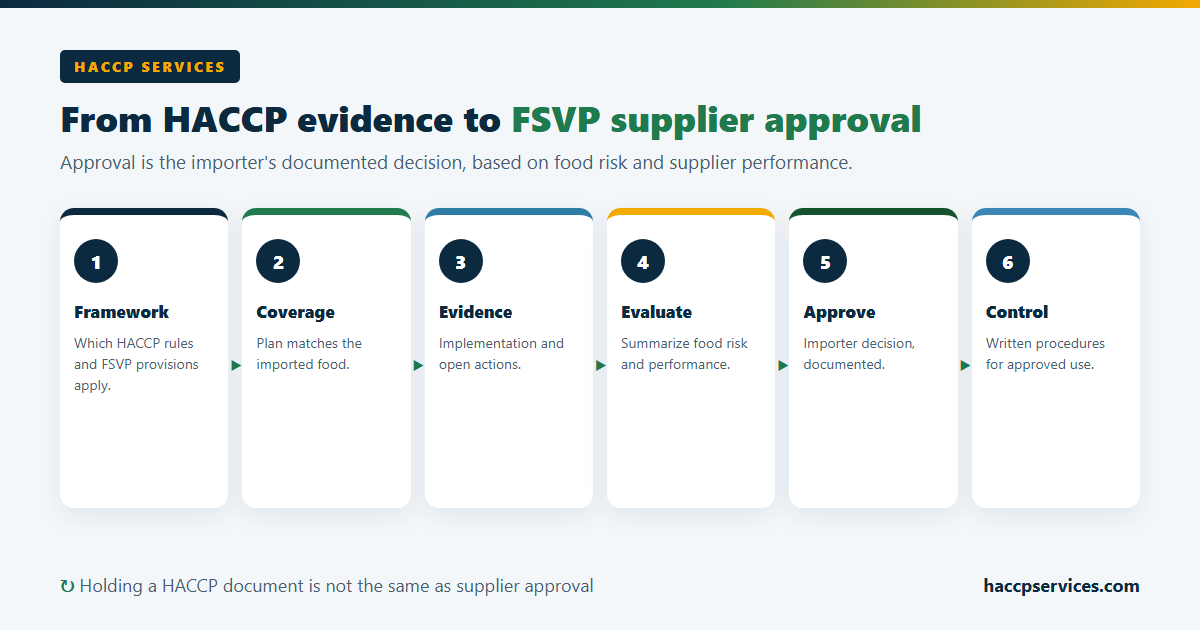
- Confirm the framework. Identify which HACCP rules and FSVP provisions apply, including any exemption or modified requirement.
- Check coverage. Confirm the HACCP documentation covers the imported food and its hazards.
- Review evidence. Examine implementation records and any unresolved supplier corrective actions.
- Summarize the evaluation. Combine the HACCP findings with other supplier performance information.
- Approve and document. Record the importer’s decision, the date and the qualified individual involved.
- Control use. Keep written procedures and an approved supplier list that purchasing actually follows.
Records to keep
- The documented evaluation and the approval decision for each supplier and food.
- The written procedures for using only approved suppliers, with evidence they are followed.
- Verification records for any temporary use of an unapproved supplier.
- Your review of any other entity’s evaluation or procedures.
Keep these records in line with 21 CFR 1.510. Our page on imported ingredient supplier controls shows how supplier files connect to the receiving facility’s own hazard analysis.
Example scenario
An importer’s usual supplier of dried fruit cannot fill an order, so purchasing proposes a new producer. The new producer sends a HACCP plan and a recent audit certificate. The importer’s qualified individual finds that the audit report lists a significant finding on metal detection that is still open.
The importer does not approve the producer yet. Instead, it requests the corrective action evidence and records the pending status on the approved supplier list. Purchasing knows the producer cannot be used until the evaluation is complete and the approval is documented.
Frequently asked questions
Does a HACCP certificate mean the supplier is approved?
No. Approval must be based on your documented evaluation of food risk and supplier performance, and the approval itself must be documented.
Can a consultant approve suppliers for us?
A consultant can prepare evidence and recommendations. The importer remains responsible for the approval decision and for its FSVP.
Can we ever use an unapproved supplier?
Only temporarily, when necessary and appropriate, and only if the food is subject to adequate verification before importing.
FSVP foreign supplier approval checklist
- Confirm the applicable HACCP and FSVP framework.
- Check that HACCP evidence covers the imported food and hazards.
- Review implementation and open corrective actions.
- Document the evaluation and the approval decision.
- Keep written approved-supplier procedures and follow them.
- Verify any temporary unapproved supply before import.
How HACCP Services can help
HACCP Services, a service of Consultare Inc. Group, supports HACCP-informed evidence reviews and approval readiness, helping importers interpret technical gaps while the importer keeps responsibility for final approval. Deliverables, timelines and responsibilities are agreed with each client, and we do not promise a particular regulatory outcome. For FSVP program support, see our sister site FSVP Services.
- HACCP supplier program evaluation
- HACCP document control and version management
- HACCP regulatory compliance audits
- HACCP recordkeeping and digital system setup
Need help preparing a supplier approval file?
Share the foods you import, your number of suppliers and the records you hold. You can book a free consultation or contact our team.
Start building your compliance system
If you prefer to organize and manage your compliance activities yourself, you can also create a free SystemsBuilder account. Then begin building a structured system for your compliance documentation and processes.
Technical sources: 21 CFR 1.503 (qualified individual), 21 CFR 1.505 (evaluation and approval), 21 CFR 1.506 (use of approved suppliers and verification), 21 CFR 1.510 (records), FDA FSVP final rule overview and the Codex General Principles of Food Hygiene (CXC 1-1969). This article is educational and is not legal advice; HACCP Services is not affiliated with FDA. FSVP obligations vary by food, importer and applicable exemptions or modified requirements, so confirm current requirements and have specific conclusions reviewed by an appropriately qualified individual.