
Supplier HACCP performance tells an importer far more than the existence of a HACCP plan. A written plan identifies hazards and controls. Supplier evaluation under the Foreign Supplier Verification Program (FSVP), however, must also consider how the supplier performs in practice. Corrective action trends, monitoring evidence, verification findings and compliance history can reveal issues that a plan alone does not show.
This article explains how to turn a supplier’s HACCP evidence into a documented FSVP evaluation, and what to do when that evidence changes.
Quick answer
Under the standard FSVP rule, importers evaluate both the risk posed by the food and the foreign supplier’s performance before approving the supplier and choosing verification activities. HACCP records are strong evidence of performance when they cover the imported food and show real implementation. Document the evaluation, approve on that basis, and reevaluate promptly when new information arrives, and in any case at least every 3 years.
What 21 CFR 1.505 asks importers to consider
Under 21 CFR 1.505, importers subject to the standard provisions must consider:
- The hazard analysis. Including the nature of each hazard requiring a control, from the 1.504 analysis.
- Who controls the hazard. The foreign supplier, its raw material supplier or another entity in the supply chain.
- Supplier procedures and practices. The supplier’s processes and practices related to food safety.
- FDA compliance information. Applicable FDA rules and whether the supplier is subject to a warning letter, import alert or other FDA compliance action related to food safety.
- Food safety history. Available test results, audit results and the supplier’s responsiveness in correcting problems.
- Other factors. For example, storage and transportation practices.
The evaluation must be documented, and supplier approval must be based on it. If you are still building the hazard analysis itself, start with our article on HACCP and FSVP hazard analysis.
What good HACCP performance evidence looks like
A HACCP manual shows intent. Performance evidence shows what actually happens on the line. Useful evidence includes:
- Monitoring records for the controls that address hazards in your food, completed and reviewed on time.
- Deviation and corrective action records that show the cause, product disposition and preventive action.
- Verification activity results, such as record reviews, calibration and testing.
- Audit reports relating to the safety of the food, with findings and closure evidence.
- Responsiveness, meaning how quickly and completely the supplier answered past problems.
Our article on HACCP monitoring records and verification review explains what complete monitoring evidence should contain.
Common gaps in supplier performance files
- Questionnaire only. Approval rests on a self-assessment with little supporting evidence.
- Outdated history. Audit, testing or regulatory information is missing or old.
- Hidden trends. Recurring deviations are not reviewed, so the need for extra verification goes unnoticed.
- Changed risk picture. A new supplier, production site or product was added without a new evaluation.
- No rationale. The team cannot explain how performance informed approval or verification decisions.
Practical steps for food importers
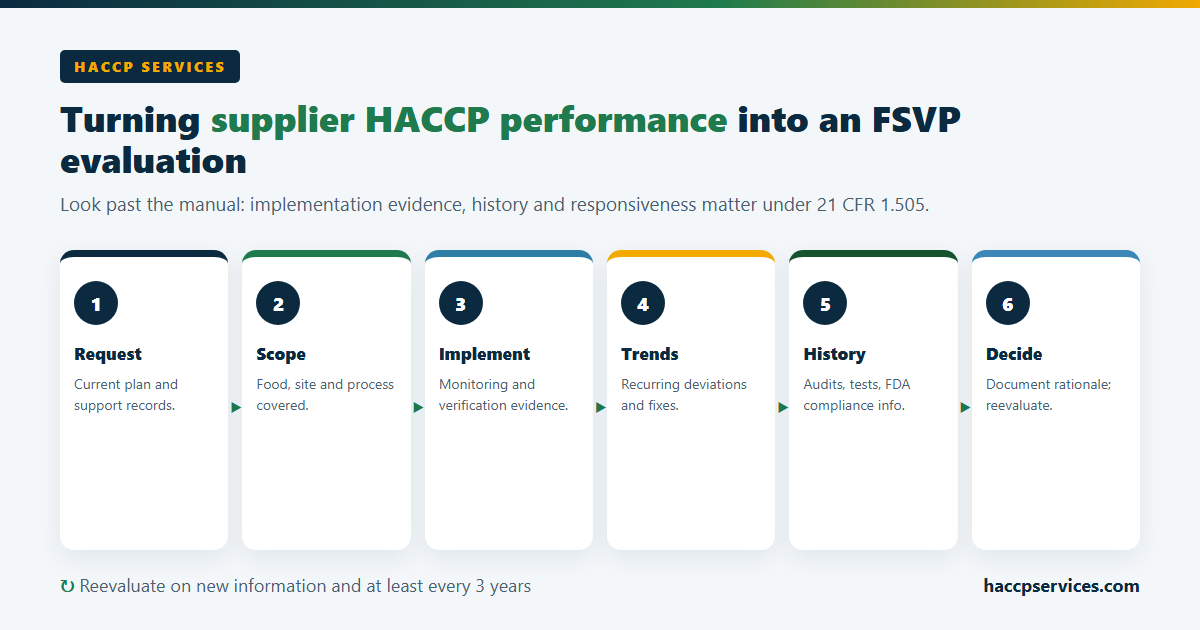
A supplier questionnaire is only a starting point. A defensible evaluation connects objective evidence about the supplier with the risks posed by the specific imported food.
- Request records. Ask for the current HACCP plan and relevant support records.
- Confirm scope. Check that the evidence covers the food, site and process you import.
- Review implementation. Look at monitoring and verification evidence for the hazard controls.
- Look for trends. Review recurring deviations and how the supplier addressed them. See our page on HACCP corrective actions.
- Check history. Gather audit, testing and FDA compliance information.
- Decide and document. Record the rationale, the approval decision and any supplier follow-up.
When to reevaluate
Under 21 CFR 1.505(c), importers must promptly reevaluate when they become aware of new information about these factors. The reevaluation must be documented. If concerns have changed, the importer must promptly decide, and document, whether to keep importing from the supplier and whether verification activities need to change. If no reevaluation has happened within a 3-year period, one is required at the end of that period.
New information can include a pattern of deviations, a failed audit, a positive test result or an FDA import alert. Each should trigger a recorded review, not just a note in an email.
Records to keep
- The documented supplier evaluation and the approval decision based on it.
- The HACCP plan version and the performance records you reviewed.
- Audit reports, test results and compliance information considered.
- Reevaluations, with the trigger, conclusion and any change to verification.
FSVP records must meet 21 CFR 1.510, including signing and dating and availability to FDA on request.
Example scenario
An importer buys frozen cooked rice meals from a long-standing supplier. During a routine record review, the importer notices three cooling temperature deviations at the same step within two months. Each deviation was corrected, but the supplier never investigated the cause.
The importer treats the trend as new information and documents a reevaluation. It asks the supplier for a root cause investigation and increases its record review frequency until the fix is verified. The decision and rationale are added to the supplier file. For more on supplier programs more broadly, see our article on imported ingredient supplier controls.
Frequently asked questions
Is a HACCP plan enough to approve a foreign supplier?
No. The plan is one input. Approval must rest on the documented evaluation of food risk and supplier performance.
How often must supplier performance be reevaluated?
Promptly when new information arises, and at least once in any 3-year period if no earlier reevaluation took place.
Can someone else do the evaluation?
An entity other than the foreign supplier may perform it using a qualified individual. You must then review and assess it and document that review.
Supplier HACCP performance checklist
- Confirm the food and process covered by the HACCP evidence.
- Review monitoring and verification records for hazard controls.
- Check recurring deviations and corrective action quality.
- Gather audit, testing and FDA compliance history.
- Document the evaluation and the approval decision.
- Set triggers for prompt reevaluation and track the 3-year limit.
How HACCP Services can help
HACCP Services, a service of Consultare Inc. Group, helps importers assess supplier HACCP records within their broader FSVP evaluation, clarify evidence gaps and coordinate practical follow-up. Deliverables, timelines and responsibilities are agreed with each client. Importers remain responsible for meeting applicable FSVP obligations, and we do not promise a particular regulatory outcome. For FSVP program support, see our sister site FSVP Services.
- HACCP supplier program evaluation
- HACCP corrective action management
- Deviation investigation and root cause analysis
- HACCP recordkeeping and digital system setup
Need help evaluating supplier HACCP performance?
Share the foods you import, your number of suppliers and the records you hold. You can book a free consultation or contact our team.
Start building your compliance system
If you prefer to organize and manage your compliance activities yourself, you can also create a free SystemsBuilder account. Then begin building a structured system for your compliance documentation and processes.
Technical sources: 21 CFR 1.505 (evaluation, approval and reevaluation), 21 CFR 1.506 (supplier verification), 21 CFR 1.510 (records), FDA FSVP final rule overview and the Codex General Principles of Food Hygiene (CXC 1-1969). This article is educational and is not legal advice; HACCP Services is not affiliated with FDA. FSVP obligations vary by food, importer and applicable exemptions or modified requirements, so confirm current requirements and have specific conclusions reviewed by an appropriately qualified individual.