
Critical limit validation answers a simple question: why does this limit control this hazard, for this product and this process? Many production teams can show that a temperature was recorded. Fewer can explain why the specified limit is adequate. Monitoring a number is not the same as substantiating it.
For food manufacturers preparing for possible H-E-B supply, a buyer conversation and a documented, compliant supply operation are different milestones. This article covers what sound scientific support looks like, the common gaps and the records to keep. Confirm any H-E-B expectations directly with the relevant H-E-B supplier or purchasing contact.
Quick answer
Each critical limit needs scientific or technical evidence showing that, when met, it controls the identified hazard. That evidence must fit your actual product, equipment and process. Review it whenever the process, formulation, equipment or hazard information changes materially. A validated limit supports supplier readiness, but it does not guarantee acceptance by H-E-B.
What the rules and standards expect
A HACCP critical limit is the maximum or minimum value that separates acceptable from unacceptable at a CCP. The Codex General Principles of Food Hygiene (CXC 1-1969) call for validated critical limits at each CCP, as FAO’s HACCP toolbox explains. The exact legal requirement, however, depends on the product:
- Juice and seafood. FDA mandates HACCP under 21 CFR Part 120 and Part 123.
- USDA-inspected meat and poultry. Under 9 CFR Part 417, plants must validate their HACCP plan. Under 9 CFR 417.5, they must also keep decision-making documents for selecting and developing CCPs and critical limits.
- Most other FDA-registered facilities. Part 117 preventive controls apply. Process controls must include parameters and the maximum or minimum values that control the hazard, under 21 CFR 117.135(c)(1).
Under 21 CFR 117.160, validation must be performed or overseen by a preventive controls qualified individual. It must include obtaining and evaluating scientific and technical evidence, or conducting studies when that evidence is unavailable or inadequate. Validation is also required whenever a change could affect whether a control works. Certification schemes and customers may add their own expectations on top of these rules.
What good scientific support looks like
- A clear hazard link. Each limit names the hazard it controls and the target outcome.
- Relevant evidence. Published research, regulatory guidance, process authority letters or in-plant studies that match the product.
- A fit to real conditions. The evidence reflects your container sizes, equipment, line speeds and formulation.
- A named approver. A qualified person reviewed and signed the justification.
- A trigger for review. The file states which changes require the limit to be re-examined.
Validation and verification are often confused. In short, validation asks whether the limit can work, while verification checks that it is working. Our article on validation versus verification for food plants explains the difference.
Common gaps in critical limit files
- Inherited limits. A value is carried forward from an older plan without asking whether it still fits.
- Generic references. A citation exists, but it describes a different product or process.
- No link to equipment. The evidence ignores real heating, cooling or mixing performance.
- No change trigger. Formulation or throughput changes happen without a validation review.
- Monitoring mistaken for proof. Signed logs are treated as evidence that the limit is adequate.
Practical steps to strengthen critical limit validation
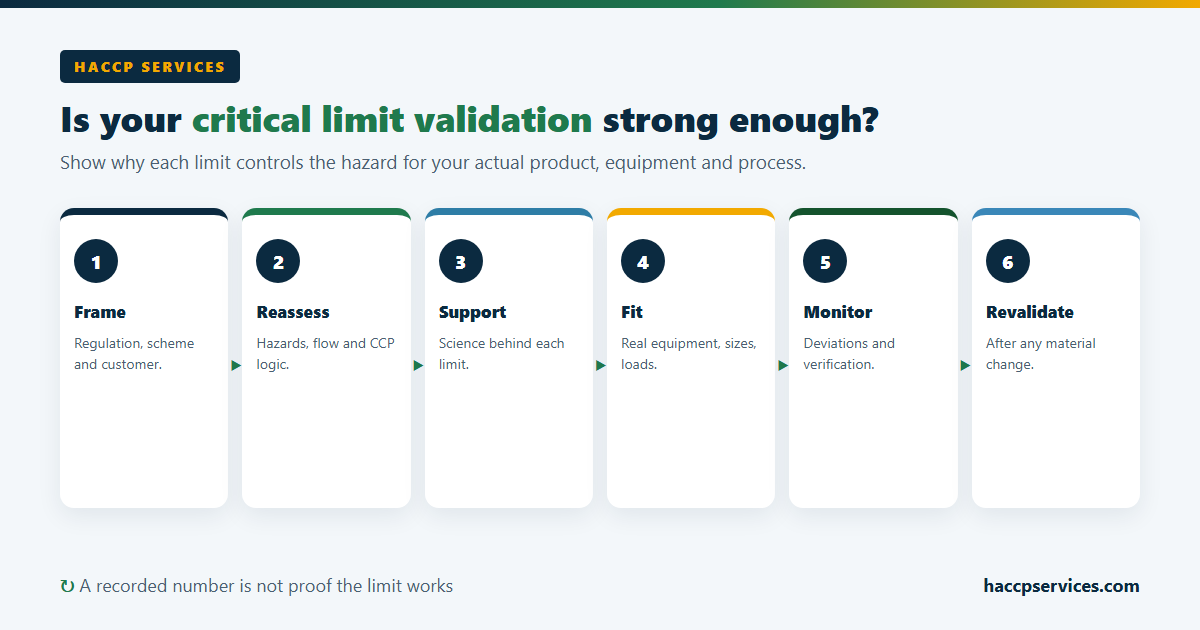
- Frame. Confirm the regulatory, certification and customer framework that governs the product.
- Reassess. Review the hazard analysis, process flow and the reason each step is a CCP.
- Support. Check the scientific or technical basis for each critical limit.
- Fit. Confirm that the evidence applies to your actual equipment, product and process.
- Monitor. Define monitoring, deviation handling and independent verification records that show control.
- Revalidate. Re-examine the limit whenever process, formulation, equipment or hazard information changes materially.
Where a technical study is needed, suitably qualified parties should perform it under an agreed scope. For heat-based CCPs, see our article on thermal process validation.
Records to keep
- The scientific or technical justification for each critical limit, with references.
- Studies, process authority letters or challenge data, where used.
- The hazard analysis and CCP decision records.
- Monitoring, deviation and corrective action records.
- Verification records, including calibration and records review.
- Change reviews and revalidation decisions, signed and dated.
Under 21 CFR 117.190, Part 117 facilities must keep verification records, including validation records, as applicable.
Example scenario: a sauce manufacturer
A sauce manufacturer changes its container size and increases processing throughput. However, the HACCP plan carries forward the existing thermal limit without asking whether the changes affect the supporting evidence.
A larger container may heat more slowly at its center, and a faster line may shorten hold times. Therefore, the team reviews the original justification against the new conditions. It decides whether a new study is needed and records the decision, the approver and the evidence. If the product is proposed for H-E-B, a confident answer needs this traceable record, not just a signed form.
Frequently asked questions
Is a monitoring log proof that a critical limit is valid?
No. A log shows the limit was met. Validation shows that meeting the limit controls the hazard.
When should a critical limit be revalidated?
Review it whenever a change could affect the control, such as new equipment, formulation, packaging or throughput, or new hazard information.
Does validated science guarantee acceptance as an H-E-B supplier?
No. Sound validation supports readiness, but supplier decisions rest with H-E-B. Also, “HACCP certification” is not a single legal certificate; it usually refers to a third-party audit.
Critical limit validation checklist
- Confirm the governing regulatory, certification and customer framework.
- Reassess the hazard analysis, process flow and CCP decisions.
- Review the scientific basis for each critical limit.
- Check that the evidence fits your equipment, product and process.
- Define monitoring, deviation and verification records.
- Revalidate after material process, formulation or equipment changes.
- Confirm current H-E-B supplier requirements with the relevant H-E-B contact.
How HACCP Services can help
HACCP Services, a service of Consultare Inc. Group, supports HACCP plan development, critical limit documentation review, hazard analysis and verification records. We also help identify when external validation studies are needed. Services are adapted to the specific product, site and customer program, subject to the engagement scope.
- HACCP plan validation and scientific justification
- HACCP plan development
- HACCP plan reassessment and annual review
- New product and process change impact assessment
Can you explain why each of your critical limits works?
Share your process flow, hazard analysis, CCP table, validation evidence and recent changes. You can book a free consultation or contact our team.
Start building your compliance system
If you prefer to organize and manage your compliance activities yourself, you can also create a free SystemsBuilder account. Then begin building a structured system for your compliance documentation and processes.
Technical sources: Codex Alimentarius (General Principles of Food Hygiene, CXC 1-1969), FDA HACCP Principles and Application Guidelines, 21 CFR 117.135 (preventive controls), 21 CFR 117.160 (validation), 21 CFR 117.190 (records), 9 CFR 417.5 (HACCP records) and H-E-B supplier information. This article is independent educational content, not legal advice. HACCP Services is not affiliated with, sponsored or approved by H-E-B or FDA. H-E-B maintains an access-controlled supplier portal, and its supplier requirements must be confirmed directly with the relevant H-E-B supplier or purchasing contact. Applicability depends on the product, facility and customer arrangements.