
HACCP cleaning validation only means something when the equipment can actually be cleaned by the method you wrote down. A cleaning procedure may look adequate on paper. However, equipment geometry, worn seals or unsuitable materials can stop it from removing residues consistently. This article explains how to check that your cleaning method and your equipment design are compatible.
The goal is practical. Teams need to know whether a method suits the surfaces, soils and hazards involved. They also need evidence that it works, plus routine checks that show it keeps working.
Quick answer
Start with the equipment, not the procedure. Map hard-to-clean points, check disassembly and access, and confirm that the cleaning chemistry suits the materials and soils. Then gather evidence that the method works where validation is appropriate. Finally, verify routinely and reassess after changes or repeat failures. Keep validation (can the method work?) separate from verification (is it working day to day?).
How equipment design creates cleaning hazards
Cleaning fails quietly when design gets in the way. For example, crevices, rough welds and hollow framework can trap food residue and moisture. Dead spaces behind guards may never see a brush or spray. In addition, damaged gaskets and seals can hold soil that a surface rinse cannot reach.
These conditions can support microbial growth. They can also leave allergen residues that carry over into the next product. Because the soil is hidden, a visual check after cleaning may look fine while the risk remains.
U.S. rules reflect this link. Under 21 CFR 117.40, equipment must be designed and made to be adequately cleanable. Food-contact surfaces must also withstand the food, cleaning compounds, sanitizing agents and cleaning procedures used on them. Furthermore, 21 CFR 117.80 expects equipment to be taken apart for thorough cleaning insofar as necessary.
Where this fits: hazard analysis or prerequisite programs?
Most cleaning work sits in prerequisite programs. In the Codex General Principles of Food Hygiene (CXC 1-1969), good hygiene practices form the foundation that a HACCP system builds on. Our guide to the HACCP prerequisite checklist before critical control points explains that relationship.
Even so, equipment design belongs in the hazard analysis too. For most FDA-registered facilities, 21 CFR 117.130 requires the hazard evaluation to consider the condition, function and design of the facility and equipment. Where a hazard needs a preventive control, 21 CFR 117.135(c)(3) describes sanitation controls, including cleanliness of food-contact surfaces. See our HACCP hazard analysis page for the method.
Note one regulatory detail. Under 21 CFR 117.160(c), sanitation controls do not need to be validated under Part 117. Many companies still gather cleaning effectiveness evidence, because customers, certification schemes or their own risk decisions call for it. Juice and seafood processors follow HACCP rules in 21 CFR Parts 120 and 123, and meat and poultry plants follow 9 CFR Part 417.
Validation versus verification for cleaning
These terms are often mixed up. Validation asks whether the cleaning method, applied as written, can remove the residues and hazards of concern from this equipment. Verification asks whether the method is being applied correctly and still works in routine operation.
For instance, a validation study might combine worst-case soils, the hardest-to-clean surfaces and swab results. Verification, in contrast, might be pre-operational inspection, routine swabbing and record review, as described in our article on HACCP sanitation verification. Our article on validation versus verification for food plants covers the distinction in more depth.
Practical review steps
Use a structured review to test whether the method and the equipment fit together.
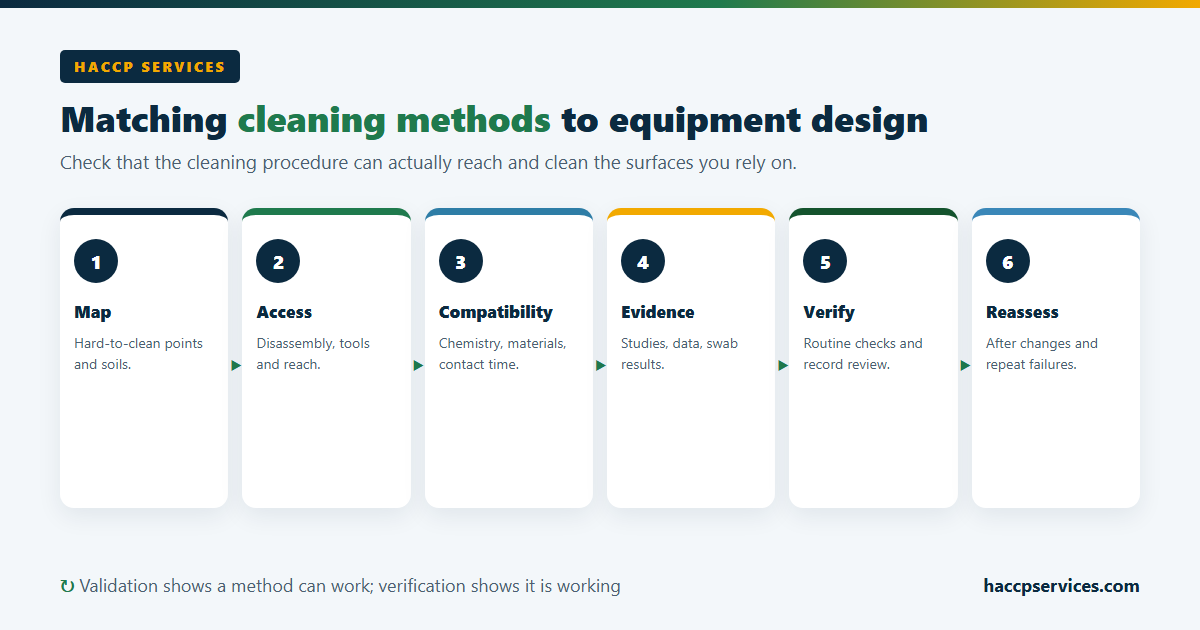
- Map hard-to-clean points. Identify where food, residues, moisture or allergens could accumulate. Include seals, dead ends, hinges and hollow parts.
- Check access and disassembly. Confirm that routine cleaning and inspection can reach each relevant surface. Note any tools or skills that disassembly requires.
- Confirm compatibility. Review cleaning chemistry, concentration, temperature and contact time against equipment materials and the soils involved. Damaged surfaces are harder to clean.
- Gather evidence. Where validation is appropriate, collect scientific or technical evidence and site data, such as swab results from worst-case points.
- Verify in routine use. Set pre-operational checks, swabbing and record review that show the method keeps working.
- Reassess. Review again after equipment changes, new products, new chemicals or repeat sanitation failures.
Records to keep
- Equipment cleaning procedures, including disassembly steps and chemical parameters.
- A map or list of hard-to-clean points and worst-case sampling locations.
- Evidence used to support the method, such as studies, supplier data and swab results.
- Routine verification records, including pre-operational inspections and test results.
- Sanitation failures, equipment repairs and corrective actions, with closure evidence.
Good records also make trends visible. Repeated failures at the same point usually signal a design issue rather than a training issue.
Example scenario
A plant runs two products on one mixer, and only one contains an allergen. Swabs after cleaning keep showing residue near a shaft seal. The team first retrains cleaners, but the result repeats. A design review then finds that the seal housing cannot be reached without partial disassembly.
So the team documents the condition and the potential allergen cross-contact hazard. Next, it assigns an owner and a deadline. Maintenance, sanitation and food safety then agree on a change: a revised disassembly step plus a seal replacement schedule. Finally, the team checks the completed action with follow-up swabs and keeps that evidence.
Frequently asked questions
Is cleaning validation required under FDA Part 117?
Part 117 does not require validation of sanitation controls under 117.160(c). However, those controls still need verification as appropriate, and customers or certification schemes may expect cleaning effectiveness evidence.
Can retraining fix a cleaning failure?
Sometimes. But if equipment design prevents access to a surface, retraining alone will not solve it. Review the design before closing the corrective action.
When should we re-check cleaning effectiveness?
Re-check after equipment changes, new products or allergens, new cleaning chemicals, and repeat sanitation failures.
HACCP cleaning validation checklist
- List hard-to-clean points for each piece of equipment.
- Confirm cleaning and inspection can reach every relevant surface.
- Check chemistry and parameters against materials and soils.
- Keep evidence that the method works where validation is appropriate.
- Separate validation records from routine verification records.
- Track repeat failures, repairs and corrective action closure.
How HACCP Services can help
HACCP Services, a service of Consultare Inc. Group, supports prerequisite program reviews, sanitation documentation improvement and coordination of evidence-based cleaning effectiveness assessments, subject to the engagement scope. Facility management keeps responsibility for approving and implementing changes, and we do not promise certification, regulatory approval or a particular audit outcome.
- HACCP sanitation program development
- HACCP plan validation and scientific justification
- Pre-operational inspection program development
- Prerequisite program gap assessment
Need help with cleaning validation and equipment design?
Discuss your equipment, cleaning methods, records and recurring findings with our team. You can book a free consultation or contact our team.
Start building your compliance system
If you prefer to organize and manage your compliance activities yourself, you can also create a free SystemsBuilder account. Then begin building a structured system for your compliance documentation and processes.
Technical sources: 21 CFR 117.40 (equipment and utensils), 21 CFR 117.130 (hazard analysis), 21 CFR 117.160 (validation) and the Codex General Principles of Food Hygiene (CXC 1-1969). This article is educational and is not legal advice; HACCP Services is not affiliated with FDA, and specific requirements depend on your products, processes and applicable regulations.