
Foreign material prevention depends on well-designed physical hazard controls that catch failures early and leave a clear record of how affected lots were handled. A single foreign material complaint can trigger a costly investigation and difficult product decisions. Good controls help teams explain exactly what happened and why.
For businesses preparing to supply Walmart, credible physical hazard controls support supplier confidence. However, applicable requirements depend on the product, the facility, the commercial relationship and current law. Confirm them directly with the relevant Walmart contact before treating any practice below as a mandatory Walmart rule.
Quick answer
Identify credible physical hazards at each process step. Then choose preventive measures that fit your equipment, challenge any detection system throughout production and investigate every rejection or complaint beyond the single package. Finally, trend the data for management review. Strong controls support readiness, but they do not guarantee acceptance as a Walmart supplier.
Who this article is for
This guide is for food manufacturers, maintenance leaders, HACCP teams and quality managers responsible for metal, glass, plastic and other physical hazards.
1. Identify credible physical hazards
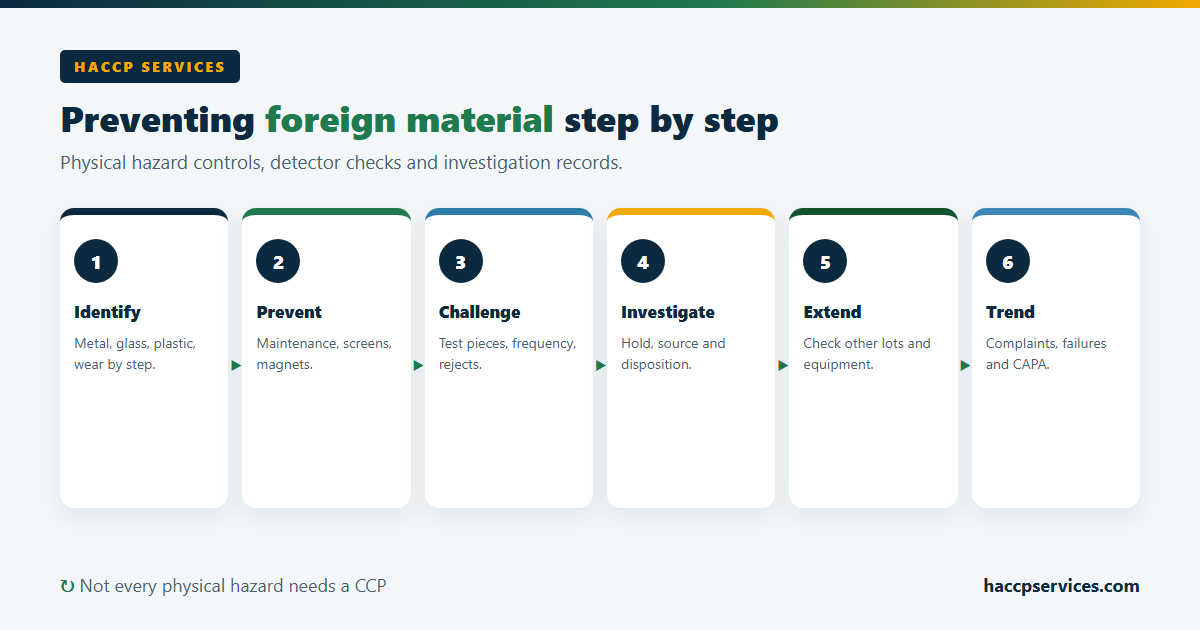
Review raw materials, equipment wear, maintenance, glass, brittle plastic, metal and other contamination routes at each process step. Under 21 CFR 117.130, a hazard analysis must consider physical hazards such as stones, glass and metal fragments. Not every physical hazard is managed through a CCP. Instead, select controls through a documented risk assessment. Our page on HACCP critical control points explains how CCPs are chosen.
2. Define the appropriate preventive measures
Consider maintenance, material screening, equipment inspections, sieving, magnets or metal detection, depending on the process. Then set acceptance criteria and verification methods that match the actual equipment and product characteristics. For example, worn parts often start as a maintenance issue before they become a product issue. For a worked example, see our bakery hazard analysis covering physical hazards.
3. Verify detection and rejection systems
Where you use detectors, define challenge tests, test pieces, frequency, reject verification and accountability for failed checks. A successful start-up check alone may not show continuing effectiveness throughout production. Where Part 117 applies, 21 CFR 117.165 requires verification that preventive controls are consistently implemented and effective.
4. Investigate rejected or contaminated product
Document lot identification, hold decisions, the likely source, product disposition and the corrective action needed. Under 21 CFR 117.150, corrective action procedures must evaluate all affected food and reduce the likelihood of recurrence. Our article on HACCP deviation handling and product disposition covers disposition decisions in more detail.
5. Extend the investigation to other lots and equipment
Consider whether other lots or equipment may be affected. Do not simply dispose of one rejected package without an investigation. A broken screen or missing fragment may point to a wider problem across shifts or lines.
6. Connect records to supplier readiness
Trend foreign material complaints, equipment failures, inspections and CAPA for management review. As a result, recurring sources become visible before they reach customers. In addition, check Walmart-specific requirements and certification standards for the relevant product and facility. For the wider picture, read HACCP plans for Walmart food suppliers.
Frequently asked questions
Does every physical hazard need a CCP?
No. Many physical hazards are controlled through maintenance, screening or prerequisite programs. The choice should follow a documented hazard analysis.
Is a passed start-up metal detector check enough?
Usually not on its own. Checks during and at the end of production show that the detector kept working throughout the run.
Does strong foreign material control guarantee acceptance as a Walmart supplier?
No. It supports readiness, but supplier approval rests with Walmart. Also, “HACCP certification” is not a single legal certificate; it usually refers to a third-party audit.
Supplier readiness checklist
- Identify credible physical hazards.
- Define the appropriate preventive measures.
- Verify detection and rejection systems.
- Investigate rejected or contaminated product.
- Extend the investigation to other lots and equipment.
- Connect records to supplier readiness.
- Confirm the applicable Walmart supplier program and all relevant product and facility requirements.
- Assign owners for documentation, follow-up actions and periodic review.
How HACCP Services can help
HACCP Services, a service of Consultare Inc. Group, can help review the hazard analysis, foreign material control procedures, metal detection evidence and corrective action workflow, subject to the engagement scope.
- Foreign material control program development
- Preventive maintenance and food safety integration
- Product hold, release and disposition program
- Deviation investigation and root cause analysis
Could a foreign material complaint expose a gap in your HACCP plan?
Discuss your equipment controls, monitoring and recent deviations with our team. You can book a free consultation or contact our team.
Start building your compliance system
If you prefer to organize and manage your compliance activities yourself, you can also create a free SystemsBuilder account. Then begin building a structured system for your compliance documentation and processes.
Technical sources: Codex Alimentarius (General Principles of Food Hygiene, CXC 1-1969), FDA FSMA Final Rule for Preventive Controls for Human Food, 21 CFR Part 117 and Walmart supplier requirements. This article is independent educational content, not legal advice. HACCP Services is not affiliated with or endorsed by Walmart Inc. or FDA. Walmart-specific supplier requirements must be confirmed directly with the relevant Walmart contact. Regulatory applicability depends on the product, facility, activity and current law.