
HACCP allergen hazard controls work only when they hold up on the production floor and are backed by current records. An undeclared allergen can come from a missed changeover, a wrong label or an unreviewed formula change. For manufacturers and importers considering Walmart supply relationships, the goal is simple: show that allergen controls work in practice.
Applicable requirements depend on the product, the facility, the commercial relationship and current law. Walmart’s supplier programs can also differ by relationship. Therefore, check current requirements directly with the relevant Walmart contact before treating any practice below as a mandatory Walmart rule.
Quick answer
Map every allergen in the facility and assess where cross-contact can happen. Next, define cleaning and changeover methods, control labels at every change and escalate suspect product quickly. Finally, trend incidents and audit findings so the controls keep improving. Strong allergen controls support supplier readiness, but they do not guarantee acceptance by Walmart.
Who this article is for
This guide is for food manufacturers, importers, HACCP teams and quality leaders who handle allergenic ingredients on shared sites or lines.
1. Identify the allergens present in the facility
Map allergens in ingredients, processing aids, rework, finished products and shared equipment. Then compare supplier specifications with the formulations actually in use. In the United States, the law identifies nine major food allergens: milk, eggs, fish, crustacean shellfish, tree nuts, peanuts, wheat, soybeans and sesame, according to FDA. Consider category-specific rules as well, rather than relying on one generic list for every market. Under 21 CFR 117.130, food allergens are part of the chemical hazards a hazard analysis must consider. Our HACCP hazard analysis guide explains the method.
2. Assess the risk of cross-contact
Evaluate shared utensils, production lines, dust, personnel movement, storage, changeovers and outsourced processes. Each route can carry an allergen into a product that should not contain it. Document how each allergen hazard is controlled in your HACCP plan or food safety plan. For facilities under Part 117, 21 CFR 117.135(c)(2) describes food allergen controls as covering both protection from cross-contact and finished-product labeling.
3. Define and verify cleaning and changeover methods
Establish cleaning practices that match the allergen risk and the equipment design. Then decide how you will show they work, through validation or verification. Notably, Part 117 does not require validation of food allergen controls under 21 CFR 117.160(c). Many sites still choose to validate high-risk changeovers. Keep objective records of changeovers, inspections and any relevant testing. However, do not assume a negative swab always proves total allergen removal.
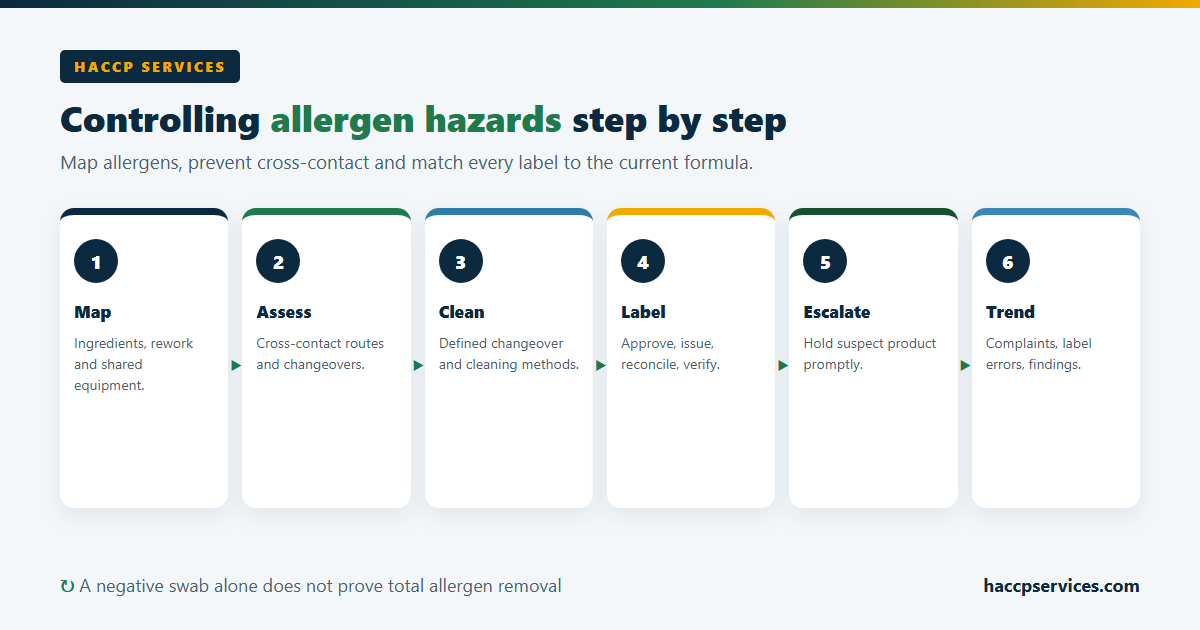
4. Control labels and packaging at each change
Approve labels against current formulas before use. Next, verify label issue, line clearance, reconciliation and correct product-to-package matching at every run. Label errors are a common route for undeclared allergens. For a worked bakery example, see our bakery hazard analysis for sesame allergens.
5. Escalate suspected undeclared allergens promptly
Treat an undeclared allergen as a potentially serious product safety issue. Hold affected product, identify the lots involved and decide disposition with documented reasons. Where Part 117 applies, corrective action procedures must ensure affected food is evaluated and kept out of commerce when its safety cannot be assured (21 CFR 117.150). See HACCP corrective actions for the principle.
6. Verify effectiveness through incidents and audits
Trend complaints, label errors, rework deviations and cleaning findings. Then update controls and training based on what the data show. In addition, confirm any applicable Walmart supplier expectations separately from federal labeling and preventive controls obligations. Our article on Walmart supplier HACCP verification covers the wider verification picture.
Frequently asked questions
Are allergen controls always critical control points?
No. Many sites manage allergens through preventive controls or prerequisite programs rather than CCPs. The choice should follow a documented hazard analysis.
Does a negative allergen swab prove a line is clean?
Not always. A test result is one piece of evidence. It should sit alongside visual inspection, defined cleaning methods and changeover records.
Does strong allergen control guarantee acceptance as a Walmart supplier?
No. Sound controls and credible records support readiness, but supplier approval rests with Walmart. Also, “HACCP certification” is not a single legal certificate; it usually refers to a third-party audit.
Supplier readiness checklist
- Identify the allergens present in the facility.
- Assess the risk of cross-contact.
- Define and verify cleaning and changeover methods.
- Control labels and packaging at each change.
- Escalate suspected undeclared allergens promptly.
- Verify effectiveness through incidents and audits.
- Confirm the applicable Walmart supplier program and all relevant product and facility requirements.
- Assign owners for documentation, follow-up actions and periodic review.
How HACCP Services can help
HACCP Services, a service of Consultare Inc. Group, supports food businesses through compliance gap assessments, program development, documentation control, audit preparation and corrective action coordination. Services are adapted to the specific product, site and customer program, subject to the engagement scope.
- Allergen management program development
- HACCP plan development
- HACCP certification and third-party audit preparation
- Corrective action management
Could an allergen changeover create an undeclared allergen risk?
Review your allergen hazard analysis, cleaning procedures and label controls with our team. You can book a free consultation or contact our team.
Start building your compliance system
If you prefer to organize and manage your compliance activities yourself, you can also create a free SystemsBuilder account. Then begin building a structured system for your compliance documentation and processes.
Technical sources: Codex Alimentarius (General Principles of Food Hygiene, CXC 1-1969), FDA FSMA Final Rule for Preventive Controls for Human Food, 21 CFR Part 117, FDA Food Allergies and Walmart supplier requirements. This article is independent educational content, not legal advice. HACCP Services is not affiliated with or endorsed by Walmart Inc. or FDA. Walmart-specific supplier requirements must be confirmed directly with the relevant Walmart contact. Regulatory applicability depends on the product, facility, activity and current law.