
FSVP sampling and testing can give importers useful assurance, but a laboratory report does not prove on its own that a supplier’s HACCP controls work. A HACCP plan may call for monitoring and verification checks. Still, isolated test results rarely show that a process control was carried out and effective.
This article explains how supplier HACCP verification records and test results relate to your FSVP obligations. It also covers what the rule asks you to document and the gaps to look for.
Quick answer
Sampling and testing is one of the supplier verification activities listed in 21 CFR 1.506. It is not required for every food or supplier. You choose it, and set its frequency, based on your risk evaluation. When you use it, you must keep specific records: food and lot identity, number of samples, tests and methods, dates, results, the laboratory, any corrective actions and evidence that a qualified individual did the testing.
Monitoring, verification and testing are not the same
Importers often receive a mix of documents and treat them all as “testing.” In fact, they serve different purposes:
- Monitoring checks that a CCP stays within its critical limit, such as a cooking temperature.
- Validation shows that the control, if done correctly, can control the hazard.
- Verification confirms the system is working, for example through record review, calibration or product testing. See HACCP verification and validation.
- Finished-product testing examines samples of the food itself.
Our article on validation versus verification for food plants explains these terms in more depth. For FSVP, the point is simple: connect each piece of evidence to a specific hazard requiring a control.
What the FSVP rule says
Under 1.506(d), the importer must determine and document which verification activities, and how often, provide adequate assurance. The choices are onsite audits, sampling and testing, records review and other appropriate activities. The determination must be based on the evaluation of the food and supplier under 21 CFR 1.505.
Notably, 1.506(e)(2) says you may not rely on the foreign supplier or its employees to perform verification activities. However, sampling and testing is the one exception. A supplier’s own testing can therefore count, as long as you review and assess the results and document that review under 1.506(e)(3).
Some foods and importers have different rules. For example, under 21 CFR 1.501(b), the FSVP subpart does not apply to certain juice and seafood. The exemption covers products from a foreign supplier that must comply with, and is in compliance with, Part 120 or Part 123. Those importers follow 120.14 or 123.12 instead. In the U.S., HACCP is mandatory for juice, seafood and USDA-inspected meat and poultry (9 CFR Part 417), while most FDA-registered facilities follow Part 117 preventive controls. Codex CXC 1-1969 sets the international HACCP principles.
What good testing evidence looks like
Good evidence starts with the hazard. First, name the hazard requiring a control from your hazard analysis. Next, choose the analyte, method and acceptance criteria that address it. Then make sure each report identifies the food and lot, so you can trace it to the shipment you received.
A COA can be useful evidence. However, a COA alone does not show that you met every FSVP obligation. It also cannot replace a missing process-control rationale. If the hazard is controlled by a cooking step, cooking records and validation support usually tell you more than a single micro result.
Common gaps
- Only a HACCP certificate is supplied.
- Microbiology results lack lot traceability.
- Deviations are left out of the evidence package.
- Testing is used in place of a missing process-control rationale.
- The report does not name the laboratory or the analytical method.
Practical steps
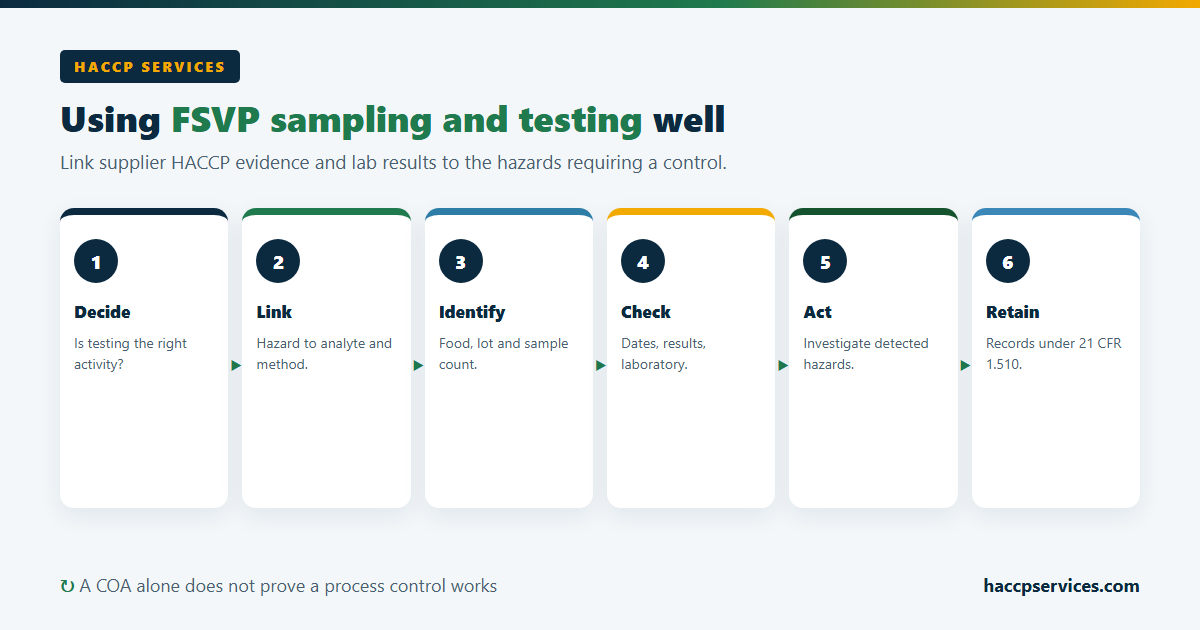
- Decide. Document whether sampling and testing is an appropriate verification activity, and set a justified frequency.
- Link. Connect each hazard to an analyte, test method and acceptance criteria.
- Identify. Make sure sampling information covers the food and lot identity and the number of samples.
- Check. Review test dates, report dates, results and laboratory details. Flag concerns for follow-up.
- Act. Investigate any detected hazard and take appropriate corrective action. See our page on HACCP corrective actions.
- Retain. Keep the records under 21 CFR 1.510.
Records to keep
Under 1.506(e)(1)(ii), documentation of each sampling and testing activity must include:
- Identification of the food tested, including lot number as appropriate.
- The number of samples tested.
- The tests conducted, including the analytical methods.
- The dates of testing and the date of the report.
- The results.
- Any corrective actions taken in response to detection of hazards.
- Information identifying the laboratory.
- Documentation that a qualified individual conducted the testing.
Also keep your documented review of the results. Separate FDA obligations from customer specifications, voluntary testing schemes and internal best practices.
Example scenario
An importer buys a ready-to-eat dried fruit product. Its evaluation identifies a pathogen hazard controlled by the supplier. The importer selects supplier testing as a verification activity, alongside periodic records review.
The supplier’s COAs list “pass” but give no lot numbers or methods. Therefore, the importer’s qualified individual asks for full reports. The new reports identify the lot, samples, method, dates and laboratory. The reviewer then documents the assessment and files it with the FSVP records.
Frequently asked questions
Is FSVP sampling and testing mandatory?
No. It is one of several verification activities. You choose it based on a documented risk evaluation of the food and supplier.
Can I rely on the supplier’s own test results?
Yes. Sampling and testing is the one verification activity the supplier may perform for you. You must still review and assess the results and document that review.
Does a COA prove the supplier’s HACCP plan works?
Not by itself. A COA shows a result for a sample. Process records and validation usually show whether a control works consistently.
FSVP sampling and testing checklist
- Confirm FSVP applies and check for exemptions or modified requirements.
- Document why sampling and testing is appropriate, and how often.
- Link each test to a hazard requiring a control.
- Require lot identity, methods, dates and laboratory on every report.
- Review results promptly and document corrective actions.
- Retain records under 1.510.
How HACCP Services can help
HACCP Services, a service of Consultare Inc. Group, helps importers map supplier HACCP evidence to hazards, review laboratory reports for gaps, prepare supplier information requests and track follow-up, subject to the engagement scope. We do not issue FDA approvals or guarantee test results, and the importer remains responsible for choosing suitable verification activities. For wider FSVP support, visit our sister site FSVP Services.
- HACCP plan validation and scientific justification
- HACCP supplier program evaluation
- HACCP recordkeeping system setup
- Corrective action management
Need help with supplier testing evidence?
Discuss your imported foods, suppliers, COAs and laboratory reports with our team. You can book a free consultation or contact our team.
Start building your compliance system
If you prefer to organize and manage your compliance activities yourself, you can also create a free SystemsBuilder account. Then begin building a structured system for your compliance documentation and processes.
Technical sources: 21 CFR 1.506 (foreign supplier verification), 21 CFR 1.505 (evaluation), 21 CFR 1.510 (records), 21 CFR 1.501 (applicability) and the Codex General Principles of Food Hygiene (CXC 1-1969). This article is educational and is not legal advice; HACCP Services is not affiliated with FDA. FSVP obligations vary by food, importer, supplier and any exemptions or modified requirements, and conclusions about a specific supplier should be reached by a qualified individual.