
Supplier HACCP records can support your FSVP verification, but only when someone qualified reviews them against the hazards that need control in the food you import. A signed HACCP plan on its own does not show that critical limits were monitored, that deviations were evaluated or that corrective actions worked.
This article explains how a foreign supplier’s HACCP evidence fits an importer’s obligations under the Foreign Supplier Verification Program (FSVP) rule. It covers what good evidence looks like, common gaps and the records you should keep.
Quick answer
Yes, a review of the foreign supplier’s relevant food safety records is one of the verification activities listed in 21 CFR 1.506. However, it must be the right activity for the food and supplier, based on your documented risk evaluation. A qualified individual must do the review. You must also document the review dates, the general nature of the records, the conclusions and any corrective actions taken for significant deficiencies.
Where supplier HACCP records fit in FSVP
Under the FSVP rule, an importer must decide which verification activities give adequate assurance that hazards requiring a control have been significantly minimized or prevented. The options in 1.506(d) are onsite audits, sampling and testing, review of the supplier’s relevant food safety records and other appropriate activities. The choice must rest on the evaluation of the food and supplier under 1.505.
For a supplier running a HACCP system, the most useful records usually include:
- Monitoring records for each critical control point (CCP), showing that checks were done at the stated frequency.
- Deviation and corrective action records, including product disposition and the cause that was fixed.
- Verification records, such as record review, calibration and any product or environmental testing.
- Validation support for critical limits, where relevant to the hazard.
- Plan revisions, so you can see whether monitoring forms still match the current plan.
Our article on HACCP monitoring records and verification review explains how these records work inside a plant. The FSVP question is different: do they give you, the importer, adequate assurance?
A note on scope and exemptions
Some importers and foods follow different rules. Under 21 CFR 1.501(b), the FSVP subpart does not apply to certain juice, fish and fishery products. The exemption covers products from a foreign supplier that must comply with, and is in compliance with, 21 CFR Part 120 or Part 123. Importers of those products follow the importer requirements in 120.14 or 123.12 instead. Other exemptions and modified requirements also exist, so confirm your status first.
In the U.S., HACCP is mandatory for juice (Part 120), seafood (Part 123) and USDA-inspected meat and poultry (9 CFR Part 417). Most other FDA-registered facilities follow Part 117 hazard analysis and risk-based preventive controls. Internationally, HACCP follows the Codex General Principles of Food Hygiene (CXC 1-1969).
What good evidence looks like
Good evidence is current, product-specific and easy to follow. It should cover the imported food, the actual manufacturing site and the hazards your hazard analysis identified. In addition, it should connect each hazard decision to the CCP or control, and then to the monitoring, deviation and verification records for that control.
A qualified reviewer should be able to answer three questions. Were the controls carried out as written? Were problems found and handled? Do the records support your verification conclusion? See our page on HACCP hazard analysis for how hazards and controls link together.
Common gaps
- The supplier sends only a HACCP certificate, not records.
- Records do not mention the product you import.
- Deviations appear without a disposition rationale.
- Plan revisions are not reflected in monitoring forms.
- Records are in a language the reviewer cannot read. The qualified individual must be able to read and understand the records reviewed.
Practical steps
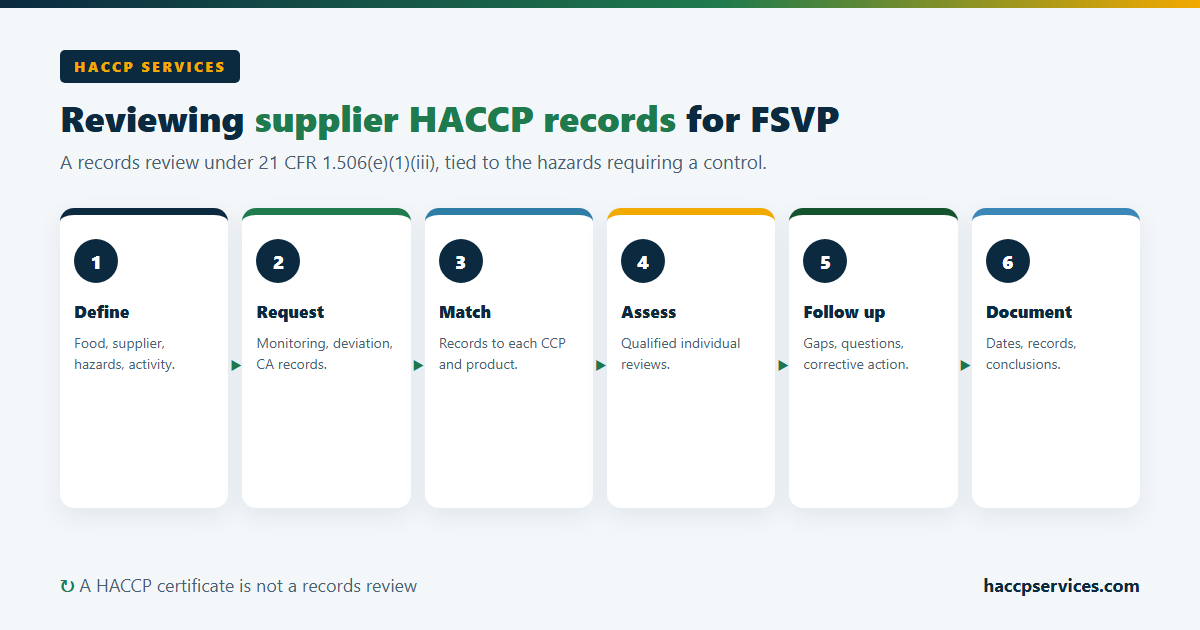
- Define. Map the food, supplier, hazards, control responsibilities and the verification activity you selected.
- Request. Ask for the records that match that activity, such as monitoring, deviation, corrective action and verification records. Avoid a generic certificate list.
- Match. Link each record to a hazard, a CCP or control, and the product you import.
- Assess. Have a qualified individual evaluate the records and explain the conclusions.
- Follow up. Flag material gaps, ask the supplier for more information and track the answers.
- Document. Record the review and keep it retrievable under 21 CFR 1.510.
Records to keep
For each records review, 1.506(e)(1)(iii) requires documentation of:
- The date or dates of the review.
- The general nature of the records reviewed.
- The conclusions of the review.
- Any corrective actions taken in response to significant deficiencies.
- Evidence that a qualified individual conducted the review.
Under 1.510, FSVP records must be signed and dated, kept legible and made available promptly to FDA on request. Most must be retained for at least 2 years. Keep legally required FSVP records separate from customer requests and best-practice documents, so the core file stays clear. Our page on HACCP recordkeeping requirements covers the plant-side records.
Example scenario
An importer of frozen cooked vegetables selects a records review as its verification activity. The supplier sends a HACCP certificate and a plan summary. The importer’s qualified individual asks for three months of cooking CCP records, the related deviation log and calibration records.
The records show one deviation with no disposition note. Therefore, the reviewer asks how the affected product was handled. The supplier provides a hold and release record. The reviewer documents the dates, records reviewed, conclusion and follow-up, then files it in the FSVP records.
Frequently asked questions
Is a HACCP certificate enough for an FSVP records review?
No. A certificate does not show how controls performed. A records review should look at the relevant food safety records and reach a documented conclusion.
Who can review supplier HACCP records for FSVP?
A qualified individual, meaning a person with the education, training or experience needed for the activity. That person must also be able to read and understand the records.
Is a records review always the right verification activity?
Not always. The choice depends on your evaluation of the food and supplier. For certain serious hazards controlled by the supplier, 1.506(d)(2) expects an onsite audit unless you make an adequate written determination that other activities are appropriate.
Supplier HACCP records checklist
- Confirm FSVP applies and check for exemptions or modified requirements.
- Link supplier HACCP records to the hazards requiring a control.
- Request product-specific monitoring, deviation and verification records.
- Have a qualified individual who can read the records do the review.
- Document dates, records, conclusions and corrective actions.
- Keep FSVP records retrievable and retained under 1.510.
How HACCP Services can help
HACCP Services, a service of Consultare Inc. Group, helps importers organize supplier HACCP evidence, map records to hazards, prepare findings registers and track follow-up, subject to the engagement scope. The importer keeps its regulatory responsibilities and final supplier decisions, and we do not promise FDA inspection results or supplier approval. For FSVP program support, see our sister site FSVP Services.
- HACCP supplier program evaluation
- HACCP recordkeeping system setup
- HACCP document control
- HACCP regulatory compliance audits
Need help reviewing supplier HACCP records?
Discuss your imported foods, suppliers and current FSVP records with our team. You can book a free consultation or contact our team.
Start building your compliance system
If you prefer to organize and manage your compliance activities yourself, you can also create a free SystemsBuilder account. Then begin building a structured system for your compliance documentation and processes.
Technical sources: 21 CFR 1.506 (foreign supplier verification), 21 CFR 1.503 (qualified individual), 21 CFR 1.505 (evaluation), 21 CFR 1.510 (records), 21 CFR 1.501 (applicability) and the Codex General Principles of Food Hygiene (CXC 1-1969). This article is educational and is not legal advice; HACCP Services is not affiliated with FDA. FSVP obligations vary by food, importer, supplier and any exemptions or modified requirements, and conclusions about a specific supplier should be reached by a qualified individual.