
A foreign supplier HACCP audit is only useful to an importer if it shows that controls operate consistently in production. Reviewing a HACCP manual is different from assessing its implementation. Audit findings on monitoring, corrective action, verification, sanitation and personnel practices can show whether the documented program really works.
This article explains when an onsite audit fits into the Foreign Supplier Verification Program (FSVP), what the rule expects of the audit and auditor, and how to assess an audit report before you rely on it.
Quick answer
An onsite audit is one of the FSVP verification activities an importer can choose. When it is used for FSVP purposes, a qualified auditor must perform it. If FDA food safety regulations apply to the food, the audit must consider them and review the supplier’s written food safety plan, if any, and its implementation for the hazard being controlled. Assess the scope, auditor, findings and corrective actions, then record your conclusions in the FSVP file.
Where audits fit in FSVP
Under 21 CFR 1.506, the importer chooses verification activities and their frequency based on food risk and supplier performance. Onsite audits sit alongside sampling and testing, record review and other appropriate activities.
For certain serious hazards controlled by the supplier, an initial and annual onsite audit is the default. An adequate written determination can justify other activities or less frequent auditing. Not every imported food needs an annual audit, and exemptions or modified requirements may apply. For the wider verification picture, see our article on verifying foreign supplier HACCP controls.
What the rule expects of an FSVP audit
- Qualified auditor. Under 1.506(e)(1)(i) and 21 CFR 1.503(b), the audit must be performed by a qualified auditor. That person is a qualified individual with the technical expertise, from education, training or experience, needed to audit.
- Regulatory scope. If FDA food safety regulations apply, the audit must consider them and review the supplier’s written food safety plan, if any, and its implementation for the hazard being controlled.
- Documentation. Importers must keep the audit procedures, audit dates, conclusions, corrective actions for significant deficiencies and evidence of the auditor’s qualification.
- Independence. No financial conflict of interest may influence results, and payment must not depend on them.
- Supplier staff. The foreign supplier and its employees may not perform the audit as your verification activity.
In some cases, inspection results may substitute for an onsite audit. These include written results of an appropriate inspection by FDA or other U.S. government agencies, or by the food safety authority of a country FDA has officially recognized as comparable or equivalent. The inspection must have occurred within 1 year of the date the audit would have been required, and other conditions apply.
How to assess an audit report
Ask these questions before relying on a supplier audit:
- Scope. Does it cover the right facility, food, process and date range?
- Hazards. Did the audit look at the hazards and controls that matter for your food?
- Auditor. Is there evidence that the auditor meets the qualified auditor definition?
- Findings. What did the audit find on monitoring, deviations, verification, sanitation and personnel practices?
- Closure. Were significant findings corrected, and is there evidence the fix worked?
A certificate alone rarely answers these questions. Ask for the full report. Our article on HACCP verification audits explains what a strong internal audit covers.
Common gaps
- Certificate only. The supplier provides a certificate without enough detail to assess findings.
- Unclear basics. Audit scope, date, facility or auditor qualifications are unclear.
- Open findings. Significant findings remain open without documented follow-up.
- No rationale. The verification plan does not explain whether an onsite audit is needed.
Practical steps for food importers
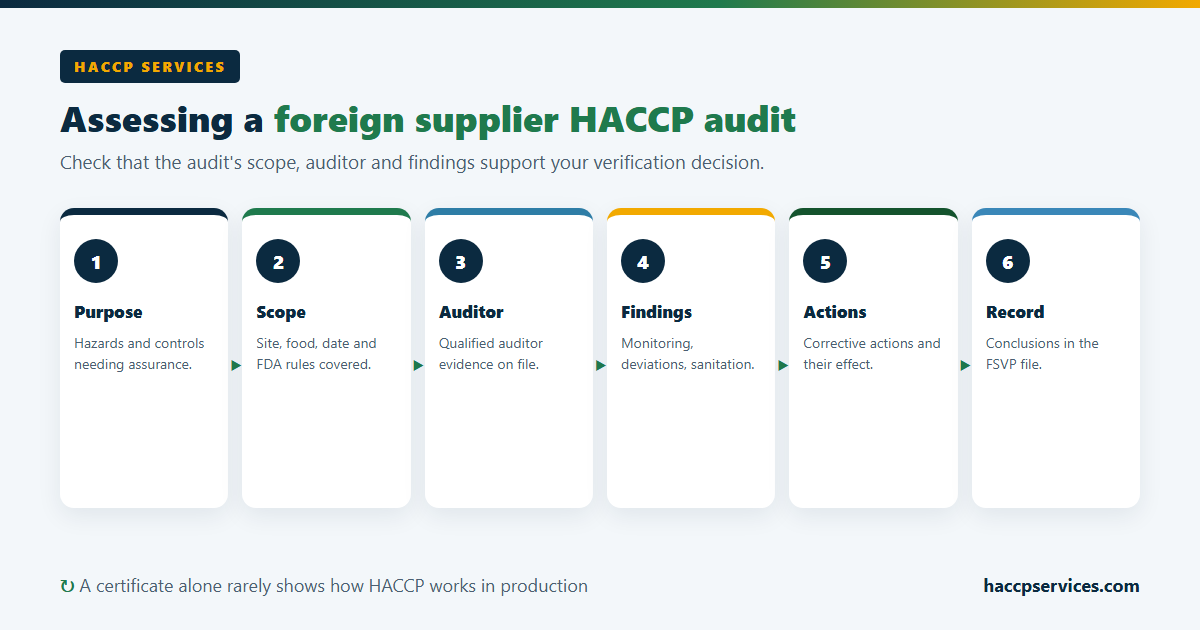
- Define the purpose. Identify the hazards and controls that need assurance.
- Check scope. Confirm the site, food, date and applicable FDA rules are covered.
- Confirm the auditor. Keep evidence of the auditor’s qualifications on file.
- Review findings. Request the full report and the HACCP corrective action details.
- Evaluate actions. Judge whether open findings are significant and whether fixes were effective. See our page on deviation investigation and root cause analysis.
- Record conclusions. Document your assessment and next steps in the FSVP file.
Records to keep
- The audit report with procedures, dates and conclusions.
- Evidence that the audit was conducted by a qualified auditor.
- Corrective actions taken for significant deficiencies.
- Your documented review and assessment of the audit results.
- Any written determination about audit frequency or alternatives.
Store these records in line with 21 CFR 1.510, which allows offsite storage if records can be retrieved and provided onsite within 24 hours.
Example scenario
An importer of frozen ready-to-eat dumplings receives a supplier’s annual audit report. The report covers the supplier’s main plant, but the dumplings are made in a second building that the audit did not visit. In addition, a significant finding on cooking temperature records is marked “in progress.”
The importer’s qualified individual concludes the audit does not provide adequate assurance for this food. The importer therefore arranges an audit of the correct building by a qualified auditor. It also requests evidence that the cooking record finding was closed. Both decisions, with the reasoning, are recorded in the FSVP file.
Frequently asked questions
Is any third-party audit acceptable for FSVP?
Only if it meets the rule: a qualified auditor, the right scope and the required documentation. You must also review and assess the results.
Does every supplier need an annual onsite audit?
No. The annual default applies to certain serious hazards controlled by the supplier, unless an adequate written determination supports another approach.
Can a government inspection replace an audit?
In some cases, yes. An appropriate inspection meeting the conditions in 1.506(e)(1)(i)(E), within 1 year of the audit due date, may substitute.
Foreign supplier HACCP audit checklist
- Define the hazards and controls the audit must cover.
- Confirm facility, food, date and regulatory scope.
- Keep qualified auditor evidence on file.
- Obtain the full report, not just a certificate.
- Check closure and effectiveness of significant findings.
- Record your assessment and next steps.
How HACCP Services can help
HACCP Services, a service of Consultare Inc. Group, helps importers interpret supplier HACCP audit records, identify implementation gaps and track supplier corrective actions within the FSVP process. Deliverables, timelines and responsibilities are agreed with each client. Importers remain responsible for meeting applicable FSVP obligations, and we do not promise a particular regulatory outcome. For FSVP program support, see our sister site FSVP Services.
- HACCP supplier program evaluation
- HACCP regulatory compliance audits
- HACCP certification and third-party audit preparation
- HACCP corrective action management
Need help assessing a supplier HACCP audit?
Share the foods you import, your number of suppliers and the audit records you hold. You can book a free consultation or contact our team.
Start building your compliance system
If you prefer to organize and manage your compliance activities yourself, you can also create a free SystemsBuilder account. Then begin building a structured system for your compliance documentation and processes.
Technical sources: 21 CFR 1.500 (definitions), 21 CFR 1.503 (qualified individual and qualified auditor), 21 CFR 1.506 (supplier verification), 21 CFR 1.510 (records), FDA FSVP final rule overview and the Codex General Principles of Food Hygiene (CXC 1-1969). This article is educational and is not legal advice; HACCP Services is not affiliated with FDA. FSVP obligations vary by food, importer and applicable exemptions or modified requirements, so confirm current requirements and have specific conclusions reviewed by an appropriately qualified individual.