
Foreign supplier HACCP controls only protect your imported food if they work every day, not just on paper. A HACCP plan describes control measures. Under the Foreign Supplier Verification Program (FSVP), however, an importer also needs evidence that those controls are implemented and effective. Monitoring records, corrective actions, audit findings and relevant tests can show whether the intended safeguards are operating.
This article explains how to choose, perform and document verification of a supplier’s HACCP controls under the standard FSVP requirements.
Quick answer
Base your verification on the food-risk and supplier-performance evaluation. Before importing, decide and document which activities you will use and how often: onsite audits, sampling and testing, review of the supplier’s food safety records, or other appropriate activities. For serious hazards controlled by the supplier, an initial and annual onsite audit applies unless you make an adequate written determination that something else is appropriate. Then review each result promptly and act when assurance is lacking.
What 21 CFR 1.506 requires
Under 21 CFR 1.506, importers subject to the standard provisions must:
- Have written procedures for ensuring that appropriate supplier verification activities are conducted.
- Provide assurance that the hazards requiring a control in the imported food have been significantly minimized or prevented.
- Determine activities and frequency before importing, based on the 1.505 evaluation, and document that determination.
- Address the right entity, meaning whoever actually controls the hazard or verifies its control.
- Conduct or obtain documentation of verification before importing and periodically thereafter.
- Promptly review and assess the results, and document that review.
The rule lists four types of activity: onsite audits, sampling and testing of the food, review of the supplier’s relevant food safety records, and other appropriate activities. The choice must fit the food, the supplier and who controls each hazard.
The serious-hazard audit rule
When a hazard will be controlled by the foreign supplier and there is a reasonable probability that exposure will cause serious adverse health consequences or death, 1.506(d)(2) applies. The importer must conduct, or obtain documentation of, an onsite audit before first importing the food and at least annually afterward. The exception is an adequate written determination that other activities, or less frequent auditing, give adequate assurance.
In other words, not every imported food requires an annual audit. However, when the serious-hazard condition is met, the default is clear and any alternative must be justified in writing.
What good verification evidence looks like
- Record reviews that state the dates, the general nature of the records, the conclusions and any corrective actions for significant deficiencies.
- Sampling and testing records that identify the food and lot, number of samples, tests and methods, dates, results, laboratory and corrective actions.
- Onsite audits by a qualified auditor, with procedures, dates, conclusions and corrective actions.
- Qualified individual evidence for each activity.
Each type of record has documentation elements listed in 1.506(e). Moreover, there must be no financial conflicts of interest that influence the results, and payment must not depend on the outcome. To see how HACCP itself separates the two ideas, read our article on HACCP validation versus verification.
Who can perform verification
You may rely on activities performed by another entity, provided you review and assess the results. However, you may not rely on the foreign supplier or its employees to perform verification activities, except for sampling and testing of the food. A supplier’s own internal audit is therefore useful background, but it cannot be your FSVP onsite audit.
Common gaps
- Certificates, not verification. The file holds certificates, but no actual verification activity can be identified.
- Unreviewed results. Audit, test or record-review results arrive but are never assessed.
- Undocumented frequency. Frequency is missing or no longer fits the risk.
- Change not reflected. A supplier deviation or product change raises questions the plan does not answer.
Practical steps for food importers
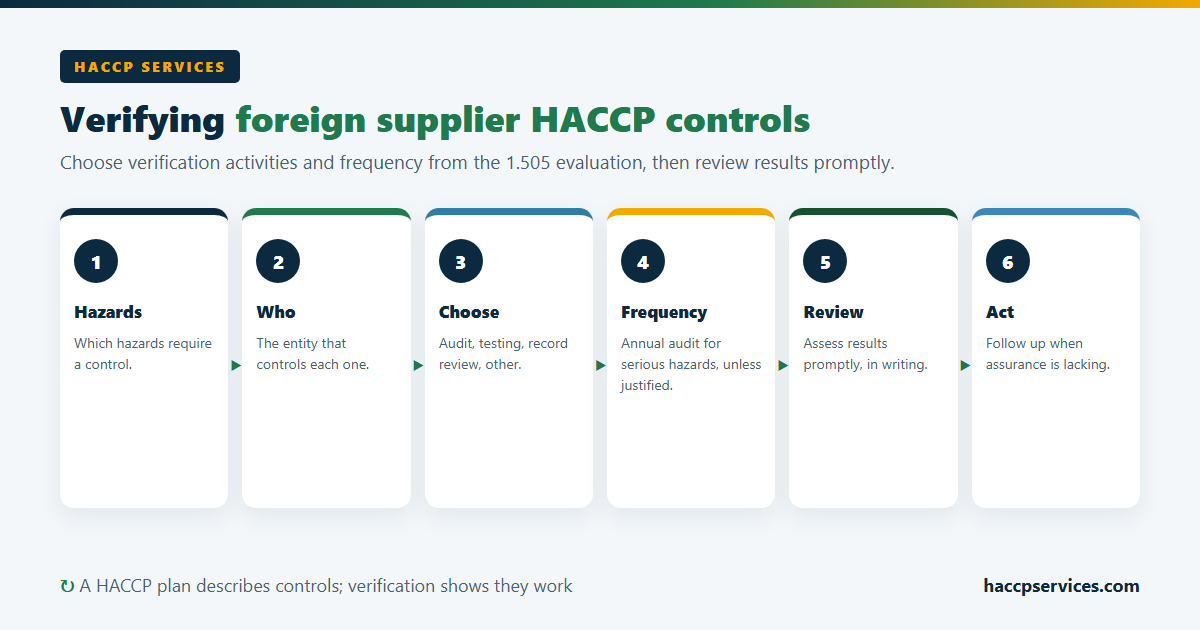
- List the hazards. Identify the product-specific hazards requiring a control.
- Identify who controls them. Name the supplier, its raw material supplier or another entity for each hazard.
- Choose activities. Select audits, testing, record review or other activities that fit the risk. Our HACCP verification and validation page explains what each can show.
- Set frequency. Apply the serious-hazard audit rule or write down your alternative.
- Review results promptly. Compare HACCP monitoring and verification records with your expectations. See also HACCP monitoring procedures.
- Act and document. Record conclusions and any supplier follow-up.
When results are not good enough
If results do not give adequate assurance, 1.506(e)(3) sends you to 21 CFR 1.508(a). That section requires prompt, appropriate corrective action. Depending on the circumstances, this could include discontinuing use of the supplier until the cause is adequately addressed. Corrective actions must be documented.
Records to keep
- Written verification procedures and the documented choice of activities and frequency.
- Any written determination replacing initial or annual onsite audits.
- Documentation of each audit, test, record review or other activity.
- Your documented review of results and resulting actions.
Keep them in line with 21 CFR 1.510. Before choosing activities, make sure the supplier is approved; see our article on FSVP foreign supplier approval.
Example scenario
An importer brings in ready-to-eat soft cheese from a foreign supplier that controls Listeria monocytogenes through pasteurization and environmental controls. The importer’s qualified individual concludes the hazard meets the serious-hazard condition. Therefore, the importer obtains an onsite audit by a qualified auditor before the first shipment and schedules one each year.
Between audits, the importer also reviews the supplier’s pasteurization and environmental monitoring records each quarter. When one review shows repeated positive environmental results near packing, the importer documents its assessment. It then asks for the supplier’s investigation and holds further shipments until the corrective action is verified.
Frequently asked questions
Is a supplier’s HACCP plan enough verification?
No. The plan describes controls. Verification activities must provide assurance that hazards requiring a control are significantly minimized or prevented.
Does every imported food need an annual audit?
No. The annual onsite audit default applies to serious hazards controlled by the supplier, unless an adequate written determination supports another approach.
Can the supplier test its own product for us?
Yes, sampling and testing is the one verification activity the supplier or its employees may perform. You must still review and assess the results.
Foreign supplier HACCP controls checklist
- List hazards requiring a control and who controls each.
- Write verification procedures and document activities and frequency.
- Apply the serious-hazard onsite audit rule or justify an alternative.
- Keep complete documentation for each activity.
- Review results promptly and record your assessment.
- Take documented corrective action when assurance is lacking.
How HACCP Services can help
HACCP Services, a service of Consultare Inc. Group, helps importers review HACCP-related verification evidence, identify missing records and coordinate corrective action follow-up within an FSVP framework. Deliverables, timelines and responsibilities are agreed with each client. Importers remain responsible for meeting applicable FSVP obligations, and we do not promise a particular regulatory outcome. For FSVP program support, see our sister site FSVP Services.
- HACCP supplier program evaluation
- HACCP plan validation and scientific justification
- HACCP corrective action management
- HACCP recordkeeping and digital system setup
Need help verifying supplier HACCP controls?
Share the foods you import, your number of suppliers and the records you hold. You can book a free consultation or contact our team.
Start building your compliance system
If you prefer to organize and manage your compliance activities yourself, you can also create a free SystemsBuilder account. Then begin building a structured system for your compliance documentation and processes.
Technical sources: 21 CFR 1.505 (evaluation), 21 CFR 1.506 (supplier verification), 21 CFR 1.508 (corrective actions), 21 CFR 1.510 (records), FDA FSVP final rule overview and the Codex General Principles of Food Hygiene (CXC 1-1969). This article is educational and is not legal advice; HACCP Services is not affiliated with FDA. FSVP obligations vary by food, importer and applicable exemptions or modified requirements, so confirm current requirements and have specific conclusions reviewed by an appropriately qualified individual.