
When a foreign supplier revises its HACCP plan, the change may be new information that calls for an FSVP supplier reevaluation. A new critical control point, a changed critical limit or a recurring deviation can reveal something important about the supplier’s food safety practices. Yet simply filing the revised plan does not tell you whether your FSVP evaluation and verification activities are still right.
This article explains when the FSVP rule expects a reevaluation, what to compare and what to document.
Quick answer
Under 21 CFR 1.505(c), you must promptly reevaluate the concerns linked to the evaluation factors when you become aware of new information about them. You must document the reevaluation. If the concerns have changed, you must promptly decide, and document, whether to keep importing from the supplier and whether your verification activities need to change. If no reevaluation has happened by the end of any 3-year period, you must reevaluate then.
Why a HACCP plan change matters
The 1.505(a) evaluation looks at several factors. These include the hazard analysis of the food, the entity controlling the hazards and the supplier’s performance. Supplier performance covers its food safety procedures and practices, its FDA compliance status and its food safety history.
A HACCP plan revision can touch any of these. For example:
- A new or removed CCP may change which entity controls a hazard.
- A changed critical limit may need new validation support. See HACCP critical limits.
- A new process step or flow may introduce hazards. Our article on process flow diagram verification explains why the flow matters.
- Recurring deviations say something about performance and responsiveness.
On the other hand, a minor formatting update may not change the concerns at all. The key is to look and record what you found.
What the 3-year rule does and does not mean
The 3-year requirement is a backstop. It applies only if no reevaluation has taken place during that period. It is not a requirement for an annual audit. However, new information should prompt a reevaluation whenever it arrives, not at the next scheduled date.
Under 1.505(d), you may also review and assess a reevaluation done by another entity, other than the foreign supplier, using a qualified individual. You must document that review, including that a qualified individual did the work.
Some foods and importers follow different rules. For example, under 21 CFR 1.501(b), the FSVP subpart does not apply to certain juice and seafood. The exemption covers products from a supplier that must comply with, and is in compliance with, Part 120 or Part 123. Those importers follow 120.14 or 123.12. In the U.S., HACCP is mandatory for juice, seafood and USDA-inspected meat and poultry (9 CFR Part 417). Most other FDA-registered facilities follow Part 117 preventive controls, while Codex CXC 1-1969 sets international HACCP principles.
Common gaps
- HACCP revisions arrive without a change log.
- Deviations recur but are not reviewed by the importer.
- Control measures change with no FSVP review.
- Prior FSVP records do not explain why the importer relies on supplier HACCP activities.
- Reevaluation dates are not tracked, so the 3-year backstop is missed.
Practical steps
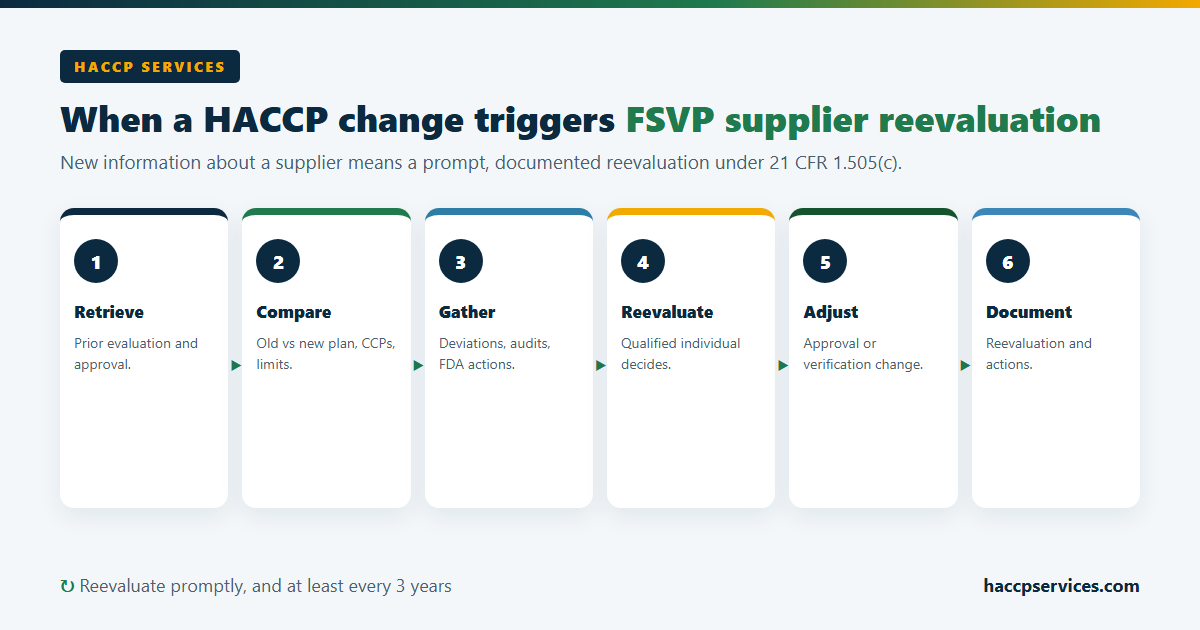
- Retrieve. Pull the prior evaluation, hazard information and approval decision for that food and supplier.
- Compare. Set the old and new plans side by side. Look at process flow, CCPs, critical limits, monitoring and verification.
- Gather. Collect recent deviations, corrective actions, audit findings, complaints and any FDA warning letters, import alerts or other compliance actions.
- Reevaluate. Have a qualified individual decide whether the concerns have changed.
- Adjust. Decide whether to keep importing and whether verification activities or frequency should change.
- Document. Record the reevaluation, conclusions and follow-up actions.
Records to keep
- The documented reevaluation and its date.
- The evidence considered, such as the revised plan and deviation history.
- The decision on continued import and any change to verification activities.
- Your review and assessment of any reevaluation done by another entity.
Under 21 CFR 1.510, records of evaluations and determinations must be kept for at least 2 years after their use is discontinued, for example after a reevaluation replaces them. Keep FDA requirements separate from customer reviews, certification cycles and internal best-practice schedules.
Example scenario
A foreign supplier of a refrigerated sauce sends a revised HACCP plan. The new version removes an acidification CCP and adds a hot-fill step. The importer’s earlier evaluation had relied on the acidification control.
The importer’s qualified individual compares both versions and asks for validation support for the hot-fill step. The reviewer also checks recent deviation records. The team then documents that the concerns have changed. As a result, it adds a records review of hot-fill monitoring before the next shipment and records the decision.
Frequently asked questions
Does every HACCP plan change require an FSVP reevaluation?
Not automatically. However, you must promptly reevaluate when you become aware of new information about the evaluation factors. A meaningful plan change often is such information.
Is FSVP supplier reevaluation required every year?
No. The rule requires reevaluation when new information arrives. If none has been done, it requires one by the end of any 3-year period.
Can someone else do the reevaluation for us?
Another entity, other than the foreign supplier, may perform it using a qualified individual. You must review and assess it and document that review.
FSVP supplier reevaluation checklist
- Confirm FSVP applies and check for exemptions or modified requirements.
- Treat supplier HACCP plan changes as possible new information.
- Compare old and new CCPs, limits and process steps.
- Check deviations, audits and FDA compliance actions.
- Decide on continued import and verification changes.
- Document the FSVP supplier reevaluation and track the 3-year date.
How HACCP Services can help
HACCP Services, a service of Consultare Inc. Group, helps importers compare current and prior supplier HACCP evidence, build trigger-event registers, prepare documentation requests and track action closure, subject to the engagement scope. We provide independent consulting support, not FDA or supplier approval authority, and the FSVP importer remains accountable for its program decisions. For FSVP program support, see our sister site FSVP Services.
- Food safety change management
- Process change impact assessment
- HACCP supplier program evaluation
- HACCP plan reassessment
Need help with a supplier plan change?
Discuss your products, suppliers, last evaluation dates and recent changes with our team. You can book a free consultation or contact our team.
Start building your compliance system
If you prefer to organize and manage your compliance activities yourself, you can also create a free SystemsBuilder account. Then begin building a structured system for your compliance documentation and processes.
Technical sources: 21 CFR 1.505 (evaluation and reevaluation), 21 CFR 1.506 (verification), 21 CFR 1.503 (qualified individual), 21 CFR 1.510 (records) and the Codex General Principles of Food Hygiene (CXC 1-1969). This article is educational and is not legal advice; HACCP Services is not affiliated with FDA. FSVP obligations vary by food, importer, supplier and any exemptions or modified requirements, and conclusions about a specific supplier should be reached by a qualified individual.