
HACCP and FSVP hazard analysis address related food safety questions, but they sit in different regulatory frameworks. Many importers hold a supplier HACCP plan and assume their Foreign Supplier Verification Program (FSVP) hazard analysis is therefore complete. A supplier HACCP plan can be valuable technical evidence. However, it does not by itself show that the importer has met every applicable FSVP responsibility.
This article explains how the two analyses differ, when a supplier’s work can support yours, and what a defensible importer file looks like.
Quick answer
Under the standard FSVP rule, the importer needs a written hazard analysis for each type of food it imports. You may meet the “hazards requiring a control” part by reviewing and assessing a hazard analysis done by another entity, such as your foreign supplier. That entity must have used a qualified individual, and you must document both your review and that fact. A supplier HACCP plan is therefore an input to your FSVP file, not a substitute for it.
How HACCP and FSVP differ
HACCP is a hazard-control system built on the Codex General Principles of Food Hygiene (CXC 1-1969) and the NACMCF principles. In the U.S., HACCP is mandatory only for juice (21 CFR Part 120), seafood (Part 123) and USDA-inspected meat and poultry (9 CFR Part 417). Most FDA-registered facilities instead follow Part 117 hazard analysis and risk-based preventive controls. See our comparison of a HACCP plan and an FDA food safety plan.
FSVP, by contrast, is an importer obligation in 21 CFR Part 1, Subpart L. It asks a different question: does the importer have adequate assurance that its foreign supplier produces the food with the required level of public health protection? The supplier’s HACCP plan describes how the supplier controls hazards in its own process. The importer’s FSVP hazard analysis, in turn, decides which hazards in the imported food require a control and feeds supplier evaluation and verification.
What 21 CFR 1.504 requires
Under 21 CFR 1.504, importers subject to the standard requirements must identify and evaluate known or reasonably foreseeable hazards for each type of food they import. The analysis must be written, whatever its outcome. Key points include:
- Hazard types. Biological, chemical (including radiological) and physical hazards must be considered.
- Origin. Hazards may occur naturally, be introduced unintentionally, or be introduced intentionally for economic gain.
- Evaluation. The analysis assesses the probability of each hazard in the absence of controls and the severity of illness or injury.
- Factors. Formulation, ingredients, processing, packaging, storage, transport, intended use and sanitation all have to be considered.
- Another entity’s analysis. You may review and assess another entity’s analysis, provided you document your review and that a qualified individual did the work.
In addition, if you conclude that a food has no hazards requiring a control, the supplier evaluation and verification steps in 1.505 and 1.506 do not apply. That rule has a stated exception for “covered produce” under Part 112.
Exemptions that matter on a HACCP site
Not every importer follows the standard requirements. Under 21 CFR 1.501(b), Subpart L does not apply to juice, fish and fishery products imported from a foreign supplier that is required to comply with, and is in compliance with, Part 120 or Part 123. Instead, those importers must meet the importer provisions in 21 CFR 120.14 or 123.12. A similar exemption covers certain raw materials and ingredients used to make juice or seafood products subject to those parts.
Other foods and importers may also be exempt or subject to modified requirements. Therefore, confirm which provisions apply to each food before you design the file.
Common gaps in supplier HACCP evidence
- Wrong scope. The plan covers a different product, site or process from the food actually imported.
- Missing hazards. Chemical hazards such as allergens, pesticide residues or economically motivated adulteration are not addressed.
- No reasoning. The plan lists hazards but not how severity and probability were judged.
- No qualified individual evidence. Nothing shows who prepared the analysis or their qualifications.
- No importer review. The document sits in a folder without a signed, dated assessment by the importer.
For a wider look at ingredient-level risks, see our article on HACCP ingredient hazard evaluation.
Practical steps for food importers
Start with product-specific information rather than a generic template. A defensible assessment shows which hazards were considered and how each conclusion was reached.
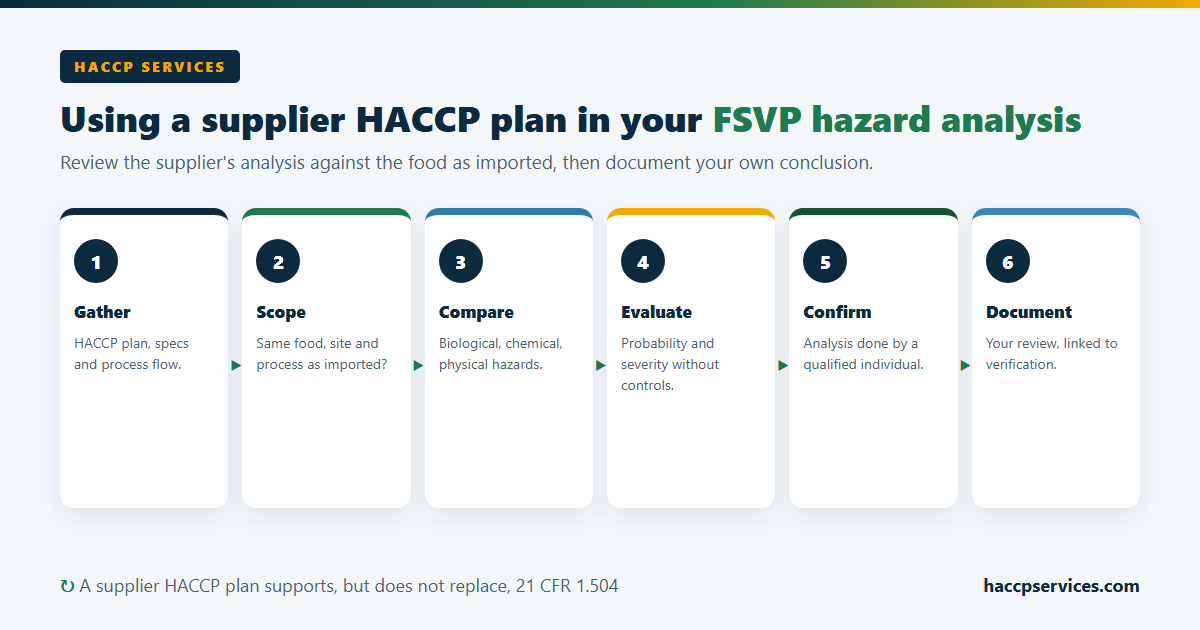
- Gather. Collect the supplier’s HACCP materials, specifications and process flow information.
- Check scope. Confirm that the analysis reflects the food as imported, from that site and process.
- Compare hazards. Compare the hazards covered with those reasonably foreseeable for the imported food. Our hazard analysis page explains the HACCP side.
- Resolve gaps. Address missing severity, probability or hazard-control decisions.
- Confirm qualifications. Record that a qualified individual conducted the analysis.
- Document your review. Sign and date your assessment, then link its findings to supplier evaluation and verification.
Records to keep
- The written FSVP hazard analysis for each type of food, or your documented review of another entity’s analysis.
- Evidence that the analysis was conducted by a qualified individual.
- The supplier HACCP plan version, specifications and flow diagram you relied on.
- Notes on gaps found and how they were resolved.
- Links from each hazard requiring a control to the supplier evaluation and verification records.
Under 21 CFR 1.510, FSVP records must be signed and dated, kept legible and made available to FDA on request. Generally, records are kept for at least 2 years. See also our page on HACCP documentation and recordkeeping requirements.
Example scenario
An importer of frozen cooked vegetables receives a supplier HACCP plan that covers the blanching line. However, the plan does not mention the supplier’s newer frozen mixed product, which includes a nut-based sauce. The importer’s qualified individual compares the plan with the product as imported and finds that allergen cross-contact is not addressed.
The importer requests the supplier’s allergen controls and labeling information. Then it documents the hazard as requiring a control and records who controls it. Finally, it carries that conclusion into the supplier evaluation and verification plan, instead of filing the HACCP plan as complete.
Frequently asked questions
Can I use my supplier’s HACCP plan as my FSVP hazard analysis?
You can use it as the basis, but only after reviewing and assessing it. You must document that review and that the analysis was done by a qualified individual.
Do seafood and juice importers need an FSVP?
Not when the food comes from a foreign supplier that must comply with, and complies with, Part 120 or Part 123. Those importers follow 21 CFR 120.14 or 123.12 instead.
What if no hazards require a control?
Your analysis must still be written. If it shows no hazards requiring a control, 1.505 evaluation and 1.506 verification are not required, except for covered produce.
HACCP and FSVP hazard analysis checklist
- Confirm which HACCP regulations and FSVP provisions apply to the food.
- Check that the supplier analysis reflects the product as imported.
- Confirm biological, chemical and physical hazards are addressed.
- Resolve gaps in severity, probability and control decisions.
- Record qualified individual evidence.
- Document your review and link it to verification decisions.
How HACCP Services can help
HACCP Services, a service of Consultare Inc. Group, helps importers examine existing supplier HACCP documents as potential supporting evidence, identify differences from FSVP needs and organize product-specific hazard analysis records. Deliverables, timelines and responsibilities are agreed with each client. Importers remain responsible for meeting applicable FSVP obligations, and we do not promise a particular regulatory outcome. For FSVP program support, see our sister site FSVP Services.
- HACCP supplier program evaluation
- HACCP plan development
- HACCP plan validation and scientific justification
- HACCP document control and version management
Need help reviewing a supplier HACCP plan against FSVP needs?
Share the foods you import, your number of suppliers and the records you hold. You can book a free consultation or contact our team.
Start building your compliance system
If you prefer to organize and manage your compliance activities yourself, you can also create a free SystemsBuilder account. Then begin building a structured system for your compliance documentation and processes.
Technical sources: 21 CFR 1.501 (scope and exemptions), 21 CFR 1.504 (hazard analysis), 21 CFR 1.510 (records), FDA FSVP final rule overview and the Codex General Principles of Food Hygiene (CXC 1-1969). This article is educational and is not legal advice; HACCP Services is not affiliated with FDA. FSVP obligations vary by food, importer and applicable exemptions or modified requirements, so confirm current requirements and have specific conclusions reviewed by an appropriately qualified individual.