
Conveyor belt sanitary design deserves its own risk assessment, because conveyors touch product across many process steps. Belt joints, support frames, rollers and hard-to-reach return paths can complicate cleaning. In addition, worn belts and fittings can introduce foreign material. These are practical risks, so they need a process-specific review.
This article explains how conveyor design creates hazards, where those hazards belong in your HACCP system and how to assess belts step by step. It is written for HACCP coordinators, food processing operators, sanitation leads and maintenance teams.
Quick answer
To assess conveyor belt sanitary design, trace where the belt touches product, then check material suitability, wear, cleaning access and places where residue collects. Next, decide whether each condition affects the hazard analysis or is managed by prerequisite controls such as sanitation and maintenance. Finally, verify the result with inspections and sanitation checks.
How conveyors create food safety hazards
A conveyor is often the longest food-contact surface in a line. As a result, a small design weakness can affect a lot of product. Watch for these issues:
- Belt joints and splices. Gaps, lacing and damaged splices can trap product and moisture.
- Return paths and rollers. The underside of the belt and its rollers are often hard to see and clean.
- Frames and supports. Hollow sections, flat ledges and seams can collect residue and liquid.
- Belt wear. Cracks, fraying and chipped modules can harbor microorganisms and shed fragments.
- Drip and transfer points. Overhead parts and transfer plates can drop residue onto product.
U.S. rules apply here too. Under 21 CFR 117.40(d), holding, conveying and manufacturing systems must be designed and built so they can be kept clean and sanitary. In addition, 117.40(b) requires seams on food-contact surfaces to be smoothly bonded or maintained to minimize buildup of food particles and organic matter.
Where conveyor design fits in HACCP
HACCP builds on the Codex General Principles of Food Hygiene (CXC 1-1969), where equipment hygiene supports the HACCP plan. In the United States, mandatory HACCP covers juice (21 CFR Part 120), seafood (Part 123) and USDA-inspected meat and poultry (9 CFR Part 417). Most other FDA-registered facilities follow 21 CFR Part 117, where the hazard analysis may lead to preventive controls, including sanitation controls under 21 CFR 117.135(c)(3).
Start with your HACCP hazard analysis and a verified process flow diagram. Mark every conveyor and note which product it carries. Then, for each conveyor, ask a simple question: is the product protected by a later lethal step? If not, for example after cooking in a ready-to-eat line, conveyor hygiene carries more weight. Our article on Listeria risk and sanitation controls explains why.
A step-by-step conveyor belt risk assessment
1. Trace product contact
First, follow the product along each conveyor. Note the contact surfaces, transfer points and any overhead parts.
2. Check material and condition
Next, confirm the belt material suits the product, temperature and cleaning chemicals. Look for cracks, fraying, chips and damaged splices.
3. Test cleaning access
Then ask whether cleaning can reach joints, rollers, the return path and the frame. If staff must dismantle the conveyor, check that the procedure says so and that they actually do it.
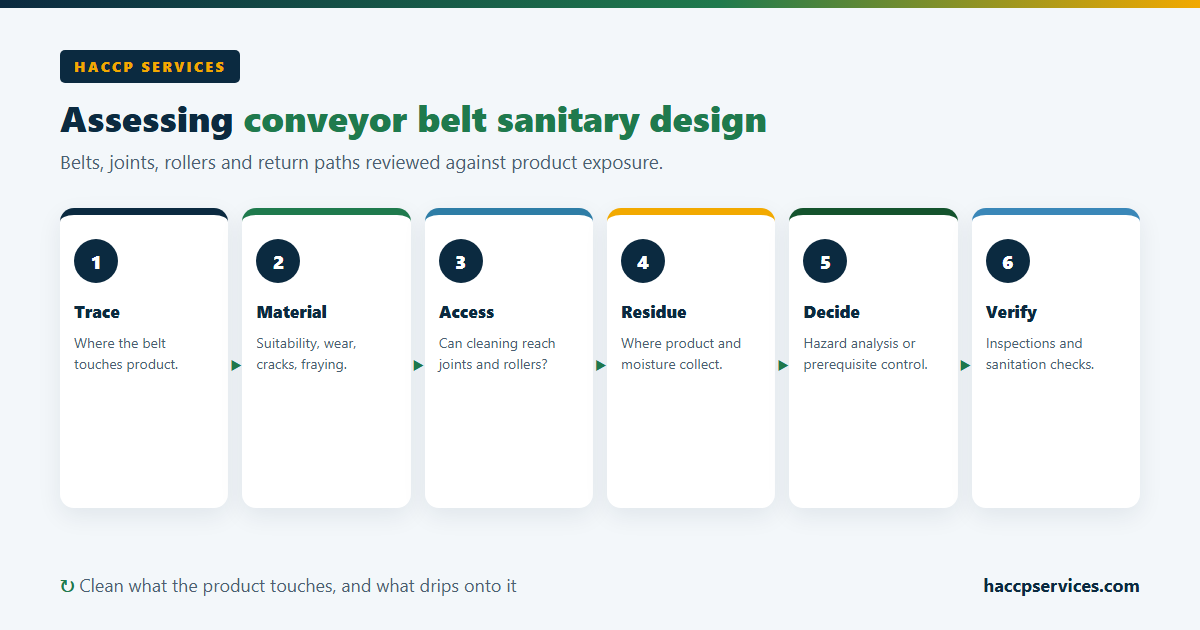
4. Find residue and moisture traps
After cleaning, inspect where product and water still collect. These spots show where design or procedure needs attention.
5. Decide how to control each condition
Now decide whether each condition affects the hazard analysis or is handled by prerequisite controls. Choose fixes such as belt replacement, redesigned supports, changed cleaning methods or more frequent inspections. Assign owners and deadlines.
6. Verify
Finally, confirm the changes work through inspections and sanitation checks. See our guide to HACCP sanitation verification for suitable methods.
Records to keep
- A conveyor inventory with product contact, belt type and cleaning method.
- Belt inspection records covering wear, damage and splices.
- Sanitation procedures, including any dismantling steps.
- Post-cleaning inspection and verification results.
- Maintenance work orders and belt replacement history.
- Corrective actions with root cause and effectiveness checks.
Example scenario
Consider a hypothetical plant packing cooked chicken strips. Post-cleaning inspections keep finding residue at a belt splice and on the return rollers. In addition, the belt edge shows fraying.
The team records the findings and links them to the post-cook packing step. Because the product is ready-to-eat, they rate the conditions as significant for environmental contamination. Next, maintenance replaces the belt and the team changes the cleaning procedure to lift the belt for roller access. The hazard analysis notes the conveyor and the sanitation controls that address it. Finally, inspections over the next weeks confirm the residue no longer appears.
When to ask for outside support
- The same conveyor findings return despite earlier corrective actions.
- A new line or conveyor purchase raises hygienic design questions.
- Your team needs help organizing evidence and owners before a customer or certification audit.
Frequently asked questions
Is a conveyor belt a critical control point?
Usually not. Conveyor hygiene is normally managed through sanitation and maintenance programs. However, the hazard analysis may identify a sanitation preventive control where RTE product is exposed.
How often should conveyor belts be inspected?
Set the frequency by risk. Consider product exposure, belt condition history and how quickly wear develops in your process.
What makes a conveyor hard to clean?
Common causes include hidden return paths, trapped splices, hollow frames and parts that staff cannot reach without dismantling.
Conveyor belt sanitary design checklist
- List every conveyor and the product it carries.
- Check belt material, wear and splice condition.
- Confirm cleaning reaches joints, rollers, return paths and frames.
- Record residue and moisture traps found after cleaning.
- Link conveyor belt sanitary design findings to the hazard analysis or prerequisite controls.
- Verify fixes through inspections and sanitation checks.
How HACCP Services can help
HACCP Services, a service of Consultare Inc. Group, helps HACCP teams document conveyor condition concerns, review sanitation and maintenance procedures and follow corrective action progress, subject to the engagement scope. Facility management approves and carries out changes, and we do not promise certification, regulatory approval or a particular audit outcome.
- Sanitation program development
- Environmental monitoring program design
- Preventive maintenance and food safety integration
- Corrective action management
Need help assessing your conveyors?
Discuss your lines, sanitation records and risks with our team. You can book a free consultation or contact our team.
Start building your compliance system
If you prefer to organize and manage your compliance activities yourself, you can also create a free SystemsBuilder account. Then begin building a structured system for your compliance documentation and processes.
Technical sources: Codex Alimentarius General Principles of Food Hygiene (CXC 1-1969), 21 CFR 117.35 (sanitary operations), 21 CFR 117.40 (equipment and utensils) and 21 CFR 117.135 (preventive controls). This article is educational and is not legal advice; HACCP Services is not affiliated with FDA, and specific requirements depend on your products, processes and applicable regulations.