

Glass and brittle plastic near exposed product are a physical hazard that facility design can reduce long before an inspection program has to catch it. Overhead lights, viewing windows, gauges and brittle fixtures can all break. When they do, fragments may reach food or packaging. This article explains how facility design and inspection controls work together in a HACCP program.
Design and inspection are partners. Good design removes or protects the riskiest items. Inspection then confirms that the remaining items stay intact.
Quick answer
Map every glass and brittle plastic item above or near exposed product. Remove or substitute items where practical, and protect the rest with shields, covers or guards. Keep a register of items and check their condition on a schedule. Write a breakage procedure that stops production, contains the area, cleans up and controls release. Finally, bring findings into your physical hazard assessment.
How facility design creates the hazard
Most glass and brittle plastic risks come from items installed for other reasons:
- Lighting. Unprotected bulbs and light covers above open lines are a common source.
- Viewing windows and sight glasses. These are useful for operators but can crack under heat or impact.
- Gauges and instruments. Dial faces and indicator covers may be glass or brittle plastic.
- Fixtures and equipment parts. Brittle plastic guards, scoops, clipboards and container lids can chip.
- Glass ingredients or packaging. Where product is packed in glass, the container itself becomes part of the review.
As a result, the question is not only “is it intact today?” It is also “should this item be here at all?”
What the rules expect
For most FDA-registered facilities, 21 CFR 117.20(b)(5) requires shatter-resistant light bulbs, fixtures, skylights or other glass suspended over exposed food, or other protection against contamination if glass breaks. In addition, 21 CFR 117.80 requires adequate measures to protect against the inclusion of metal or other extraneous material in food.
The hazard analysis under 21 CFR 117.130 lists glass as an example of a physical hazard. It also requires the evaluation to consider the condition, function and design of the facility and equipment. HACCP is mandatory in the U.S. only for juice (21 CFR Part 120), seafood (Part 123) and USDA-inspected meat and poultry (9 CFR Part 417). Elsewhere, HACCP follows the Codex General Principles of Food Hygiene (CXC 1-1969).
Hazard analysis or prerequisite program?
For most sites, glass and brittle plastic control is a prerequisite program. It usually covers the item register, inspections and breakage response. However, the hazard analysis should still record glass as a potential physical hazard at each exposed step, and explain which controls address it.
Where the product itself is packed in glass, the risk is different. For example, our article on juice HACCP and glass bottling hazards discusses controls for glass containers on the line. For broader physical hazards, see our article on foreign material prevention and HACCP controls, and our HACCP hazard analysis guide.
Practical review steps
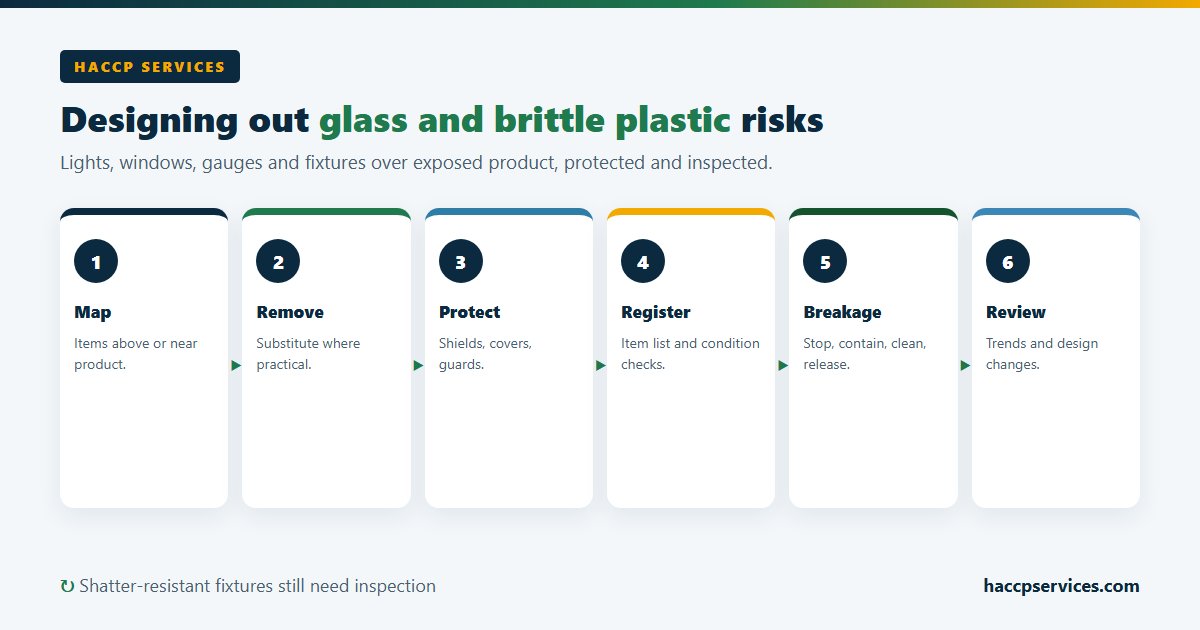
- Map vulnerable items. Walk each product area and list glass and brittle plastic above or near exposed product and packaging.
- Remove or substitute. Replace items with non-brittle alternatives where practical. Remove items that are no longer needed.
- Protect what remains. Fit shatter-resistant covers, shields or guards. Relocate items away from open product where design allows.
- Keep a register. Record each item, its location and its condition. Inspect at a frequency that reflects the risk.
- Prepare a breakage procedure. Define who stops production, how the area is contained and cleaned, and how product and equipment are released.
- Review trends. Use breakage and inspection findings to drive design changes, not just repairs.
Records to keep
- A glass and brittle plastic register with item locations and protection status.
- Scheduled condition inspection records, including damaged items found.
- Breakage incident records, with product hold, clean-up and release decisions.
- Design changes and replacements, with dates and responsible owners.
- Corrective actions and verification of closure.
Example scenario
During a scheduled inspection, an operator finds a cracked plastic cover on a light above a packing table. No fragments are missing, yet the cover is clearly brittle and aging. The team records the finding and checks the area and recent product.
Next, the team reviews the register and finds several identical covers above open lines. So it ranks the risk, assigns an owner and sets a deadline. The covers are replaced with shatter-resistant fittings. Finally, the team updates the register and confirms the change at the next inspection.
Frequently asked questions
Is glass control a critical control point?
Usually not. Most sites manage glass and brittle plastic through prerequisite programs. The hazard analysis decides whether any step needs a preventive control or CCP.
Do shatter-resistant fixtures remove the need for inspection?
No. Shatter-resistant items can still crack, loosen or age. Keep them on the register and inspect them.
What should happen after a breakage?
Stop work in the area, protect and hold potentially affected product, clean up under a defined procedure, inspect, and record the release decision.
Glass and brittle plastic checklist
- List all glass and brittle plastic near exposed product.
- Remove or substitute items where practical.
- Protect remaining items with shatter-resistant covers or guards.
- Inspect items on a risk-based schedule.
- Keep a tested breakage and release procedure.
- Use trends to drive design improvements.
How HACCP Services can help
HACCP Services, a service of Consultare Inc. Group, supports foreign-body program reviews, inspection register improvement and corrective action planning, subject to the engagement scope. Facility management keeps responsibility for approving and implementing changes, and we do not promise certification, regulatory approval or a particular audit outcome.
- Foreign material control program development
- Pre-operational inspection program development
- Product hold, release and disposition
- Corrective action management
Need help controlling glass and brittle plastic?
Discuss your facility, product exposure, registers and records with our team. You can book a free consultation or contact our team.
Start building your compliance system
If you prefer to organize and manage your compliance activities yourself, you can also create a free SystemsBuilder account. Then begin building a structured system for your compliance documentation and processes.
Technical sources: 21 CFR 117.20 (plant and grounds), 21 CFR 117.80 (processes and controls), 21 CFR 117.130 (hazard analysis) and the Codex General Principles of Food Hygiene (CXC 1-1969). This article is educational and is not legal advice; HACCP Services is not affiliated with FDA, and specific requirements depend on your products, processes and applicable regulations.