
FDA registration food categories and HACCP product descriptions both describe what a facility makes, but they serve different regulatory functions. A facility may manufacture several food types under one quality system. Registration records which categories of food the facility handles. A HACCP plan, by contrast, describes each product and process in enough detail to analyze its hazards.
This article explains how to review both during the 2026 biennial renewal period without treating every wording difference as a failure. It is part of our FDA registration renewal 2026 series.
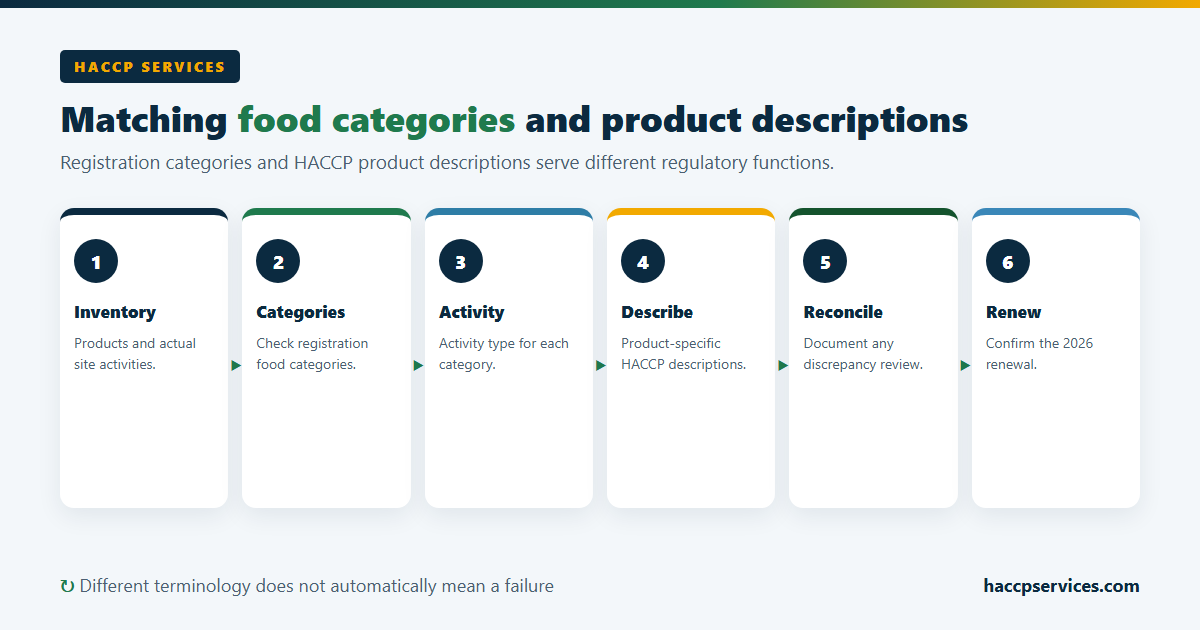
Quick answer: Inventory the foods and activities at each site. Check that the registration lists the applicable food product categories and activity types. Keep product-specific descriptions in the HACCP plan. Then document any discrepancy review and confirm the 2026 renewal for covered facilities.
Who this article is for
This guide is written for regulatory contacts, HACCP coordinators, PCQIs, product development teams and quality managers at multi-product food facilities.
1. What registration asks about your foods
Under 21 CFR 1.232, a registration must include the applicable food product categories of any food manufactured/processed, packed or held at the facility, as identified on Form FDA 3537. It must also include the type of activity conducted for each category. More than one activity type can apply to a category.
The activity types in the rule include, for example:
- Manufacturer/processor and packer/repacker.
- Ambient, refrigerated or frozen human food warehouse/holding facility.
- Labeler/relabeler.
- Acidified food processor and low-acid food processor.
- Farm mixed-type facility and other activity.
In other words, registration links broad food categories to what the facility does with them. It is not a product list or a recipe file.
2. What a HACCP product description covers
A HACCP product description is far more specific. Following Codex and NACMCF principles, it typically covers composition, processing, packaging, storage conditions, shelf life, intended use and intended consumers. That detail drives the HACCP hazard analysis. For example, two products in the same registration category may need very different controls.
For new items, our guide to hazard analysis for new food products explains how to build the description before production starts.
3. Why the two can look different
The two records use different vocabularies. Registration uses the category names on Form FDA 3537. HACCP plans use product names, internal codes and process steps. As a result, terminology often differs. A difference can justify a documented review, but it does not automatically prove a regulatory failure.
What matters is substance. Does the registration cover the categories of food the site actually handles? Does each HACCP plan cover the products and processes actually run? Our article on mapping food handling activities helps you link activities to each location first.
4. Review categories when products change
New products can move a facility into a new category or activity type. For instance, adding a frozen line or a relabeling service may change what the registration should show. Under 21 CFR 1.234, covered facilities update registration within 60 calendar days of a change to required information. Meanwhile, the HACCP team assesses the new product’s hazards through its own process. Our article on FDA registration for food packing and processing operations covers how activity classification works at mixed sites.
5. Confirm the 2026 renewal
Under section 415 of the FD&C Act (21 U.S.C. 350d) and 21 CFR 1.230, facilities subject to registration renew between October 1 and December 31 of each even-numbered year. The 2026 deadline is December 31, 2026. A registration update earlier in the year does not count as the renewal. FDA charges no renewal fee and currently accepts the DUNS number as the Unique Facility Identifier. The renewal is a good moment to confirm that categories and activity types are still accurate.
Example category review workflow
- Quality lists every product made, packed or held at the site, with its process type.
- The regulatory contact compares the list with the registered categories and activity types.
- The HACCP team confirms each product is covered by a current product description and hazard analysis.
- The team documents any discrepancy, its cause and the decision taken.
- An authorized person submits any required registration change.
- The regulatory contact confirms the 2026 renewal and files the confirmation.
Common mistakes to avoid
- Copying registration category names into HACCP product descriptions instead of real product details.
- Grouping products into one hazard analysis when their processes differ.
- Forgetting to review categories after launching a new product type.
- Assuming a wording difference proves the registration is wrong.
Frequently asked questions
Do registration food categories have to match HACCP product names?
No. They serve different purposes. The registration should be accurate for the applicable categories and activities, while the HACCP plan describes specific products.
Where are the registration food product categories defined?
21 CFR 1.232 refers to the food product categories identified on Form FDA 3537.
Is a category review the same as the 2026 renewal?
No. A review or update is separate. Covered facilities must still renew between October 1 and December 31, 2026.
FDA registration food categories checklist
- Inventory products and actual facility activities.
- Review the accuracy of registered food categories and activity types.
- Maintain product-specific HACCP descriptions and hazard analysis.
- Document any discrepancy review and its outcome.
- Confirm completion of the 2026 biennial renewal.
- Repeat the review whenever a new product type launches.
How HACCP Services can help
HACCP Services, a service of Consultare Inc. Group, supports HACCP program development, product hazard analysis, food safety documentation and regulatory data coordination, subject to the engagement scope.
- HACCP plan development
- New product and process change impact assessment
- HACCP document control
- HACCP regulatory compliance audits
Need help reviewing your product categories?
Discuss your food safety and regulatory documentation needs with our team. You can book a free consultation or contact our team.
Start building your compliance system
If you prefer to organize and manage your compliance activities yourself, you can also create a free SystemsBuilder account. Then begin building a structured system for your compliance documentation and processes.
Technical sources: FDA Food Facility Registration User Guide: Biennial Registration Renewal, FDA reminder on biennial renewal requirements, FDA Online Registration of Food Facilities, 21 U.S.C. 350d and 21 CFR Part 1, Subpart H. This article is educational and is not legal advice; HACCP Services is not affiliated with FDA, and specific requirements depend on your facility, operations and applicable regulations. Verify current requirements through official FDA sources.