
HACCP for rice noodles starts with one practical question: how long does the product really spend at temperatures that allow pathogen growth? Rice-based foods may support pathogen growth or toxin formation when preparation, cooling and packing allow extended exposure to uncontrolled temperatures.
A sound hazard analysis follows the complete process, from rice preparation to cold storage. It also distinguishes ready-to-eat (RTE) rice noodles from not-ready-to-eat products such as rice cakes intended for further cooking.
Quick answer
A HACCP-based assessment for refrigerated rice foods should evaluate cumulative time-temperature exposure, spore-forming pathogens, formulation and packaging barriers, monitoring, deviation response and verification. The applicable regulatory framework then determines how controls must be implemented. For most FDA-registered facilities, that framework is the preventive controls rule in 21 CFR Part 117.
Who this article is for
This guide is written for rice-noodle and rice-cake producers, HACCP teams, and QA and production managers.
1. Build a detailed flow diagram
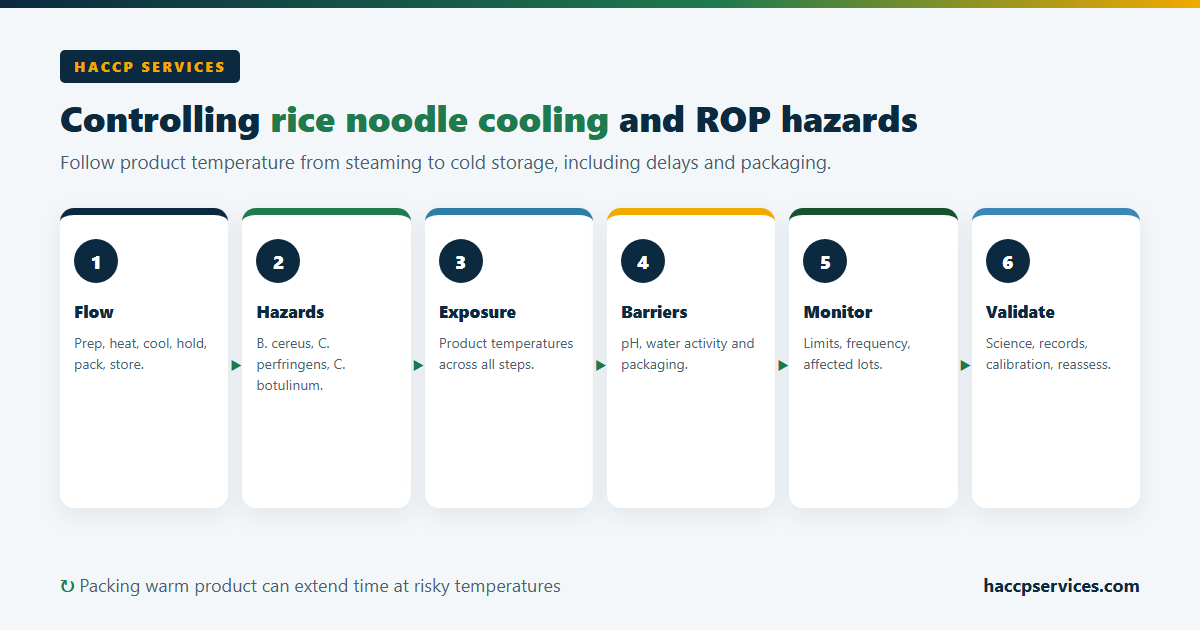
Capture rice preparation, heat treatment, cooling, ambient holding, pack-out, cold storage and distribution. Include reasonably foreseeable delays, such as line stoppages or full coolers. Then confirm the diagram on the floor; see process flow diagram verification.
2. Identify significant biological hazards
Evaluate Bacillus cereus, Clostridium perfringens and Clostridium botulinum as relevant to the product and process. These spore-formers can survive heating. As a result, the hazard analysis must consider both growth and toxin formation during slow cooling or holding.
3. Assess total time-temperature exposure
Measure representative product temperatures across all steps, not only cooler set points or isolated end-point readings. Thick stacks and packed cases cool more slowly than single sheets. Our article on cooling and pathogen growth in RTE foods explains how to profile cooling.
4. Evaluate pH, water activity and packaging
Use product-specific evidence wherever formulation is relied on for safety. In addition, assess reduced-oxygen packaging (ROP) for added hazards. ROP can favor anaerobic organisms such as C. botulinum, so it needs its own safeguards.
5. Establish monitoring and deviation procedures
Define parameters, responsibilities, recording frequency and affected-lot controls. Also define the response to out-of-limit conditions. Under Part 117, process controls such as refrigeration must include the parameters and the values they must be controlled to (21 CFR 117.135(c)(1)). See HACCP critical limits and our guide to process deviations and batch records.
6. Validate, verify and reassess
Support the selected parameters with suitable scientific evidence. Part 117 requires validation of process controls with scientific and technical evidence, or studies where evidence is lacking (21 CFR 117.160). Then verify records and calibration, and reassess after changes or recurring failures.
Frequently asked questions
Is all cooling automatically a HACCP critical control point?
No. The hazard analysis and applicable rules determine the right control approach.
Can packaging rice noodles before they cool create risk?
Yes, it can. Packing warm product can prolong elevated temperatures. In reduced-oxygen packaging, it may also add hazards that need specific safeguards.
Are RTE rice noodles and not-RTE rice cakes equivalent?
No. Intended use and preparation instructions affect the hazard analysis and the consumer-facing information.
Rice noodle HACCP checklist
- Confirm the products, intended use, regulatory scope and current process flow.
- Review the hazard analysis against actual time-temperature exposure and packaging.
- Verify scientifically justified process criteria, monitoring methods and records.
- Identify and assess deviations, affected lots and any required corrective action.
- Confirm management oversight, ongoing verification and record availability.
How HACCP Services can help
HACCP Services, a service of Consultare Inc. Group, supports HACCP gap assessments, process flow mapping, food safety plan development or review, cooling validation planning, packaging hazard assessments and verification procedures. Work is scoped to the product, facility and agreed engagement.
- HACCP plan development
- HACCP plan validation and scientific justification
- Frozen foods and RTE meals HACCP plans
- Corrective action management
Need help with your rice noodle HACCP plan?
Discuss the food, process, documentation and improvement priorities with our team. You can book a free consultation or contact our team.
Start building your compliance system
If you prefer to organize and manage your compliance activities yourself, you can also create a free SystemsBuilder account. Then begin building a structured system for your compliance documentation and processes.
Technical sources: 21 CFR Part 117 (CGMP and Preventive Controls for Human Food), including 117.135 and 117.160, and FDA Draft Guidance: Hazard Analysis and Risk-Based Preventive Controls for Human Food. This article is educational; HACCP Services is not affiliated with FDA, and specific requirements depend on your products, processes and applicable regulations.